By Carlos González Penalva
The newly published US National Security Strategy is not just another document from the diplomatic apparatus. It is the orderly confession of a global reconfiguration project at a time of hegemonic crisis: Washington acknowledges that it can no longer dominate everywhere, so it decides where it will tighten its grip. And the map is clear: absolute priority for the Western Hemisphere, disciplining of European allies, and a strategic encirclement of China, Russia, and Iran.
The political core of the document is simple: the United States asserts itself as a “sovereign republic” surrounded by threats—military, economic, migratory, and cultural—and reserves the right to intervene wherever its “vital interests” are at stake. To justify this, it invokes a supposed “predisposition toward non-intervention” inherited from the Founding Fathers, but immediately adds an escape clause: for a country with “such numerous and diverse” interests, rigid non-intervention “is not possible.” This is the old moral alibi of empire: proclaim the general principle while safeguarding all exceptions.
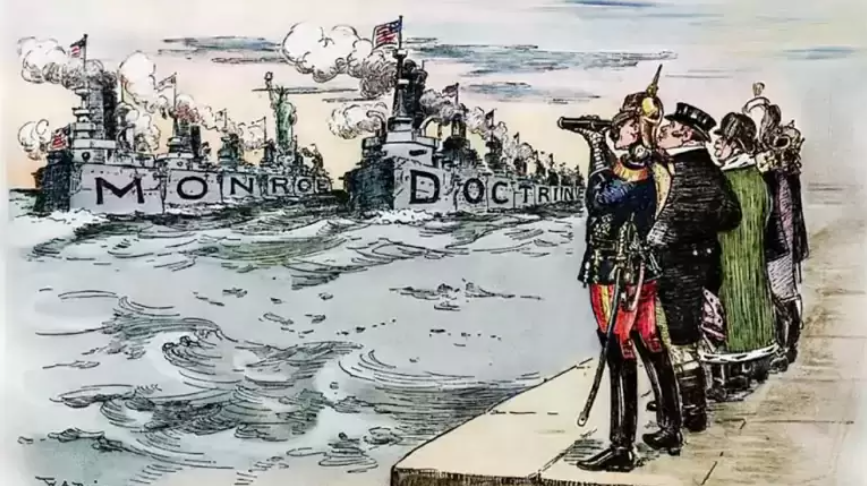
Herein lies the most serious gesture: the so-called “Trump Corollary to the Monroe Doctrine.” In plain language, the United States announces that it will once again “affirm and enforce” the idea that the Western Hemisphere is its exclusive sphere of influence. No extra-hemispheric power should be able to control ports, mines, energy networks, digital infrastructure, or logistical bases in Latin America and the Caribbean. In practice, this means turning any relevant agreement with China or Russia into a matter of U.S. national security. And it opens the door to the entire repertoire of pressure tactics, sanctions, soft coups, and even “selective” military actions already familiar from Latin American history.
But the document is not limited to Latin America. The Trumpian shift has a global dimension: European allies are being asked to increase military spending, align their energy policies with the United States’ fossil fuel expansion, and accept confrontation with China and Russia as the central focus of the agenda and a fundamental requirement for maintaining their status as “reliable allies.” The vacuum left by the US withdrawal from the Western Hemisphere will have to be filled by “allies” who will have no option but to increase their aggression against US rival powers, diverting resources currently used for the social welfare of their populations to purchase American weaponry and replace the existing extensive and economical supply chains offered by Russia and China—which the US itself will continue to benefit from—with less competitive American ones that have much higher associated costs. This dynamic, already seen with gas imports after the war in Ukraine, will only intensify, diminishing European competitiveness in other international markets.
Spain appears in this scheme as a subordinate “partner,” with two main functions: First, a military platform (Rota, Morón, projection towards the Sahel and the Mediterranean) at the service of a strategy defined not by Madrid or Brussels, but by Washington. Second, a political and cultural bridge to Latin America, which will be made jointly responsible for managing a portion of the Latin American migration to the US, as well as for co-promoting pro-US leaders in the region.
For Latin America, the risks are direct. The Strategy transforms migration and cartels into existential threats to the United States and proposes the deployment of forces, even lethal ones, beyond its borders to combat them. This means more militarization of the Caribbean and Mesoamerica, more pressure on governments to act as outsourced border guards, more leeway to justify incursions, bases, and covert operations, all under the dangerous doctrine of “peace through strength.” At the same time, the Hemisphere is conceived as a laboratory for “nearshoring”: relocating industries from Asia to “friendly” countries, subordinating its productive structure to the needs of US companies and to the economic war with China.
At the communications level, the document enshrines something we have been witnessing in practice: cognitive warfare as a state policy. It denounces the “destructive propaganda” and “influence operations” of adversarial actors, while simultaneously reclaiming US soft power as a benign force that has no reason to apologize for its past. In practice, this translates into more pressure on critical media, greater control of digital platforms, and increased stigmatization of any alternative narrative as “disinformation” or “foreign interference.” Cuba, Venezuela, and Palestine are already testing grounds for this approach; the Latin American and European left will increasingly become so.
For Europe, and particularly for Spain, the dilemma is clear: continue deepening its strategic subordination to a power that is rearming its imperial project in an openly reactionary vein, or seek margins of autonomy in an increasingly multipolar world. Persisting in the first option means adopting conflicts that are not our own, sacrificing energy and technological sovereignty, and accepting that any relationship with the Global South will always be conditioned by Washington’s agenda.
The new United States National Security Strategy directly challenges us. It is not a distant or abstract text: it defines how the military, financial, diplomatic, and media resources of the world’s leading capitalist power will be deployed. The strategic analysis working group of the Lázaro Cárdenas Association and the Asturian Association of Friendship with the Peoples has prepared a more comprehensive report to analyze this document from a Latin American and European perspective. The conclusion is clear: if Trump intends to revive the Monroe Doctrine, the only possible response is greater sovereign integration in Our America and autonomous action by Spain that prioritizes cooperation with the sovereign nations of Latin America based on our historical and cultural ties, rather than serving US imperial interests. Anything less is to accept, without question, the role of a backyard… or a mere vassal.
[ SOURCE: CUBA DEBATE ]