It was December 19, 1989. After dinner, the couple had set about building the nativity scene. They had placed almost everything: the Virgin Mary, Saint Joseph, the shepherds, the cow, the donkey, and a good number of plastic figurines. She had had to explain twenty times to Jorge, the youngest, who was four years old, why they had to wait until December 25 to put the baby Jesus in: that was the day he was born.
When it was time for bed, the babies refused to sleep in their beds. They wanted to sleep near the nativity scene. Ana, the mother, agreed on the condition that they sleep on the opposite side, near the window. They put a mattress there for them.
There was music playing in some nearby places. The festive atmosphere was growing because Christmas was already in the air, particularly in this Panamanian neighborhood of Chorrillo. Her husband went to bed. She felt strange. Although tired, she preferred to sit on the floor and read a book. At times, she gazed tenderly at her two little boys. Time passed.
She looked at the old clock above the television and realized that one hand was about to cover the other: it was almost midnight. Then the set began to vibrate. She looked at the walls, the ceiling, and her eyes fell on the figurines that were shifting positions. Everything was shaking! She heard a terrible crash, then another, and then several more. For a few seconds, she thought it was another maneuver by the U.S. Army, stationed around the Canal.
She jumped up and rushed into the room, where her husband was already standing in his underwear. They both went to the window and fearfully looked out. They lived on the fourth floor. Flashes and explosions everywhere: “The invasion, the invasion!” These were the anguished cries they heard almost in unison. Helicopters were firing rockets at the Panamanian Defense Forces Headquarters, not far away.
They ran to the living room. She opened the door, stepping out onto the balcony to witness the beginning of the apocalypse. The screams of terror grew louder all around, as did the explosions and bursts of gunfire. She rushed inside and threw herself upon the children, who were already sitting crying in fear. She hugged them. She looked up and saw her husband standing in the middle of the room, unsure what to do. “Bring a mattress! Bring a mattress!” she yelled at him. The man reacted, but only to shout that they should put the children next to the manger so that the Virgin Mary would protect them.
“Bring a mattress, for God’s sake, bring it!” she cried desperately. “The Virgin doesn’t protect us now!” she insisted. Seeing no reaction, with flashes of light streaming through the window and the earthquake at her feet, she ran to the children’s room, grabbed the spare mattress, and lifted it as if it were made of feathers. She placed it on top of the babies, who were crying incessantly in a panic.
Supersonic jets streaked overhead, their noise shattering ears and windows. The sky was reddish from the reflection of explosions and fires. The whir of helicopter blades was everywhere. Rockets were also coming from the nearby bay; ships were shelling.
Suddenly, a kind of blinding beam of light shot through the door. When she opened her eyes, everything was still illuminated and shaking, but there was a kind of smoke with an indescribable smell. Where the nativity scene and television had been, there was only a stain like black oil and ash. Not even the Virgin Mary had been spared.
Her husband, terrified and speechless, stared at the scene and then at the babies. If it hadn’t been for her…
Ana remembered she was a community leader, so she had to calm down and try to help. She went to the exit, finding the whole neighborhood in chaos, not knowing what to do.
She told her husband they had to leave with the children, because a bomb could destroy the seven-story building. They had to find shelter. He left carrying the babies, and she went upstairs to demand the building be evacuated. Then she saw, on the top floor, two elderly people crying and shouting, begging their grandson to get off the balcony across the way. The young man was threatening a helicopter with a revolver that was out of bullets. Ana yelled at him that because of him they were going to bomb the building. He, as if driven mad, shouted at the top of his lungs: “Murderous Yankees!” “Yankee sons of bitches!” The three of them saw when a kind of laser beam sliced the young man in two at the waist. Not even a saw could have done it so easily. Screams and more screams of panic and helplessness in the face of that horror. Ana pushed her grandparents, forcing them to go downstairs, even though they no longer wanted to live.
Downstairs, she found her husband. All the children there were in a state of complete panic. Cautiously, she opened the gate and started to leave. Her husband didn’t even dare to stop her. That was just how she was. Several buildings were burning diagonally across the street. With each bomb blast, screams erupted, as everyone thought the bombs were falling on their heads.
Women and men ran in every direction, some carrying up to three children in their arms. Children carrying other children. Elderly people knelt in doorways, praying.
On the corner, about a hundred meters away, she saw three men in civilian clothes firing at the helicopters. She ran to them and asked for a weapon. There weren’t any.
Disappointed, she returned. She suggested they stay there because there was nowhere else to go. They huddled together inside the building. Some huddled together. Weeping, men and women waited for daylight; perhaps it would lessen the horror of that nightmare.
At 6:15 a.m., the explosions continued. She slowly opened the gate, peeked out, and found herself face to face with several men with painted faces. She felt like she was going to die when they pointed their enormous weapons at her. They began shouting various things at her, of which she only understood “go, go, go,” out, out, out. They gestured for them to come out with their hands up. The invaders had already seized almost all the houses and buildings. One of them, with a Latino face, told them in Spanish that they should go to Balboa, a port at the mouth of the Panama Canal, on the Pacific Ocean, about 5 kilometers away.
The tanks were entering El Chorrillo en masse. Invaders got out and, shouting in English, demanded that they vacate the houses and buildings. Then they began throwing a small device inside that set them on fire. It was a chilling kind of magic. They were doing the same thing in San Miguelito, another poor neighborhood.
Ana wanted to help a wounded woman who could barely walk, holding her young son in her arms. The soldiers were pointing their guns menacingly. Another woman came to help, knowing they could be killed for not raising their arms.
There were many dead in the streets, all civilians. A boy of about ten pointed, horrified, to the bodies of two classmates lying in a large pool of blood. Ana felt her heart break when she recognized her neighbor clutching her two children, all three of them nearly burned to a crisp.
Never had such heart-wrenching screams been heard: a tank ran over two men, though one of them was sitting wounded in the street. The tracks turned them into mush. Brains were splattered several meters. Several people vomited or fell to their knees at the sight. This was repeated several times along the way.
They walked among corpses. The invaders had free rein to kill. Civilians were executed in the streets simply for shouting “Yankee go home!”
No one was allowed to help the wounded, nor were relatives allowed to touch their dead. The invaders’ trucks came to collect them and take them away. Many residents of the capital saw them being burned alive with flamethrowers on the beaches. Hundreds more bodies were thrown into mass graves.
Yet in wealthy neighborhoods, women came out to take pictures with the invaders, waving American flags. Some even wanted to kiss them. In some rural areas, they were also offered Coca-Cola and cigarettes.
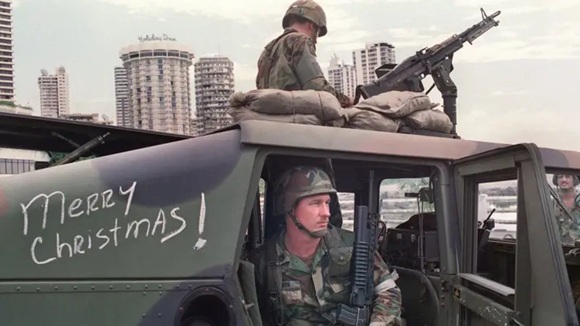
It was the American invasion called “Operation Just Cause”: the largest airborne landing since World War II. The full military might of the world’s leading power descended upon this small country of three million inhabitants: 26,000 soldiers who seemed thirsty for blood.
The invasion became a testing ground for the most advanced military technology, the same technology that would later be used against Iraq in 1991. For example, the lightning bolt that destroyed Ana’s nativity scene and television, and killed her grandson. The “Stealth” bomber had its baptism of fire there.
The Panamanian Defense Forces had fewer than 3,000 combat troops. They lacked air defenses. Civilians and military personnel gave their lives for sovereignty and the nation, not for General Manuel Antonio Noriega.
Because more than 4,000 were killed under the pretext of capturing the dictator for being a repressor and drug trafficker. A military man who, until a few months earlier, had been one of the United States’ favorites in Latin America. A CIA operative and close friend of George Bush Sr., he was the link between the Colombian mafia and the CIA for the cocaine trafficking that financed the counterinsurgency war in Central America in the 1980s. But in a fit of sovereignty, he wanted the United States to have no control whatsoever over Panama, starting with the Canal. And the sins that had never been seen in the general became world news.
When they invaded, they couldn’t find him. The CIA was ridiculed. They had to offer a reward for his capture. He surrendered on January 3, 1990.
The invaders targeted El Chorrillo and San Miguelito because they knew they weren’t welcome there. Only a few concrete pillars remained of those neighborhoods. The American soldiers themselves began calling El Chorrillo their “Little Hiroshima,” comparing it to the atomic bomb dropped by the United States on the Japanese city on August 6, 1945. The vast majority of Panamanians recognize it as the “Martyr Neighborhood.”
Ana was a heroine and a martyr. She left her husband with the children and escaped from the concentration camp where they had been taken in Balboa. She joined those fighting the invading troops. She inflicted several casualties and damaged a helicopter. The woman firing beside her saw Ana take a bullet in the chest. As he lay dying, he said, “Tell my children about me.” They almost managed to pry his hand open to retrieve the rifle.
IMAGE CREDIT: U.S. troops during the invasion of Panama. Photo: Getty Images.
[ SOURCE: CUBA DEBATE ]