“The Government Program to correct distortions and revitalize the economy is our compass, our roadmap, the guiding thread for our work to solve current problems.”
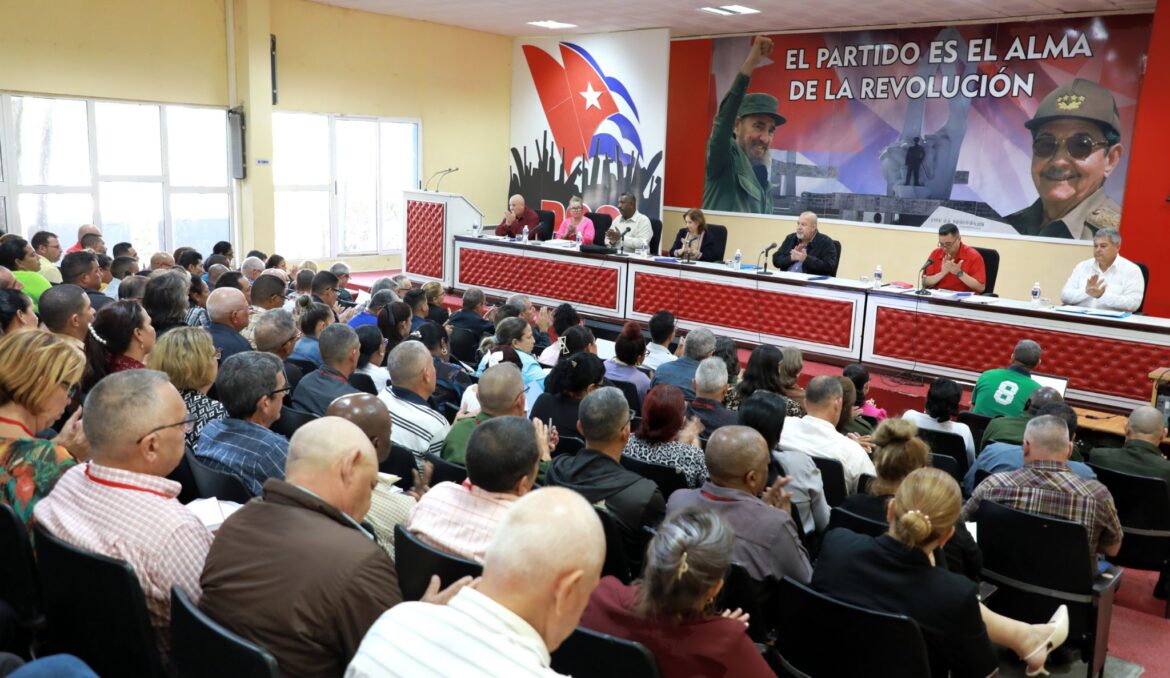
This was stated by the Prime Minister of the Republic of Cuba, Manuel Marrero Cruz, at the extraordinary Provincial Government Council meeting held in Las Tunas, which highlighted the province’s potential to transform current circumstances through integrated work among all stakeholders.
In his exchange with the participants, the member of the Political Bureau of the Party also specified that regulations and decisions have been approved in the country—some not yet implemented—that will contribute to the results projected for this year.
“How to achieve this?” “We are doing things differently because we live in different times,” he said, adding that it was Commander-in-Chief Fidel Castro Ruz who called us to constant change on May 1, 2000, with his concept of Revolution.
“We say we are in a war economy, but we don’t act like it; we continue with inertia, waiting for things to happen. Our survival and the development of each region will depend on individual and collective effort.”
The Cuban head of government referred to food production as a matter of national security.
In this regard, he learned about the province’s actions, outlined in the implementation of the Agreements of the 11th Plenum of the Central Committee of the Party, the 6th Ordinary Session of the National Assembly of People’s Power, and the Council of Ministers, during the analysis of the Plan and Budget for 2026.
These actions include the establishment of 14 production hubs, attention to livestock efficiency indicators, the increase in areas dedicated to rice cultivation, the identification of new exportable products, and the assessment of rural crops, among others.
However, Marrero Cruz mentioned existing difficulties in the territory that must be addressed with different approaches. These include, for example, the quality and distribution of water to the population, community hygiene, and the health situation in several municipalities.
He indicated that attention to social centers must be strengthened and criticized the slow pace at which shipping containers delivered to the province are being processed for conversion into housing, a matter of utmost priority, as Las Tunas has approximately 2,000 families affected by weather events, awaiting solutions.
The Prime Minister added that it is imperative to identify and resolve the obstacles preventing progress. He also reiterated that the US blockade is the fundamental obstacle to the country’s development, but that this imperialist policy cannot justify the poor performance and inefficiency of some companies.
He insisted that the primary arena is the municipality. “That’s where economic activity unfolds,” therefore, “we must understand the needs of the population and the potential of each area.”
The Head of Government asserted that governance cannot be achieved through meetings and reports alone. “The real battleground is on the ground, where we must act with truth and great sensitivity, convinced that every day we wage a battle for the benefit of the people and the economy.”
He commented that more than 3,450 proposals were submitted to the Government Program by the various government structures and political and mass organizations in Las Tunas to correct distortions and revitalize the economy.
“Now it’s time to work to overcome the current crisis and do it right, with all economic actors working together, with greater effort.”
For her part, Ana María Mari Machado, Vice President of the National Assembly of People’s Power and the Council of State, emphasized that work systems must respond to the priorities of these times.
Several ministers and deputy ministers spoke at the meeting about the potential of the Las Tunas region to achieve self-sufficiency in various agricultural sectors, the need to consolidate social policies, taxpayer oversight, and the elimination of financial indiscipline.
At Wednesday’s meeting, the governor of Las Tunas, Yelenis Tornet Menéndez, gave an account of her administration.
TIMES OF COMBAT IN CAMAGÜEY
Maintaining the surplus status of municipalities in Nuevitas, Camagüey, and Vertientes, and incorporating Minas, Sierra de Cubitas, Sibanicú, and Céspedes, reducing the fiscal deficit by more than 600 million pesos, increasing commercial circulation by more than 400 million pesos, seeking new exportable goods, lifting more than 800 families out of vulnerability, and reducing infant mortality to less than six per thousand live births are some of the actions proposed by Camagüey as part of the implementation of the agreements of the 11th Plenum of the Central Committee of the Party, the National Assembly, and the Council of Ministers, with the purpose of fulfilling the Government Program to correct distortions and revitalize the economy.
How to achieve this by utilizing the province’s immense productive and human capital reserves was one of the topics discussed this Wednesday at an Extraordinary Government Council meeting presided over by Political Bureau member and Prime Minister of the Republic, Manuel Marrero Cruz.
It was revealed during the meeting that there are 1,566 pending land usufruct applications in the province, a figure that is unforgivable at a time when increasing national food production is urgently needed. In this regard, Deputy Prime Minister Jorge Luis Tapia Fonseca called for monitoring lands that have already been granted but are not being used. Both battles must be won at the municipal level, with proper oversight by the structures responsible for monitoring these processes.
The meeting also analyzed the declining livestock population in Camagüey, which is resulting in a considerable reduction in milk and meat deliveries to the industry. To regain traditional production levels, efforts are underway to restore pastures and water storage sources.
In addition to production control, more planting is needed, along with the development of technologies to increase yields, explained Ydael Pérez Brito, Minister of Agriculture. He added that Camagüey has all the necessary conditions to be self-sufficient in rice, but resources must be allocated to achieve this, and production chains with new economic actors must be truly effective.
A key point in the discussion was emphasized by Yudier Rodríguez Pérez, president of the Municipal Assembly of People’s Power of Minas: the population must be involved to achieve production goals. “The people must embrace the Government Program for its implementation.”
Marrero Cruz inquired about the actions being implemented in the municipalities slated to become surplus producers and learned that the plans were based on objective reserves in those territories that are not being fully exploited.
During the debate in Camagüey on the Government Program, obstacles affecting the development of Camagüey’s business network were identified. Among the most discussed issues in workplaces and other structures were increasing national food production, expanding access to banking services, and matters related to the social policies of the Revolution.
The session’s agenda also included ensuring the accountability process of the Councils of Administration to their Municipal Assemblies of People’s Power and the accountability report on the provincial Governor’s performance during the past year.
For her part, Ana María Mari Machado emphasized the need to perfect the People’s Power system as a key element of the Cuban political system.
To achieve the effective implementation of the Government Program in the province, its structures adopted the following principles: making greater use of the powers granted to state-owned enterprises, generating more foreign currency revenue, applying science and innovation to different processes, and protecting the most vulnerable.
The Head of Government urged the identification of all available resources to meet the challenges of the current year, thus contributing to the solution of the main problems facing the country today. Therefore, he indicated that the debate should not be confined to provincial levels, but must reach the municipalities and the grassroots level.
As a tool for its implementation, the Prime Minister emphasized the role of popular control, which has always been a strength of the Cuban revolutionary process, and its ongoing collective development.
“These are times when we cannot continue doing more of the same. These are times of struggle in which we must follow the example of our historical leaders.”
[ SOURCE: GRANMA ]