By Cubadebate Media Observatory / Published in: Cubadebate Media Observatory
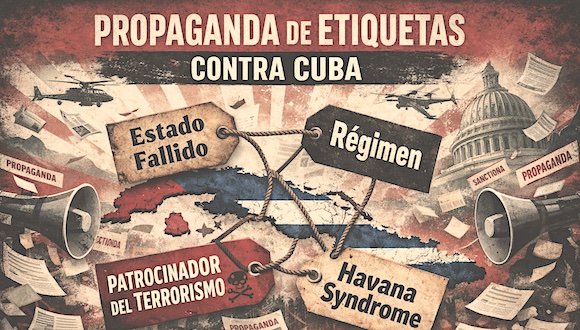
There are words that don’t describe: they condemn. In foreign policy, the United States has perfected a repertoire of pejorative labels capable of turning a complex conflict into a brief, easy-to-repeat, and difficult-to-discuss statement. “State sponsor of terrorism,” “failed state,” “regime,” “narco-state,” “Havana syndrome” are pronounced as if they were objective diagnoses, but they operate—in practice—as tools of power.
Viewed through the lens of framing theory, these formulas function as interpretive frameworks that select and prioritize characteristics of the labeled country to define the problem, attribute causes, issue a moral judgment, and suggest remedies, according to Robert Entman’s classic definition (1993).
At the same time, from the perspective of securitization theory in International Relations, labels can function as speech acts that transform a political dispute into an “existential threat,” justifying exceptional measures and shifting the discussion toward a logic of emergency (Buzan, Wæver, and de Wilde, 1998). In their sociological dimension, they also connect with labeling theory (Becker, 1963) and the notion of stigma (Goffman, 1963): marks that degrade legitimacy, condition institutional treatment, and restrict access to resources.
In short, the theoretical evidence is consistent. These labels not only shape headlines, establish consensus, and legitimize sanctions, but also pave the way for aggression, including military aggression. In the public discourse on Cuba, these formulas don’t appear only in official speeches. They circulate in the media, on social networks, and in mass searches, allowing us to observe their trajectory.
In this analysis, we will call the systematic use of geopolitical labels that package a political and moral assessment into a short formula “label propaganda.” Their function is not conceptual precision, but framing: by labeling a reality, they guide interpretation and, incidentally, suggest a response.
The United States and the Politics of Naming to Act
In the 1990s, with the USSR no longer its main antagonist, Washington needed a new moral map to guide its foreign policy. The Clinton administration found the label “rogue states” to be an extraordinarily effective tool. They used a concise label that allowed them to group different countries under the same threat framework, maintain sanctions, and justify the logic of containment without delving into uncomfortable nuances.
The problem is that this very effectiveness came at a cost. Once a country is labeled a “rogue state,” any diplomatic gesture is interpreted as a concession or a sign of weakness. It is no coincidence that, over time, the State Department itself attempted to tone down the term and announced it would stop using “rogue state” and replace it with “states of concern,” acknowledging that the label had become a political and diplomatic obstacle.
After the attacks of September 11, 2001, George W. Bush took this labeling propaganda to an even more moralizing level. With the “axis of evil” in 2002, the White House not only pointed to adversaries: it placed them in a narrative of total war, where “evil” replaced analysis and the exception became the norm.
The label simplified the world for governance — and for mobilizing domestic support — but it increased the cost of foreign policy: it hardened positions, narrowed diplomatic avenues, and shifted the conflict to an emotional terrain that polarizes both inside and outside the labeled countries. The cost, therefore, was not merely rhetorical; it meant a loss of negotiating power and greater friction with third parties who might share partial objectives, but not the absolute moral framework.
Since then, the pattern has repeated itself regularly. The label appears in the mouth of a high-ranking official, in an official document, or in a highly visible political forum; then it spreads rapidly — through spokespeople, think tanks, editorials, agencies, and social media — until it becomes normalized. And that’s where the decisive moment occurs: the label begins to manage the conflict.
The typical sequence is well-known: it is named; it is amplified; it is codified (lists, sanctions, restrictions); the cost is externalized (banks, shipping companies, and businesses withdraw for fear of risks); And finally, the circle closes when the resulting damage is used as “proof” of the label (“if it collapses, it’s a failure”; “if no one trades, it’s a terrorist”; “if there are shortages, it’s incompetent”).
The political effect is twofold: within the United States, it manufactures consensus; outside, it pressures third parties and produces isolation, even without the need for explicit blockades.
Cuba, a laboratory for label propaganda
Cuba occupies a unique place because different types of labels converge there: some are media “brands,” others are administrative categories, and still others are normalized political insults. Taken together, label propaganda forms an ecosystem of stigmatization capable of operating at various speeds.
To observe how this ecosystem unfolds in the digital public sphere, we combined two complementary tools: Google Trends, which allows us to reconstruct the historical and geographical interest in terms such as “Havana syndrome,” “failed state,” or “state sponsor of terrorism”; and EmbedSocial, used to track the specific circulation of these hashtags in the conversation associated with #Cuba on X, from January 2022 to February 2026, identifying peaks in attention, moments of amplification, and patterns of propagation.
This approach does not, in itself, “prove” causality, but it does allow us to measure how hashtag propaganda driven from Washington translates into real conversation, at what rates it is activated in response to political events, and how it stabilizes—or is contested—as an interpretive framework.
1) Havana Syndrome: When the Name Already Points to the Culprit
The so-called “Havana syndrome” is an almost didactic example of how the label contains its own verdict: “Havana” embeds the accusation in the name. The campaign surrounding the term refers to the collection of accusations, official reports, press leaks, and media investigations—initiated between 2016 and 2017—regarding alleged “invisible attacks” suffered by U.S. personnel, first in Havana and then in other countries.
Although internal assessments by the U.S. intelligence apparatus itself have been contradictory and have largely ruled out a coordinated external cause, the term has become established as a narrative marker.
It automatically associates the phenomenon with Cuba, establishes the idea of a hostile environment, and functions as a device for persistent suspicion. More than a definitive medical diagnosis, it has operated as a useful security narrative to damage the island’s international image, justify diplomatic tensions, and fuel the perception of threat, even without conclusive and verifiable evidence of a coordinated attack campaign.
This refers to historical searches for the concept of “Havana syndrome,” in English and Spanish, from January 2017 to February 2026. Source: Google Trends
Google Trends data shows spikes and international interest concentrated in certain countries and regions; and, in related searches, formulations appear that push the interpretation toward geopolitical themes (“…Russia,” “news”).
Note how the related searches point to Russia. Source: Google Trends
In other words: even before there is any certainty, the label helps to create a map of suspicion. For Cuba, the consequence was immediate: the country became associated in the global imagination with a “syndrome” that operates as a narrative of threat. The label creates a climate. And the climate, in foreign policy, often translates into decisions.
In X, the behavior of the label is intermittent. Clear peaks are observed (January 2023, March 2024, July 2024) that coincide with media publications and “revelations”; between peaks, the conversation drops to almost zero. It is not a structural narrative, but rather an episodic campaign that is reactivated when it is convenient to reinforce the idea of Cuba as a hostile or dangerous space for U.S. personnel.
Source: EmbedSocial
2) State Sponsor of Terrorism: the label that becomes a structure of punishment
Here we are not just talking about propaganda. The designation as a “State Sponsor of Terrorism” has legal and financial effects: sanctions, restrictions, regulatory alerts, and a “fear factor” that pushes international banks and companies to distance themselves for self-protection. It is especially effective because it translates a political dispute into an administrative gesture (“it’s on the list”) and, at the same time, imposes a systemic penalty that permeates international trade: payments, insurance, logistics, credit, reputation.
In practice, this label creates an additional problem: over-compliance. Many entities prefer to avoid anything that smacks of risk, even when exceptions exist. The result is not only pressure on the state; it’s pressure on everyday life.
Source: EmbedSocial
In X, a clear pattern is observed: low daily frequency, but extremely high peaks. There is gradual growth during 2023, a sharp increase in 2024, and a peak in early 2025, followed by a sharp drop and subsequent rebounds. This is the typical behavior of an administrative label: it doesn’t exist in the daily flow; it enters as an “information shock” associated with announcements, high-level decisions, and regulatory moves. It functions as a weapon of concentrated impact.
3) Failed State: Turns Damage into Diagnosis
The Google Trends graph on “Failed State” provides a revealing piece of data: Cuba appears as one of the regions with the greatest interest in that search during the observed period.
This suggests something deeper than external propaganda: the label is being consumed, contested, and discussed within the Cuban media sphere itself and its surrounding environment.
This refers to historical searches for the concept of “Failed State,” in English and Spanish, during the period January 2017–February 2026. Source: Google Trends
“Failed State” is a category that, to operate, doesn’t need to demonstrate much. It’s enough to associate crisis, scarcity, or conflict with the idea that “the State no longer functions.”
Label propaganda gains a strategic advantage here: it allows any external pressure to be presented as an inevitable response to a supposedly internal and natural “collapse,” neither induced nor conditioned. At that point, the label becomes circular, like a revolving door: material deterioration fuels the narrative, and the narrative legitimizes measures that exacerbate the deterioration.
Source: EmbedSocial
In X, “Failed State” exhibits episodic but increasingly intense behavior, with notable spikes in mid-2024, in 2025, and a historic peak in January 2026.
It is the label that translates economic pressure into a political diagnosis: it transforms scarcity and crisis into “internal failure.” Its growth toward 2026 indicates a shift in discourse: from punishment (“terrorism”) to the certification of collapse (“failed”), typical of advanced stages of information warfare.
4) “Regime”: the underlying language that normalizes delegitimization
“Regime” is the base label, the one that requires no further explanation. Its function is to strip the Cuban government—and, by extension, its institutions—of political legitimacy. It is not a technical term: it is a loaded word, designed so that the reader fills in the rest with their own imagination.
Unlike “terrorism,” it does not require concrete acts or evidence. It’s a discursive predisposition; any Cuban policy is interpreted within a predetermined framework. In this grammar, the question isn’t which measures are just or effective, but when “the regime” will fall.
Source: EmbedSocial
In X, it is by far the most voluminous and stable over time. It doesn’t function as an “event,” but as a permanent background noise of anti-Cuban discourse.
Since 2022, it has maintained a high base, with sustained increases during 2024–2025. In late 2025 and early 2026, there is an abrupt jump that reaches its historical peak, coinciding with the hardening of Washington’s discourse and the reactivation of collapse narratives.
“Regime” operates as a narrative infrastructure: it is the semantic ground upon which the other labels are built.
Conclusions: A Multi-Speed War
A combined reading of this data suggests that we are not dealing with isolated words, but rather a coordinated system of ideological frameworks, each with a specific political function: “regime” as a means of permanent delegitimization; “state sponsor of terrorism” as a legal-financial punishment; “failed state” as a diagnosis of collapse; and “Havana Syndrome” as an episodic activation of threat. They do not compete: they complement each other, take turns, and reinforce one another.
In this system, language does not accompany politics, but rather prepares it. Naming is a form of action, because the label dictates headlines, establishes consensus, and narrows the margins of what is debatable. When this shifts from quotation marks to headlines without them, it has already won: the sanction ceases to appear as aggression; it is presented as a “logical” response to a country previously reduced to a single word.
Dismantling the propaganda of labels requires challenging the narrative. It involves identifying who issues it, with what evidence, what measures it enables, and what costs it imposes on daily life. It also demands journalism that doesn’t repeat labels as diagnoses, but rather treats them for what they are: instruments of stigmatization and coercion.
When language is used to punish, the first act of informational sovereignty is simple: to rename reality with verifiable facts.
[ SOURCE: CUBA DEBATE ]