The State of the Union address, which takes place every year in the plenary session of the US House of Representatives, is a political exercise that has been used for decades to present the executive branch’s main proposals and concerns to the legislative branch. As political polarization has increased in that country, the staging has evolved into an exhibitionist platform, where, in addition to slogans, personalities are projected who appear the next day in the headlines of the main (mis)information media.
February 5, 2019, was the night Donald Trump took center stage for the second time. In 2018, he had devoted most of his presentation to economic and domestic policy issues, but twelve months later, he mentioned by name a group of countries he considered enemies and threats, namely China, Russia, Iran, Afghanistan, and North Korea.
Two weeks earlier, his administration had “recognized” Juan Guaidó as “president” of the Bolivarian Republic of Venezuela, after concluding that the Venezuelan government had manipulated the results of the last elections.
National (in)security advisor John Bolton, the recycled Elliot Abrams, and Florida Senator Marco Rubio, who had taken full advantage of the Democratic threat of possible impeachment against Trump to negotiate protection for the president in the Intelligence Committee in exchange for more leeway in actions toward Latin America and the Caribbean.
In that space, Rubio developed very special personal relationships with Guaidó and his entourage. That is why he was primarily responsible for Guaidó’s “ambassador” in Washington, Carlos Vecchio, sitting in a privileged seat in the legislative chamber that night in 2019. Again and again, the self-employed diplomat looked at Trump in bewilderment, waiting for his moment in a speech in which he was never mentioned. He felt that this would be a unique opportunity to enter Washington society, so he sought some visual feedback from Rubio, who was sitting at the end of the room reserved for senators.
The Floridian, for his part, was so focused on his moment to take the stage that he did not applaud his president even once.
This and other events that occurred during those days fueled journalists and observers to repeat the idea that while Trump was in favor of a confrontation with the Bolivarian government, he did not fully “buy” Guaidó’s recipe, did not trust his potential leadership abilities, nor did he believe that he could be an essential factor in changing the state of affairs within Venezuela.
While Trump devoted most of his time to political survival, evading the tax authorities, and defending himself in various court cases, the aforementioned senator, using the banner of “anti-Chavism,” pressured bureaucrats and lulled gullible politicians into ensuring that the “Venezuelan government in exile” was strengthened through the granting of significant funds from federal budgets or through the theft of Venezuelan sovereign assets abroad.
Several investigations by US media and agencies have explained over the years since then how the whole exercise surrounding the formation and operation of the so-called Lima Group, the fuel for the guarimbas and violence within Venezuela, was in fact a business move to increase the personal capital of several of the puppets being manipulated from Washington, as well as that of their drivers. Some received a check for participating in the scam, others were more careful and were favored by “legal contributions” to their political campaigns in the US.
Those who moved around the sale of large Venezuelan properties, as was the case with the CITGO company, deserve a separate chapter. Rarely in history has an action by privateers and pirates such as this been better dressed up in the colors of business.
What has been succinctly described so far may be one of the reasons why, in his second term, Trump has been more careful about participating directly in the actions to be taken against Venezuela and in the peculiars of the tangible results of the operation.
Many have been surprised that on this occasion the US government has not taken the trouble to present to the world an alternative (credible or not) to the Bolivarian government, has spared itself the diatribe about a supposed regime change, and has placed a huge tombstone on those who in the last stage have self-appointed themselves in various capacities within an “alternative” Venezuelan executive.
This does not appear to be a matter of grand strategic reasoning, as everything indicates that the reasons for such a stance revolve around the old business axiom of costs versus benefits. Trump must have asked himself, why invest in a move where I get no direct benefit?
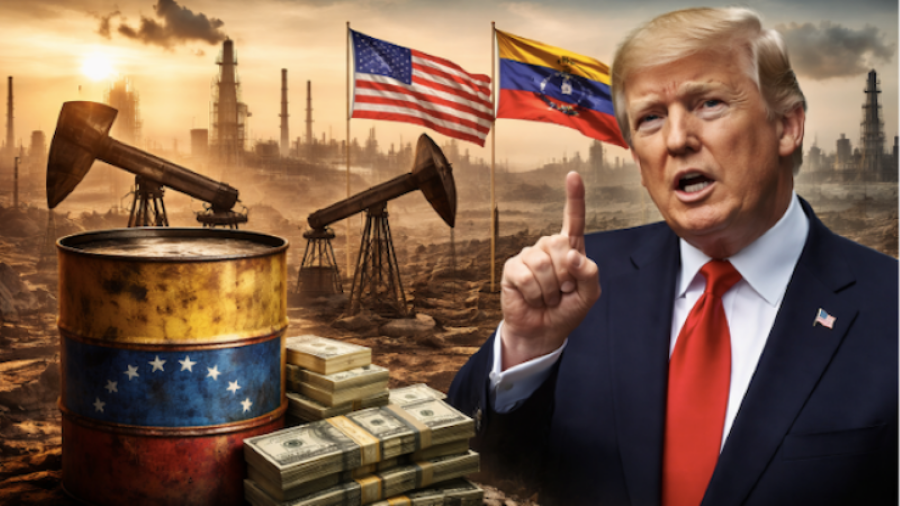
Kidnapping the head of state and his wife, threatening the rest of the country’s leaders, and reversing the situation to the moment before the sanctions he imposed in 2019 seemed like decisions that would allow him to pounce more decisively on Venezuela’s oil resources, propose the return of major corporations to the scene (charging them entry fees), and personally distribute the first contracts for the sale of Venezuelan crude oil on the US market.
This time, Marco, Juanes, and Carlos were left out of the pie. But within the group, some would be more exposed than others.
The former senator, now secretary of state and chief archivist, who shortly before the actions of January 3 had moved to a military base for security reasons, has tried to take some of the credit for the “success” of the actions against Venezuela, and thanks to his repeated threats against Cuba, he has earned the Trumpist merit of being suggested as a possible “future president” on the island. And the incredible thing is that the individual smiled at such a proposal.
This is the second time in recent weeks that Trump has stated in one way or another that he does not support Rubio in his aspirations to become a candidate for the presidency of the United States.
But the consequences of the events summarized here have another interpretation further south in the United States.
The former Florida senator has built almost his entire political career on the votes of those who believed that he supported a “Cuban cause” or a “Venezuelan cause.” The fact is that now, as secretary and advisor, he is part of a team that has taken an extreme position against immigrants, regardless of their origin and status. Moreover, in the case of Venezuela, the US executive branch is currently arguing that the conditions are in place for ALL migrants from that nation to return to their places of origin.
Rubio, designer of the Guaidó plan in 2019 and promoter of the Edmundo González-María Corina Machado duo in 2025, has now become co-author of a recipe in which the “opposition” has no place. The question then would be: how does this proposal work in the case of Cuba?
Will Marco be able to return to Miami-Dade to lead rallies of the so-called Cuban “opposition”? What distinction will he make between the “legitimate” candidates with Batista roots and those newcomers who declare themselves more Trumpist than Melania in order to find employment? How will he be able to argue that the little money left over from the former USAID should be used to finance organizations and figures that are considered part of “Cuba’s future”?
Images are multiplying of Venezuelan immigrants who come out to celebrate the coup against Maduro in the United States and are detained to be deported. There are also reports of Cubans with various immigration statuses who have nothing to celebrate, but who are also detained and threatened with possible deportation.
The Trump team’s new experiment with the Venezuelan reality is in its very early stages, and logically, the progress or regression of its proposals will depend greatly on Bolivarian resistance. At the end of 2026, the so-called midterm elections will take place, which could put the Republican president in a position to act in a minority in one or both houses of Congress.
These changes, and others, could cause Trump (as happened at the end of 2018) to use the domestic broom to cleanse his government of everything he considers disposable. Which of the current champions will be on the list?
(José Ramón Cabañas is Director of the International Policy Research Center -CIPI-)