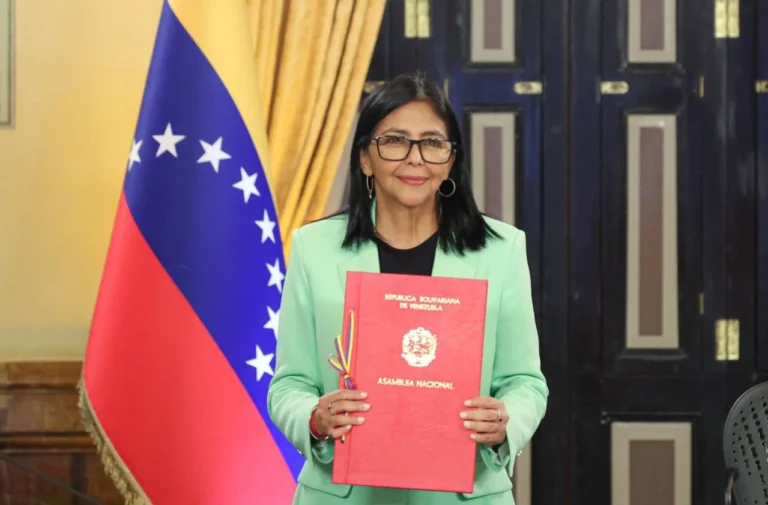
In a context marked by recent imperialist aggression and US ambitions, Venezuela’s interim president, Delcy Rodríguez, announced the receipt of the first $300 million from the direct sale of crude oil.
As the president detailed last Tuesday, January 20, these resources will cover the income of Venezuelan workers through the stabilization of the economy. “These initial flows will be used and employed through the foreign exchange market in Venezuela, the national banking system, and the Central Bank, to consolidate and stabilize the market and protect the income and purchasing power of our workers,” she reported.
Previously, during the presentation of the 2025 State of the Nation Address to the National Assembly, the official announced the creation of two sovereign wealth funds intended to strengthen social protection and national infrastructure, as part of a comprehensive economic and social development strategy.
“Any foreign currency that comes in will go to two funds. I am instructing the Vice Presidency for the Economy and the Ministry of Economy and Finance to create two sovereign wealth funds,” Delcy Rodríguez declared at that time.
Partial Reform of the Hydrocarbons Law
Through a partial reform of the Organic Hydrocarbons Law, the Bolivarian Government seeks to consolidate an accelerated production model that not only protects investment from external aggression and safeguards the South American country’s hydrocarbons, but also guarantees the direct redistribution of wealth in areas such as health, education, and exchange rate stability.
One of the proposals for this reform, presented by Acting President Delcy Rodríguez to the Venezuelan Parliament during her annual State of the Nation address, is the incorporation of Productive Participation Contracts (CPPs), oil agreements between Petróleos de Venezuela (PDVSA) and private/foreign companies to increase crude oil production.
This mechanism, which has already proven its effectiveness under the Anti-Blockade Law, allowed the country to reach a production of 1.2 million barrels per day by 2025 and attract investments of nearly $900 million, as Rodríguez recently detailed.
The new regulations will facilitate the exploitation of “green fields,” that is, those that remain unexploited and therefore require a much larger investment. In this way, the regulations promoted by the Executive Branch aim to offer a framework of legal security and profitability for international partners, without ceding sovereignty over the resource. “Oil underground is useless; it must be converted into schools and hospitals,” emphasized the President of the National Assembly, Jorge Rodríguez, last Tuesday, January 20.
The parliamentarian explained that the country has a model that has proven successful in increasing crude oil production. He recalled that when Venezuela was not under sanctions, it was possible to attract foreign investment and establish partnerships with national companies for the exploitation of “mature fields,” referring to those deposits that already have prior investment for their operation.
“But it is essential to find the optimal conditions to attract investors for the so-called green fields, that is, those that are unexploited and therefore require a much larger investment. To this end, it is necessary to ensure that this foreign investment is protected and profitable; that is why the CPP (Productive Participation Contracts) mechanism was tested, a key factor in increasing oil production,” he emphasized.
Transparency
Furthermore, Rodríguez explained, a cutting-edge technological platform for managing funds is being developed, which will guarantee real-time auditing to ensure transparency and the efficient use of every foreign currency that enters the country.
According to the president of the Venezuelan National Assembly, this involves launching official websites that will publish detailed information on all Venezuelan state revenues from oil and mineral sales, as well as the precise allocation of these resources.
The initiative, spearheaded by acting president Delcy Rodríguez, aims to ensure that “people can see, know, and question” the management of national income. “So that everyone knows everything that has come in (…) and how every cent has been spent,” stated Jorge Rodríguez during a meeting of the parliamentary Advisory Commission.
Furthermore, to complement the reform in the National Assembly plenary session, where 29 laws from the Legislative Agenda will be presented, the Organic Law for the Acceleration and Optimization of Procedures will be discussed. This bill is also based on the anti-blockade model, seeking to eliminate the bureaucracy that hinders industrial development.
“We are obligated to collaborate in maintaining peace in the Republic and in building a strong economy,” Jorge Rodríguez stated on his social media.
A response to external ambitions
Faced with threats from international actors who have expressed their intention to seize Venezuelan oil, the Government reaffirmed that this energy wealth belongs exclusively to the people.
The legal reform acts as a shield against the blockade, allowing Venezuela to maintain its 19-quarter cycle of sustained growth and an 8.5 percent increase in Gross Domestic Product (GDP).
The debate to reform the Hydrocarbons Law will formally begin next Thursday, January 22, in the National Assembly plenary session, marking the start of a new era of economic independence and social well-being for all Venezuelans.
“The entire Venezuelan territory is here to guarantee the happiness of our people, and we are here to safeguard our territorial integrity, our sovereignty, our freedom, and our independence,” reaffirmed Delcy Rodríguez during a social outreach event at the Hugo Salas Socialist Mission Base in the La Vega parish of Caracas, the Venezuelan capital.
“We are building a better Venezuela, a Venezuela of the future, a peaceful Venezuela, and an inclusive Venezuela,” she emphasized.
This legislative initiative comes after the military aggression perpetrated by the United States on January 3, which resulted in the kidnapping of President Nicolás Maduro and First Lady Cilia Flores. During that attack in Caracas and several areas of the states of Aragua, Miranda, and La Guaira, more than 80 people, including civilians and military personnel, were killed, and more than 112 were wounded.
The Venezuelan government has repeatedly denounced the Trump administration for using the narrative of fighting drug trafficking as a pretext to justify its interest in Venezuela’s energy resources, whose wealth, despite the invasion and the illegal kidnapping of Bolivarian leaders, remains under the control of the Venezuelan government.
IMAGE CREDIT: The reform was presented by interim president Delcy Rodríguez to the Venezuelan Parliament during her annual State of the Nation address. Photo: Delcy Rodríguez – Telegram.
[ SOURCE: teleSUR ]