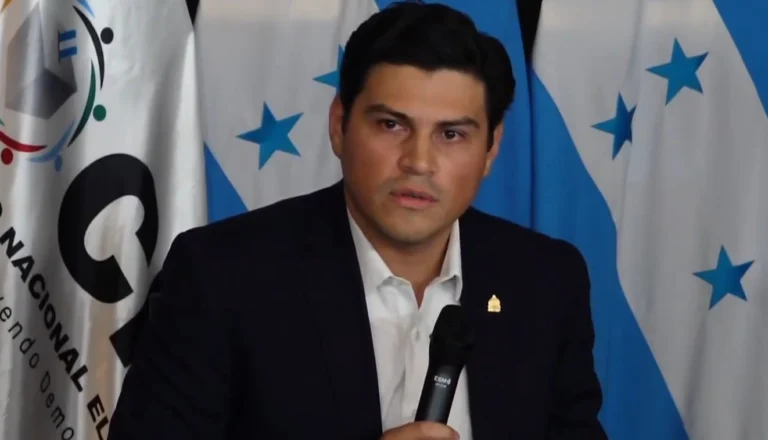
Marlon Ochoa, a member of Honduras’ National Electoral Council (CNE), addressed the Honduran people this Thursday in a press conference before national and international media regarding the “plot” of an “electoral coup” in the country, asserting that the Preliminary Electoral Results Transmission (TREP) system is a “real trap.”
After reading a document titled “Electoral Coup 2025,” Ochoa warned that this could be “the least transparent election” and the “most manipulated in our democratic history,” surpassing even the 2013 and 2017 elections, due to serious flaws in the TREP system, vote buying, intimidation, and “blatant foreign interference.” His statements add to the accusations of fraud made by candidate Rixi Moncada (Libre) in the November 30 elections.
During his appearance, which was marked by suspicious technical difficulties, Ochoa outlined seven key points supporting the accusation of an “electoral coup”:
1. Elimination of biometric control: The night before the elections, Saturday, November 29, by decision of the two council members from the two-party system, the National Electoral Council (CNE) approved a resolution that eliminated the mandatory cross-referencing between voters registered on the biometric device and those registered on each tally sheet, violating the Honduran Electoral Law. This measure facilitated the alteration of results through the “inflation” of tally sheets.
2. Scandalous Results with Erroneous Ballots: Of the 19,167 polling stations nationwide, as of 8:00 a.m. on Wednesday, December 3, 15,297 presidential ballots had been transmitted, representing 69.8 percent. Of these, 13,246 ballots, or 86.6 percent, contained errors and inconsistencies between the biometric record and the content of the ballot transmitted by the Preliminary Results Transmission System (TREP). These inconsistencies resulted in a difference of 982,412 votes.
3. Deliberate Structural Failures Since the Simulation: The November 9 simulation revealed serious structural flaws in the system. Low transmission capacity for ballots was observed, as well as the absence of the vote counting module and the automatic dissemination module, and the extraordinary allocation of votes. Although some deficiencies were corrected, Ochoa stated that the necessary guarantees to verify the integrity of the results were not provided.
4. Ignored External Audit and Internal Sabotage: On Saturday, November 29, the day before the elections, the National Electoral Council (CNE) received an external audit report confirming the persistence of critical inconsistencies. Ochoa attempted to read it to the full council, but a council member sabotaged the session, preventing urgent decisions from being made to correct the deficiencies and publicly lying about the report’s contents.
5. Automatic Alteration of Vote Counts: On election night, thousands of polling station officials and custodians confirmed that the Preliminary Results Transmission System (TREP) did not correctly read or interpret the handwritten vote counts on the tally sheets. The system assigned unrealistic figures, up to 600 or 700 votes, falsifying the original documents.
6. Automated fraud and vote transfer: The system skipped boxes, transferring votes from one candidate to another and from one party to another. This confirmed the manipulation previously reported through leaked audio recordings.
7. Withholding of crucial tally sheets: A total of 1,615 tally sheets were held within the system for 40 hours without clear justification, raising suspicions of manipulation.
Addressing the press, Marlon Ochoa lamented that, despite his initial warnings since the November 9th simulation, the flaws in the electoral system were ignored. The council member denied the existence of an operational contingency system, stating that the “contingency system 2,” which according to the contract should have been ready since November 12th (more than three weeks ago), is still being finalized by the Colombian company ASD.
Ochoa pointed out that even on election day itself, November 30, at four or five in the afternoon, the final adjustments to the results dissemination and general vote count system were being made, demonstrating a lack of preparation and structural flaws.
The contingency process, which involves scanning and transcribing physical tally sheets in Tegucigalpa—vital for the immediacy of the election results—is not yet finished as of December 5, five days after the election. Ochoa emphasized that the full National Electoral Council (CNE) cannot claim ignorance, as they received numerous documented warnings from technicians, the TREP monitoring commission, and the external auditing firm.
Marlon Ochoa concluded his statement by emphasizing that this election will be remembered not only for the failures in the results reporting system and the execution of a fraud plan, but also for vote buying, the intimidation of thousands of people throughout Honduras, and, in particular, for the “blatant foreign intervention” that has occurred, which he describes as unprecedented in the Latin American region.
The council member assured that “absolute transparency can be expected” from him, and that he will continue to denounce and fight within the electoral body to ensure that the popular will, manipulated from the outset, is respected for the remainder of the process. He also expressed his concern about agreements that the two-party system is reaching within the National Electoral Council (CNE) without his participation.
These denunciations echo those of Rixi Moncada, the presidential candidate for the ruling Liberty and Refoundation Party (Libre), who has denounced an “electoral coup” due to technical irregularities, media manipulation, and unprecedented external interference.
The preliminary results from the TREP (Preliminary Results Transmission System), which Libre has not recognized, show a virtual tie between Salvador Nasralla (Liberal Party) and Nasry Asfura (National Party), who is publicly backed by Donald Trump. The same results place Moncada in third place, with approximately 19 percent of the vote, a figure his party rejects.
[ SOURCE: teleSUR ]

1 comment
Seven to Two
In the article photo, Marlon Ochoa, appears to be a male, but the article’s author seems unsure: (1) Her statements; (2) her appearance; (3) his initial warnings; (4) his statement; (5) he describes; (6) from him, and that he will; (7) He also; (8) his party. Seven male pronouns versus two female pronouns. I’m guessing Marlon is a male (?).