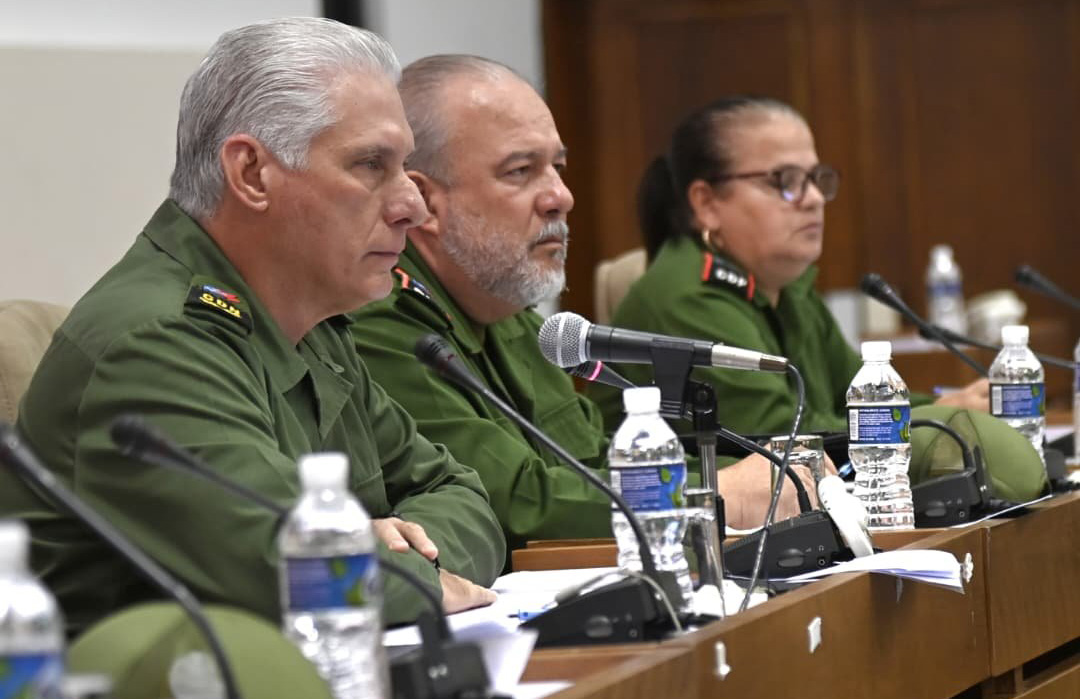
Miguel Díaz-Canel, First Secretary of the Central Committee of the Communist Party of Cuba (PCC) and President of the Republic, led today’s weekly meeting between the country’s leadership and Havana authorities to follow up on efforts to address the city’s accumulated problems.
The meeting included the presentation of preliminary results from a study on the generation of municipal solid waste in households and state and non-state economic entities in Havana neighborhoods. The study was led by the Ministry of Science, Technology and Environment, universities, and other Havana institutions, the Presidency reported.
The assessment, which will allow for a precise determination of how much garbage and other waste is produced daily, revealed that between November 21 and 27, 91,695 cubic meters (m³) of municipal solid waste were collected, averaging 13,101 m³ per day, 1,877 m³ less than the previous week.
“This is a crucial issue, because we need to know how much solid waste is actually being generated in the capital today,” commented Prime Minister Manuel Marrero, who was accompanied by Esteban Lazo, President of the National Assembly of People’s Power; Inés María Chapman, Deputy Prime Minister; Liván Izquierdo, First Secretary of the Provincial Committee of the Communist Party of Cuba; and Yanet Hernández, Governor of Havana.
“This is an essential issue, because we need to know how much solid waste is actually being generated in the capital today.” It was reported that an average of 221 pieces of equipment were used during the period, 73 fewer than the previous week. The inability to implement the system that allows trucks to be put into service the day before was cited as a limiting factor for waste collection, due to difficulties with fuel deliveries, as well as disruptions caused by occasional breakdowns due to a lack of oils and lubricants, and equipment being out of service due to tire and battery issues.
The number of street sweeping brigades has increased, reaching 85 to date. These workers have covered 650 sections and 47 avenues. To further enhance the efficiency of this essential service, which is highly valued by the public, the Cuban Steel Company is also producing 40 new pickup trucks.
Another positive development is the increase in the number of Ampiroll containers, with a program to refurbish 40 units. Twenty-one have already been completed, ten are scheduled for delivery this Monday, and the remaining nine are expected to be ready in December.
During the week, according to the study, 30 garbage containers were delivered to the Playa municipality, 50 more are scheduled for collection this Monday, and the next 80 to be manufactured will be allocated to Old Havana.
Regarding recyclable material collection, the meeting reported the recovery of 197 tons (t) of these products, 8.2 t more than the previous week.
Non-state management entities (FGNE) delivered 109.2 t, the “Recycle My Neighborhood” movement 77.31 t, and 11.29 t of materials were collected from the main roads. These efforts not only help improve the city’s cleanliness but also generate revenue, including foreign currency, which can contribute to the maintenance of sanitation efforts.
During the week, 4,111 non-state economic actors (FGNE) were visited—bringing the total number of interviewed non-state economic actors to 22,049—and 4,111 agreements were signed for the management of the waste they generate, for a total of 19,005 such contracts to date.
According to the information, these agreements uphold the law and a principle implemented by Commander Ernesto “Che” Guevara when he was Minister of Industries, which states that those who generate waste must protect, conserve, and deliver it.
Regarding the water supply, the week saw improved electrical stability at the water sources, which, combined with the repair of pumping equipment, has resulted in improved service, reducing the impact on 65,228 residents. However, a significant number of people still lack access to water, according to the established schedule.
Regarding the epidemiological situation, it was reported that over the last five weeks, the number of febrile cases has been decreasing; however, differentiated care continues for pregnant women, elderly people living alone, and children under three years old. 112 pregnant women at term were admitted; 148 adults and 162 children under three remain hospitalized.
This marks the sixth week of intensive adulticide treatment in Havana, where work is underway in 303,600 homes.
The University of Medical Sciences is participating in screening, surveillance, and care activities for patients with arboviruses in primary care, while also working across sectors on sanitation and the environmental situation in the capital.
However, actions against the Aedes aegypti mosquito have been limited by the availability of sprayers; in 12 municipalities, the work has been completed at 100% of the planned target, and even exceeded; however, the same cannot be said for Cerro, Plaza, and Playa.
Díaz-Canel criticized this situation and demanded that the many resources available in each territory be utilized, where students and workers can provide support, but for this to happen, they must be called upon and mobilized.
Liván Izquierdo pointed out that these three municipalities have no justification for this deficit, since in the other twelve of the city the number of forces has multiplied.
IMAGE CREDIT: ACN | Photos: Estudios Revolución
[ SOURCE: AGENCIA CUBANA DE NOTICIAS ]