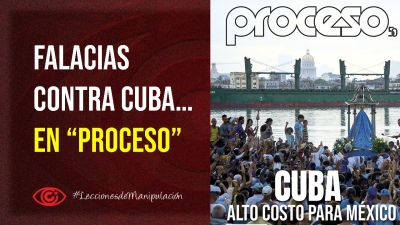
Fallacies Against Cuba… in “Proceso”
José Manzaneda, coordinator of Cubainformación
If Proceso were the critical voice of power it once was, and not the shameful mouthpiece of the right wing it is today, it would publish in-depth reports on the possible imminent “humanitarian collapse” in Cuba—as the UN Secretary-General has described it—due to a perverse and criminal oil blockade imposed by the US.
Fallacy 1. Mexico’s Oil Given Away
This falsehood was rigorously refuted at a press conference by the director of Petróleos Mexicanos, Víctor Rodríguez: “If you ask me if Cuba is paying for its shipments, of course it is. We don’t have any overdue invoices according to the contract. They are very punctual with their payments” (2).
The Proceso journalist, Dalila Escobar, couldn’t believe her fabrication had been so shamefully exposed. And, monopolizing the question-and-answer session, she insisted on the same point repeatedly, which provoked protests from the other journalists. But what did she write next in her article? That some “consulted experts” had assured her that Cuba “hasn’t paid a single cent for those contracts” (3). Without evidence, without documents. Nothing.
Fallacy 2. Mansions of the Cuban Leadership
This journalist recently traveled to Cuba to “portray—we read—the contrasts between the rampant social poverty and the pampering of the Cuban hierarchy” (4). Upon her return, she published gems like the following: “Human rights organizations in Cuba indicate that 89% of the population lives in extreme poverty; while in municipalities like Playa, one observes large mansions and the luxury of those in power” (5).
Human rights organizations? No. Her source is the “Cuban Observatory for Human Rights,” an entity linked to the U.S. State Department, which supports sanctions against Cuba and works to extend them to the European Union (6). It is an “NGO” sustained by annual allocations from the U.S. government agencies USAID and NED (7). The source, therefore, is not a “human rights organization.” It is the White House itself.
On the other hand, the comment about the “grand mansions” and “the luxury of power” in the Playa municipality demonstrates her audacious ignorance about Cuba. She is referring to Miramar, an area west of Havana, formerly the domain of the Cuban bourgeoisie, where today there are embassies, ambassadors’ residences, company headquarters, and also single-family homes, where Cuban families of all kinds live (8). By the way, where are the photographs of these “grand mansions” of the Cuban leadership, which have never been seen in 67 years?
Fallacy 3. Mexican Aid Is for the Cuban Government
The journalist also tried to discredit Mexican humanitarian aid to Cuba, sowing doubts about its distribution. “The perception of the (Cuban) population is precisely that much of what is sent… which they would appreciate if it reached them directly, because they have the perception that it doesn’t reach them, that there is a group or handful of people in the government who live well and are the only ones who can eat,” she questioned at the press conference.
Really? And where is the evidence of this supposed diversion to a “handful” of officials? The only “evidence” she offers is the “perception” of someone who has not benefited from Mexican aid, which, evidently, reaches a minimal percentage of the island’s population.
Fallacy 4. The Cuban President’s Salary
Regarding the situation in Cuba, the Proceso journalist doesn’t seem concerned about the US-imposed hunger blockade. What’s relevant is whether or not we know the Cuban president’s exact salary. “There’s no transparency, not even about what the president earns, unlike, for example, in our country, where we know the salary, in this case, the president’s,” Escobar said.
In 2008, a ranking of presidential salaries in the Americas, published by Columbia University, was topped by George W. Bush with $33,000 a month and brought up the rear by Fidel Castro with $30 (9). This hasn’t changed. Even so, let’s remember that Forbes magazine fabricated a supposed fortune for Fidel, estimated at $900 million (10). And since they had no proof whatsoever, because it was all a blatant lie, what did the magazine do? It attributed three large state-owned companies to the Cuban president. Today, Proceso magazine is trying to make us swallow the same garbage.
Fallacy 5. Cuban Medical Cooperation: A Burden for Mexico
Proceso has also contributed to the campaign against the Cuban medical teams contracted by Mexico, which provide specialized services in impoverished areas of the country (11). These positions are not filled by Mexican personnel because, following neoliberal policies, the country stopped training medical specialists for years (12).
And in the war of lies against Cuban medical cooperation, Proceso has been a mouthpiece for organizations like Prisoners Defenders (13), which, like the aforementioned Cuban Observatory for Human Rights, is linked to the US government and its genocidal blockade policy (13).
By the way, isn’t it strange that we can’t find a single article in Proceso’s archives about the four ophthalmological centers donated to Mexico by Cuba in 2007, which benefited tens of thousands of people (14)?
Aren’t you concerned about the potential humanitarian collapse in Cuba?
The Mexican president acknowledged that they have suspended oil sales to Cuba due to the tariff threat announced by Donald Trump, and that she is “seeking diplomatic avenues to resolve the problem” without “affecting Mexico” (15). If Proceso were the critical voice of power it once was, and not the shameful mouthpiece of the right wing it is today (16), it would publish comprehensive reports on the possible imminent “humanitarian collapse” in Cuba—as the UN Secretary-General has described it (16)—due to a perverse and criminal oil blockade imposed by the US.
IMAGE CREDIT: “Cuba: High Cost for Mexico.” This is the latest cover of the Mexican magazine Proceso, which repeats the fallacy of an alleged “gift” of oil to Cuba Cover photo: Proceso.
[SOURCE: cubainformacion.tv]