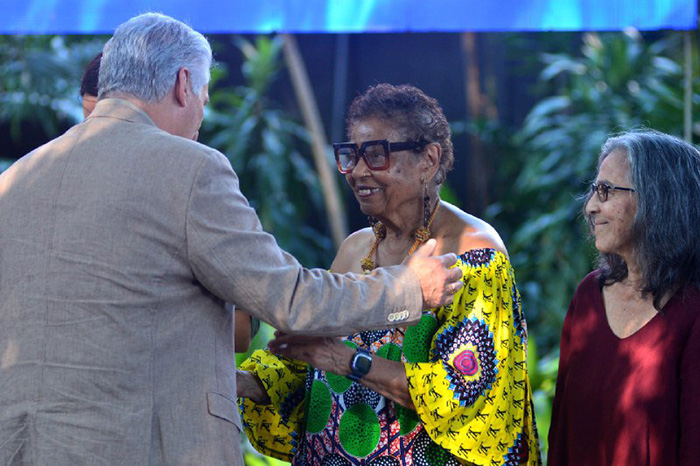
The President of the Republic, Miguel Díaz-Canel Bermúdez, First Secretary of the Central Committee of the Communist Party of Cuba, attended the main event on Monday afternoon commemorating the 65th anniversary of the Cuban Institute of Friendship with the Peoples (ICAP), founded by Commander-in-Chief Fidel Castro on December 30, 1960.
Also present at the commemorative ceremony were Political Bureau members Roberto Morales Ojeda, Secretary of Organization of the Central Committee of the PCC, and Bruno Rodríguez Parrilla, Minister of International Relations, as well as the President of ICAP, Fernando González Llort, along with other leaders, representatives of the Party and the Government, and members of solidarity movements.
The anniversary celebration, part of the activities honoring Fidel Castro as his centennial approaches, includes the participation of some 250 activists from 32 countries, who covered their own travel and accommodation expenses in Cuba.
The program commemorating the 65th anniversary of ICAP began on Saturday with a panel discussion about the historical leader of the Cuban Revolution, his thought, his actions, and his impact on international solidarity.
On the same day, a photographic exhibition on international solidarity with Cuba and Fidel Castro opened in Havana. Activists and representatives of organizations and movements in solidarity with the island attended the opening.
During Monday’s ceremony, the Cuban president presented the commemorative seal for ICAP’s 65th anniversary to international solidarity movements with Cuba, including the Cuba-Italy National Association, the International Committee for Peace, Justice and Dignity of the Peoples, the Brazilian Movement of Solidarity with Cuba, and the Antonio Maceo Brigade.
Speaking at the ceremony, the president of the institution, Fernando González Llort, stated that “65 years after that December 30, 1960, the Cuban Institute of Friendship with the Peoples not only endures, but is renewed in fulfilling the same mission for which it was conceived: to build bridges, unite wills, and cultivate peace, friendship, and solidarity among peoples.”
He emphasized that ICAP has been “a witness to and active participant in the history of the Cuban Revolution: welcoming people from all over the world interested in learning about the transformations driven by the revolutionary process; encouraging the creation of solidarity committees with Cuba on all five continents; hosting important events; and promoting, from within our society, Cuba’s support for the just causes of the world’s peoples.”
He recalled that for 65 years the Institute has marched alongside “the unwavering support of a solidarity movement that has grown immensely in the most difficult moments: in the defense of Cuba’s right to be a free, independent, and sovereign country, in the denunciation of hostility and aggression against our country.”
He also highlighted this support in the battles for Elián’s return and the release of the Cuban Five, and more recently, during the COVID-19 pandemic. “To all of them,” he emphasized, “our infinite gratitude.”
The president of ICAP said that the complex current situation “makes it necessary to increase the pace and urgency of our work,” amidst “unprecedented global challenges” and in a context where “the economic war against Cuba has reached extreme levels, with the attempt to strangle our economy becoming increasingly cruel and inhumane.”
Faced with the harassment against the island, he continued, “we have witnessed the ongoing mobilization of the global solidarity movement with Cuba, which responds with concrete and diverse actions, defending our truth against the provocations of a counterrevolution funded by the U.S. government.”
Together, he emphasized, “we will continue the struggle against this hostile policy toward Cuba,” and he highlighted that solidarity organizations have been “the voice of our Revolution on social media and in the streets in each of their countries.”
He said that in the immediate future, efforts are focused on 2026. “It will be a year of tribute and reaffirmation, as we celebrate the centennial of the birth of the historic leader of the Cuban Revolution, Commander-in-Chief Fidel Castro Ruz.”
He added that, “inspired by his legacy, our path will be guided by the commitment to honor his memory, transforming each international solidarity brigade with Cuba, each solidarity gathering, and each action into a living tribute to his anti-imperialist, internationalist, and humanist thought.”
In that spirit, he called for strengthening solidarity and unity among movements in every country, “weaving even stronger, more coordinated, and more mobilized networks across the globe, adding new voices, especially young people, to the defense of truth and justice,” and emphasized that “it is strategic to continue encouraging the incorporation of younger generations into solidarity actions with Cuba.”
Norberto Abel Galiotti, founder of the Argentine Movement of Solidarity with Cuba and spokesperson for the Continental Network of Solidarity with Cuba, highlighted ICAP’s trajectory as “an instrument of the Revolution for building people’s diplomacy” and expressed the commitment of solidarity movements to support the island in the face of the tightening of the US blockade.
Galiotti reviewed expressions of Cuban internationalism such as the fight against apartheid in Africa, Operation Miracle, the “Yes, I Can” educational method, and the work of the international medical brigades, along with the training of thousands of doctors at the Latin American School of Medicine.
After denouncing the arbitrary and unilateral inclusion of Cuba on the list of alleged state sponsors of terrorism, he warned of the US media offensive against the island and called for the coordination of unions, youth groups, feminist movements, parliamentarians, jurists, and intellectuals in the “cognitive battle for truth and justice.”
In addition to highlighting the work of the Continental Solidarity Network, which supported Cuba during critical moments such as the Covid-19 pandemic, the organization called, within the framework of the tribute to Fidel Castro, for a “global marathon of love for Cuba” and for forging “the centennial solidarity generation” to defend sovereignty and peace against imperialism.
IMAGE CREDIT: During Monday’s ceremony, the Cuban president presented the commemorative seal for ICAP’s 65th anniversary to international solidarity movements with Cuba and individuals… including author and professor Rosemari Mealy. Photo: ACN.
[ SOURCE: CUBA DEBATE ]