History, in its inexorable march, often acts as a sieve that separates the wheat from the chaff, nobility from baseness.
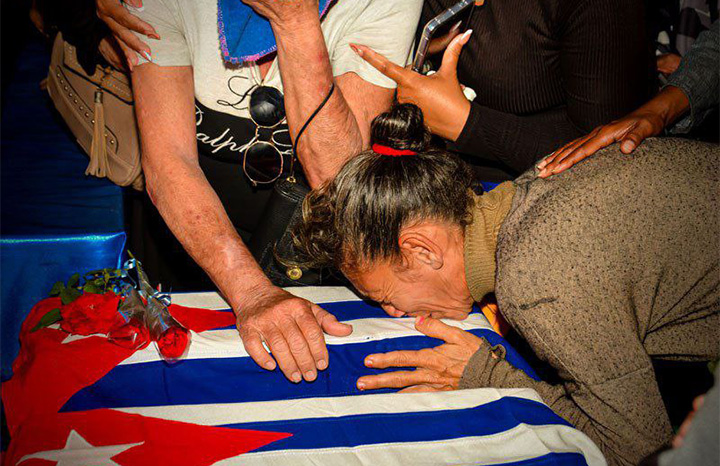
The recent sacrifice of the 32 sons of Cuba, who fell in the line of duty on January 3, has not only left a physical void in their families and national mourning in the soul of the nation, but has also laid bare, with surgical starkness, the profound moral asymmetries that coexist in the contemporary world.
While the humble people mourn their martyrs, a phenomenon emerges from the digital sewers that, although predictable, is no less monstrous: the celebration of death, the mockery of the survivor, and the genuflection before foreign power.
The commodification of impiety
The attitude of those who have made hatred a profession and social media a trench of infamy is not surprising, though it is infuriating.
These are individuals who have replaced the ethical compass with financial calculation; beings for whom the flag is not a banner of freedom, but a wad of bills; these mental masters, who from the comfort of the algorithm praise foreign military might and yearn for invasions or massacres in their own land, suffer from a terminal humanist blindness.
For this sector, human life only has value if it is traded on the stock market. They are incapable of understanding the mystique of sacrifice because their world is exhausted by the profit margin.
At this point in history, that unbridled ambition and lack of empathy are not merely character traits; they are profoundly destructive forces seeking to undermine the foundations of national sovereignty.
Whoever celebrates the death of a compatriot wearing the uniform of citizen protection has, de facto, renounced their status as a brother of the land.
The tragedy of lukewarmness: the fear of the chain
However, there is a group that evokes a feeling closer to pity than to rage: the lukewarm. Those who, possessed by a pusillanimity disguised as neutrality, live cautiously, careful not to upset the former. They are the false heroes who have understood, with a base logic of survival, that there are two opposing forces.
In their metaphor of cowardice, they identify the Revolution as the monkey that can be pinched, stoned, and beaten without major personal consequences, while they maintain a complicit silence before the owner of the chain, that hegemonic power they don’t dare even touch, lest its fury close the doors of opportunity or the benefits of the system that protects them.
This calculated neutrality is, in essence, a form of complicity with evil. It is the perverse game of justifying the powerful abuser while applying absolute ruthlessness against the victim.
It is here that fascism reveals one of its most insidious faces: the inversion of values, where the hero is crucified and the executioner is applauded.
The Last Moral Barrier
Forgiveness for the oppressor and blame for the fallen are symptoms of a moral crisis that admits no half measures. As Dante Alighieri aptly warned in his Divine Comedy, the hottest places in Hell are reserved for those who, in times of moral crisis, maintain their neutrality. There is no ethical refuge in silence when those who gave everything for the peace of others are scorned.
A final bulwark against this tide of indignity is memory and humanist patriotism. As long as people walk toward the gardens to converse with history, and as long as the majority of the people recognize in the 32 combatants the very essence of sovereignty, the infamy of the traitors and the vacillation of the lukewarm will be reduced to a footnote in the annals of infamy.
Cuba does not surrender, neither to the fire of aggression nor to the poison of slander, because at the end of the day, the garment of glory — the one worn today by the 32 — only fits those whose hearts are big enough to put the well-being of others before their own self-interest.
The others, those who laugh over graves or remain silent out of convenience, are already inhabiting, in this life, that frigid corner of oblivion that history reserves for traitors of the spirit.
Honor and glory to those who hold the sky of the homeland on their shoulders.
[ SOURCE: AGENCIA CUBANA DE NOTICIAS ]