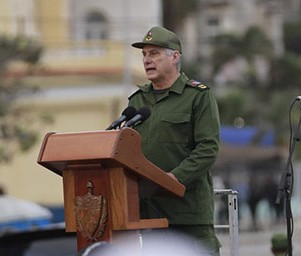
“Like the reeds knotted at the center of the shield, unity is the most powerful weapon of our Revolution,” affirmed Miguel Díaz-Canel, First Secretary of the Central Committee of the Communist Party of Cuba (PCC) and President of the Republic, on Friday, as he began the March of the Fighting People in homage to the 32 compatriots who fell during the U.S. aggression against Venezuela.
As part of Cuba’s tribute to its heroes, who fell in the early morning of January 3 in direct confrontations with the attackers or due to the bombing of facilities, the march proceeded from the José Martí anti-imperialist grandstand to the Avenue of the Presidents, with the participation of some 500,000 residents of the capital.
Below, we publish the Cuban President’s speech in its entirety:
Family members, comrades-in-arms, and friends of our combatants, compatriots.
On January 3, 2026, in the darkest hour of the early morning, while its noble people slept, Venezuela was attacked on the orders of US President Donald Trump.
Once again, this time in his homeland, Bolívar’s visionary statement was confirmed: “The United States seems destined by Providence to plague America with misery in the name of liberty.” And Ernesto “Che” Guevara’s warning that “imperialism cannot be trusted even a little bit, not at all.”
Bombs and kidnapping were the United States’ response to the Venezuelan president’s statements, who, hours earlier, had expressed his willingness to discuss any issue. It was a difficult early morning for Cuba, as the first news of the treacherous attack against several states of the sister nation, where hundreds of Cuban collaborators are serving, was received.
Agonizing hours passed, filled with indignation and helplessness, after learning that President Nicolás Maduro Moros and his wife, Cilia Flores, had been kidnapped.
Those of us who consider these brave members of the personal security detail part of our family, and who know their unwavering commitment to defending the lives under their protection, knew, even before the news was confirmed, that they would behave like titans, even in their final battle.
“Only over my dead body will they be able to take or kill the president,” declared First Colonel Humberto Alfonso Roca, head of the small group of Cubans who that morning protected the presidential couple at the cost of their own lives.
They, along with the members of the Revolutionary Armed Forces who also fell under the attackers’ bombardment, embody in their admirable service records all the qualities that distinguish heroes, Cuban heroes.
Thus they transcended national borders to become paradigms in the history of struggles for a united America, a dream still realized by Bolívar and Martí.
The sacred remains of our 32 compatriots arrived back in our homeland yesterday, like eternal soldiers of the integration we owe ourselves.
They are the only possible measure of the courage and character of Cubans loyal to a brotherhood forged since the time of Bolívar, extolled by Martí, and already legendary for the close relationship between Fidel and Chávez, leaders of regional integration who in just a few years brought literacy, restored sight, and delivered medical and educational services to millions of Venezuelans and other inhabitants of our Latin America and the Caribbean.
The instigators of the attack and kidnapping of President Maduro and his wife, resorting to the most abominable methods of fascism, wove a thick cloud of lies and defamation against the Bolivarian leaders before cowardly launching their attack on Venezuela, openly disregarding the limits of international law, which until that day guaranteed a minimum of civilized coexistence among nations.
The current US administration has opened the door to an era of barbarism, plunder, and neo-fascism, regardless of the potential for more wars, destruction, and death.
The news of the aggression hit us hard. For more than 25 years, Cuba and Venezuela have shared ideals and endeavors in favor of a better world, committed to achieving justice through socialism, but each country with its own methods and different realities.
Only those who don’t understand the value of friendship, solidarity, and the cooperation forged between peoples can mistake the relationship between Cubans and Venezuelans for a mere business transaction or a vulgar exchange of goods and services. Above all, Cubans and Venezuelans are sisters and brothers.
Giving one’s own blood and even one’s life for a brother nation might surprise some, but not Cubans.
U.S. officials have acknowledged with astonishment, but also with undisguised admiration, the bravery of this handful of men who, despite a marked disadvantage in numbers and firepower, offered fierce resistance to the hijackers, even wounding several of their own personnel and, as far as we know today, partially disabling one of their vehicles.
However much they insist on praising their soldiers camouflaged with helmets and bulletproof vests, night-vision goggles, and overprotected by planes, helicopters, and helicopters amidst intentional blackouts, the Delta terrorists’ assault was not the walk in the park they’ve portrayed to the world.
One day we will know the whole truth, but even Trump hasn’t been able to deny that several attackers were wounded. Our brave fighters, armed with conventional weapons and with nothing but their morale and loyalty to the mission they were fulfilling, fought to the death and struck their adversaries.
None of them were superhuman. They were honorable soldiers, trained in the ethical school of Fidel and Raúl, in patriotism, anti-imperialism, and unity. Heirs to the ideals of Antonio Maceo, who immortalized Baraguá with his manly refusal to negotiate a peace without freedom.
And of Juan Almeida, who shouted under a hail of bullets, in the middle of a remote sugarcane field, “No one here surrenders.”
The current emperor of the White House and his infamous Secretary of State haven’t stopped threatening us. “I don’t think much more pressure can be exerted,” Trump has said, in a tacit acknowledgment of the extreme levels to which the blockade imposed on Cuba for more than six decades has escalated. “Entering and destroying the place” is what, according to their imperial conception, is left for them to subdue us.
The grotesque phrase that has awakened profound indignation in the Cuban people can only be interpreted as an incitement to massacre, without any regard for the consequences, from a country that has never promoted hatred toward another. Cuban patriotism was expressed very early on by Martí in Abdala.
“The motherly love for the homeland is not the ridiculous love for the land and the grass beneath our feet. It is the invincible hatred of those who oppress it. It is the eternal resentment toward those who attack it.”
Cuba is not anti-imperialist by the book. Imperialism made us anti-imperialist. But not only Cuba, the world will become increasingly anti-imperialist after this assault on all international norms. This offense against intelligence and human dignity, this act of criminal arrogance with which a sovereign state is attacked by an empire that despises the rest of the nations.
All the victories of the Cuban people are linked to the strength of their unity. Every time the patriotic forces were divided, we lost. Every time they united, we triumphed.
The enemies of the nation know this well, and that is why they are betting on breaking that unity. Their current threats remind us of those of almost every US administration controlled by the so-called warmongers.
Do the current warmongers know that the revolutionary defense strategy, known as the people’s war, was born in response to the worst threats from other warmongers? Do they know how much their warmongering predecessors invested in that so-called era, after failing in all their attempts to destroy an indestructible leadership?
In recent days, young Cubans have been sharing on social media the anecdote about the barracuda experienced and recounted by Fidel. He tells how, while swimming underwater, he saw a barracuda coming toward him, and his first reaction was to retreat. But he quickly reconsidered and lunged toward the aggressive fish, which disappeared from sight.
“This is how we must act against an empire that is a barracuda, a piranha, a shark, and vermin.”
But I insist and reiterate one fact: It was young Cubans who made that video go viral on social media. Here we are, not one, but thousands of continuers of the work of Fidel, Raúl, and their heroic generation.
They would have to kidnap millions or wipe us off the map, and even then, the ghost of this small archipelago, which they had to pulverize because they couldn’t subdue it, would haunt them forever. No, imperialists, we are not afraid of you at all. And, as Fidel said, we don’t like being threatened. You will not intimidate us.
Like the reeds knotted in the center of the shield, unity is the most powerful weapon of our Revolution. Dear compatriots, several comrades who were on the front line are now back home with their bodies covered in shrapnel like medals of valor.
One of them, Lieutenant Colonel Jorge Márquez, was the one who hit a helicopter, and who knows how many of its crew members. He did so by firing his anti-aircraft gun despite being wounded and bleeding profusely from his leg.
Courage is the word everyone uses to describe the confrontation with the aggressors, and they mention First Colonel Lázaro Evangelio Rodríguez Rodríguez, who led the attempt to rescue the first fallen until one of the enemy drones hit him. “They wounded me, Long live Cuba!” were his last words.
When it seems that the world is burying even its last utopia, that money and technology are above all human dreams, that humanity is weary, at that very moment 32 brave Cubans offer their lives and rise to the occasion in a fierce battle until the last bullet, until their last breath.
There are no enemies capable of intimidating such heroism. The promising youth of most of those who fell in combat brings to mind Martí’s verses to the eight medical students murdered by the Spanish metropolis in 1871.
“Beloved corpses, you who once dreamed of my homeland.” All that we know of their personal stories, of the love and bravery that distinguished their actions, of the commitment, dedication, and selflessness with which they went into battle, makes the pain all the more poignant. A pain that does not diminish, but rather further exalts the patriotism and generosity of Cubans.
Today, there are 32 new faces, 32 new stories, the unsurpassed Martí definition that “Homeland is humanity.” They not only defended the sovereignty of Venezuela, President Nicolás Maduro, and his wife Cilia Flores. They defended human dignity, peace, the honor of Cuba and of our America.
They were the sword and shield of our peoples against the advance of fascism. And they will forever be a symbol, proof that no nation is small when its dignity is so unwavering. Thank you for your courage and example, comrades.
Today we embrace their loved ones: mothers, fathers, wives, children, grandchildren, siblings, grandparents, their soulmates, and their friends. “Pain is not shared,” the Commander-in-Chief said at the funeral farewell for the martyrs of Barbados. “Pain multiplies, and when a spirited and virile people weep, injustice trembles.”
As Silvio sang then, “Let injustice tremble when Fidel’s valiant people weep.” Cuba does not threaten or defy. Cuba is a land of peace. It was here in Havana, at the initiative of Cuba, that 12 years ago, during the second CELAC summit, Latin America and the Caribbean were proclaimed a zone of peace.
A conquest brutally lacerated by the fascist attack in Venezuela. That commitment to peace in no way diminished our readiness to fight in defense of sovereignty and territorial integrity.
If we were to be attacked, we would fight with the same ferocity bequeathed to us by several generations of brave Cuban combatants, from the War of Independence in the 19th century, through the Sierra Maestra, the underground resistance, and Africa in the 20th century, to Caracas in this 21st century.
There is no possibility of surrender or capitulation, nor of any kind of agreement based on coercion or intimidation. Cuba must not make any political concessions, and that will never be on the table for negotiations between Cuba and the United States. It is important that they understand this.
We will always be open to dialogue and improving relations between the two countries, but on equal terms and based on mutual respect.
History will be no different now. To the empire that threatens us, we say: Cuba, we are millions. We are a people prepared to fight if attacked, with the same unity and ferocity as the 32 Cubans who fell on January 3rd.
Compatriots, let us march united, and before the memory of their heroic example, let us swear…
¡Patria o muerte! ¡Venceremos!
¡Hasta la victoria siempre!
Homeland or death! We will win!
Ever onward to victory!
IMAGE CREDIT: Equipo ACN | Fotos: Luis Jiménez Echevarría
[ SOURCE: AGENCIA CUBANA DE NOTICIAS ]