By Frank Martínez Rivero, Enrique González Díaz (Enro)
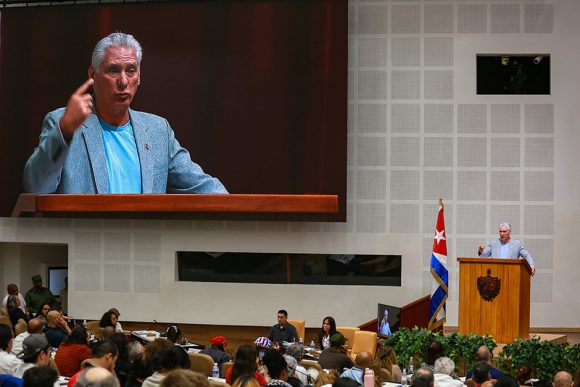
In a gathering charged with symbolism and emotion, the First Secretary of the Communist Party of Cuba and President of the Republic, Miguel Díaz-Canel Bermúdez, presided over a day of brotherhood this Friday at the Palace of Conventions in Havana with members of the *Nuestra América* Convoy. The initiative — which defies the energy blockade imposed by the United States government — is preparing to converge in the Cuban capital on March 21st in a mobilization described by its organizers as an act of humanitarian defiance against the economic siege.
The meeting became a space for both denunciation and hope. According to the organizers, the convoy not only transports humanitarian aid intended to alleviate growing shortages on the island, but also stands as a symbol of outright rejection of what they term Washington’s “policy of suffocation.”
The meeting takes place against a backdrop of tightening sanctions, during which activists recalled recent statements by U.S. President Donald Trump, who—on February 16th, aboard Air Force One—boasted about the critical situation on the island caused by the blockade: “No oil. No money. Nothing.” However, a poll published by the firm YouGov reveals that 46 percent of U.S. citizens do not support the current oil blockade imposed by their government on Cuba.
The *Nuestra América* Convoy thus positions itself as a bridge of both symbolic and material resistance. Despite logistical restrictions and border controls, participants insisted that the March 21st mobilization would demonstrate that “the Cuban people are not alone,” in an effort to counter narratives of total collapse and exert moral pressure on the international community to condemn the intensification of the blockade.
Voices from Around the World: A Cry Against the Blockade and for Cuban Dignity
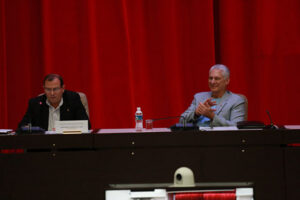
Fernando González Llort, President of the Cuban Institute of Friendship with the Peoples (ICAP), opened the proceedings by highlighting the historical magnitude of the moment. “The people of *Nuestra América* [Our America] are making history—for Cuba and for a world that is rising up to defend humanist values, decency, and morality,” he declared.
González Llort emphasized that the convoy serves to build bridges of brotherhood, denounce the blockade, and reaffirm that united peoples are invincible. He reported that they are accompanied by approximately 650 visitors from 33 countries, representing over 140 social, political, cultural, and solidarity organizations—including parliamentarians, judges, ambassadors, youth, artists, intellectuals, and activists from practically every continent.
“This is the true scope of internationalist solidarity. It is the true scope of what Cuba’s dignity represents to the world,” affirmed the head of ICAP, who offered his thanks on behalf of the Cuban people: “This is not a merely ceremonial expression of gratitude; it is the sincere gratitude of a people under blockade — harassed and illegally sanctioned — yet a people who know they are not alone.” Referring to the current context, he warned that “an empire threatens us with the use of force, almost openly. They want to see us on the ground — sold out, crushed.” Yet he declared: “They will not succeed. The dignity, the power of ideas, and the high moral fiber of this people can stand against the most powerful weaponry.”
Fernando Pereira, President of Uruguay’s Broad Front (*Frente Amplio*), offered a regional perspective on the current situation. “We neither want to nor can we overlook what the world is currently experiencing. What has transpired in just a few short months serves as an example of the prosecution of someone who attempted to stage a coup in Brazil, interfere in the election in Argentina, and interfere in the election in Honduras—someone who kidnapped the president of Venezuela and bombed Iran,” he enumerated.
Pereira emphasized that “any humanist—regardless of their political views—must reject U.S. interference in Cuba. The struggle for peace is a struggle that the Uruguayan people can never abandon,” he asserted, recalling the historical ties shared with the island—from the founders of the Broad Front to the more than 100,000 Uruguayans who received treatment at the José Martí Eye Hospital, and the exiles who found their first refuge in Cuba during the dictatorship. “Cuba is not alone, and it will not be alone,” he declared, urging his audience not to renounce internationalism: “For the Left, to renounce internationalism would be to renounce its very soul.”
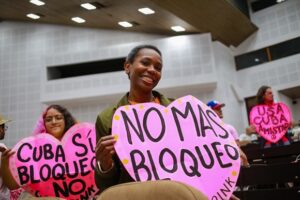
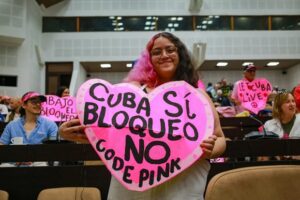
Medea Benjamin, co-founder of Code Pink, brought a voice from the United States to the plenary session. “We come with heavy hearts, in the sense that we are living in a country where our president claims he can seize the nation of Cuba and do whatever he pleases with it. And for us, that is deeply painful,” she confessed. Nevertheless, she clarified that this stance “does not represent the people of the United States,” who wish to live in cooperation, friendship, and love with Cuba. She announced that they would take the stories from these days back to their members of Congress and friends, in an effort to convince those who govern their country that they must put an end to this cruel and inhumane policy and lift the blockade once and for all.
From Italy, Michele Curto, President of the Agency for Economic and Cultural Exchange with Cuba (AIEC), underscored the importance of internationalism and the need for Europe to adopt a firm stance. “As Europeans, we must be clear about the relationship we share with Cuba,” he asserted, highlighting the need to be “a little bit entrepreneurial, a little bit scientific, and highly creative—for that is the approach we will champion within the European Union.”
Ada Galano, President of the National Coordinating Committee of Cubans Residing in Italy, represented the Cuban diaspora with a speech charged with emotion. “We Cubans residing abroad are not here because we were forced to leave. We are here—as the Master once said—fulfilling the portion of duty that falls to us. We are children of this homeland; we owe ourselves to this soil and to this nation,” she declared. Galano expressed her gratitude to the solidarity organizations and emphasized that Cubans living abroad feel every hardship faced by their people—specifically, “every medicine missing from a hospital, a pharmacy, or a healthcare facility.” In a moment of profound emotion, she invoked the principle of “Come and Reap”—affirming that, today, the Cuban people are reaping the harvest of solidarity they have sown throughout the world.
Gerardo Pisarello—representing the organization *Sumar* and serving as Secretary of the Bureau of the Spanish Congress of Deputies—delivered a speech of significant political weight. “We are here today to give back to millions of Cuban men and women what they taught us—every time they sent a doctor, sent teachers, or sent their vaccines to the most remote corners of the entire world,” he stated.
“Not only will we continue—until our very last breath—sending all our aid, food, medicine, and solar panels to Cuba; but also, if Cuba is attacked, we will fight, and we will not allow them to cast us into the shadows to sleep like traitors,” he declared, linking the aggressions against Cuba,
Venezuela, Palestine, and the American people themselves as expressions of a voracious capitalism. “We do not renounce the revolution, and we do not renounce the dream of a different world,” he concluded.
Marcos Castillo, coordinator for Global Exchange, reaffirmed solidarity from the North. He reported that the U.S. delegation has undertaken fundraising and material collection efforts that have enabled the delivery of thousands of dollars’ worth of medicines to various centers. “Here, in this space, one feels and perceives what is missing in the United States—and what seems to be dying there. They may attempt to impose an economic blockade, but love has arrived in Cuba,” he asserted.
In defense of Cuban sovereignty, he remarked: “When have you ever seen Cuba attempt to bomb another country? When have you ever seen Cuba attempt to invade one? How, then, has it ‘invaded’ the world? With doctors, with medicines, with love, and with solidarity. No one can tell Cuba how to live—no one but the Cuban people themselves.”
María Fernanda Carrascal, a member of the Colombian Congress, offered a moving testimony. “Here, we bring not only material humanitarian aid; we also bring many willing hearts—we bring an embrace,” she said.
She recalled Cuba’s role as a guarantor in the Colombian peace talks and expressed gratitude for the training of Colombian doctors on the island. She warned against U.S. interference in Colombian politics and the threat of military intervention, and she called for international support for the process of change currently underway in her country.
Daniel Núñez, a Chilean senator, recalled the darkest moments in his nation’s history: “Many Chilean men and women are alive today—they survived the horrors of the dictatorship—thanks to the support they received from the Cuban people.” He recounted how, during the Special Period, Cuban doctors saved lives in Chile, and he highlighted that following the 2010 earthquake, Cuba dispatched a medical brigade that worked there for over two months. “Solidarity with Cuba at this moment is an ethical duty for Chilean society,” he affirmed, characterizing the blockade as a form of collective punishment against the Cuban people.
Claudia de la Cruz, Executive Director of IFCO/Pastors for Peace, concluded the segment of international speakers with a speech of profound political significance. “We want you to know—from the United States—that we are very clear about who the enemies are. And the enemies are the very same ones who seek to stifle the dream: the collective construction of this socialist project called Cuba,” he affirmed.
He noted that the task is to bring the reality and voices of the Cuban people to the forefront in order to strengthen an anti-imperialist struggle—a historical responsibility of the American people. “Cuba will triumph. And we—men and women alike—will stand with you until victory,” he declared.
At the conclusion of the gathering, the Cuban president expressed his gratitude for the support of international organizations; he also explained how democracy functions in Cuba and denounced the falsehoods being fabricated against the Island.
“Here, we are speaking about the present and the future. Here, we are speaking about the present and the future of the world. It is the world we wish to transform,” the president stated.
Díaz-Canel acknowledged those present one by one: the Italian Agency for Cultural and Economic Exchange with Cuba, Members of the European Parliament, national deputies, senators, and political forces such as the Uruguayan Popular Party, the French Communist Party, the Communist Party of Brazil, the Popular Socialist Party, and social movements from the United States.
“Thank you for that intent and for your love for Cuba. This embrace you offer us—this joy—serves as a ratification from a million people,” he expressed.
The president reviewed the nation’s history, from the early days of the Revolution and the struggle against Batista to the 66 years of the blockade. He then spoke of the people of today: “That Revolution, together with the people of today—a people possessed of creative resistance.”
He then posed a question: How many nations in the world could withstand a blockade like the one Cuba endures?
He answered his own question: “Could they still be resisting? Could they still be dreaming? Could they still be planning? We have not lost our programs; we have not lost our dreams. We continue to seek solutions; we are not sitting idly by.” Díaz-Canel also spoke of the aggressions Cuba has endured: terrorist attacks, manipulation campaigns, and the U.S. military presence in the region. He recalled the case of the Cuban anti-terrorist fighters who were unjustly imprisoned in the United States and returned thanks to an international campaign.
And, visibly moved, he added: “You are building the bridges that the empire cannot destroy.”
The President insisted that international solidarity has served as a shield. “Every flag the enemy sees here is a battle flag. Every raised hand is a bulwark against the colonial mindset that seeks to entrench a generalized war,” he said.
Díaz-Canel issued a warning regarding the current era: “If we address the world today, we must state that what we face is a fourth-generation war—an unconventional war, a war of disinformation.”
He explained that the objective of this war is “to sever our ties to our historical and cultural roots.”
To isolate Cuba, he argued, is to legitimize the criminal blockade. Yet, he expressed his gratitude to those present: “Here, you stand shoulder to shoulder with this people—for all time. But your merit is even greater, for you have come to stand with us during our most difficult and complex moments.”
The President addressed the falsehoods circulating about Cuba. One such claim is that the Revolutionary Government seized power illegitimately. “Nothing could be further from the truth,” he asserted, “for the Cuban Revolution overthrew a military dictatorship.”
He also dismantled the lie that human rights are not respected in Cuba. “The greatest manifestation of a human rights violation is the criminal blockade,” he declared.
And he issued a challenge: “Ask any Cuban whether the blockade does not exist—whether it does not affect them every single day.”
Díaz-Canel also refuted the claim that Cuba is a terrorist state: “We have, in fact, been victims of terrorism—throughout the entire history of the Revolution.”
The President paid tribute to the valor of Cuba’s combatants. He cited the thwarted infiltration attempt along the coast of Villa Clara, as well as the dignified conduct of the Cuban combatants who fell in Venezuela.
“The leadership of the Revolution acts in unity, and its decisions are made collectively,” he stated. “What we do have here is ethics and morality. And rest assured that we will give our lives, if necessary, to defend our Homeland.”
He concluded with an expression of gratitude: “Infinite thanks for not leaving us alone. We are in difficult times — times, however, of defining moments for saving the nation.”
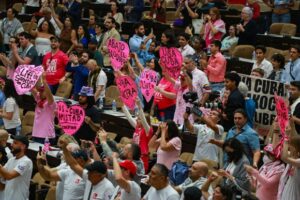
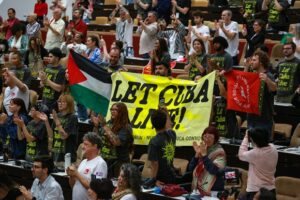
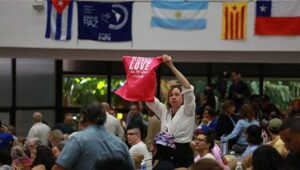
IMAGE CREDIT: Díaz-Canel welcomes the *Nuestra América* Convoy. Photos: Enrique González Díaz (Enro).
[ SOURCE: CUBA DEBATE ]