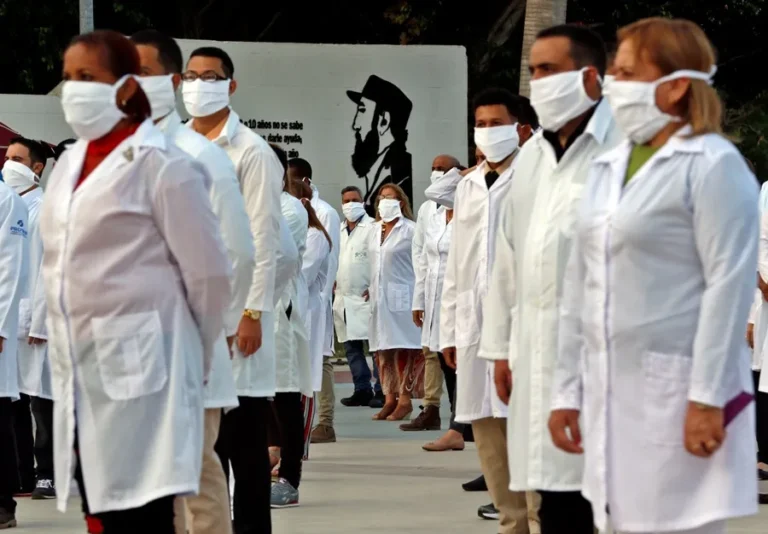
Cuban Foreign Minister Bruno Rodríguez Parrilla denounced this Tuesday, March 24, that the United States government is exerting intense pressure and employing blackmail tactics against countries in Latin America and the Caribbean “to ensure that Cuban Medical Brigades leave every country in the region where they are currently present.”
The head of the Caribbean nation’s Ministry of Foreign Affairs noted that Washington “not only seeks to strike a blow against the humanist and solidarity-based program created by Cuba and Fidel, but also to continue cutting off sources of revenue for our economy.”
Bruno Rodríguez warned that those primarily affected by these maneuvers are the most vulnerable sectors of the region, which for decades have received assistance from Cuban professionals to access basic healthcare services.
Finally, the foreign minister criticized the promises of resources that the U.S. administration offers in exchange for expelling Cuban aid workers. Rodríguez asserted that such financial and material benefits are deceptive, stating, “We know that they will never arrive, nor will they benefit those populations.”
The international Cuban assistance mission began in 1963 with its first deployment to Algeria, driven by the vision of Fidel Castro. At that time—facing the departure of French doctors following Algerian independence—the Cuban leader called upon volunteers to assist a nation suffering from healthcare shortages.
“The majority of doctors in Algeria were French, and many have left the country.” “There are four million more Algerians than Cubans, and colonialism has left them with many diseases; yet, they have only one-third—or even fewer—of the doctors that we have. (…) That is why I told the students that we needed 50 volunteer doctors to go to Algeria,” the leader of the Cuban Revolution stated that year.
Fidel added: “I am certain that there will be no shortage of volunteers. (…) Today we can send only 50, but in 8 or 10 years—who knows how many?—we will be helping our brothers (…) because the Revolution has the right to reap the fruits it has sown.”
Since that mission, more than 600,000 Cuban professionals have provided services in 165 nations. The creation of the Comprehensive Health Program in 1998—following the passage of Hurricanes Mitch and Georges through Central America—the formation of the Henry Reeve Contingent, and Operation Miracle all underscore a track record of service in rural areas, low-income communities, and regions affected by natural disasters and epidemics.
However, smear campaigns promoted from Washington have led to the termination of agreements in Central America and the Caribbean. In Honduras, following the decision by Nasry Asfura’s government to end the collaboration, Cuba’s Ministry of Public Health reported the interruption of work that, since 2024, had amounted to more than 30 million medical consultations and nearly 900,000 surgical interventions within that territory.
Similar situations unfolded in Guatemala—where the gradual withdrawal of specialists, who had been present since 1998, was recently announced—and in Jamaica, whose government rescinded its cooperation agreement on March 4th. The conclusion of the mission in Jamaica marks the end of a chapter that saw over 8 million medical consultations and 74,302 surgeries performed, in addition to the 25,000 patients who regained their sight through Operation Miracle.
IMAGE CREDIT: Discrediting campaigns promoted from Washington have led to the termination of agreements in Central America and the Caribbean. Photo: EFE
[ SOURCE: teleSUR ]