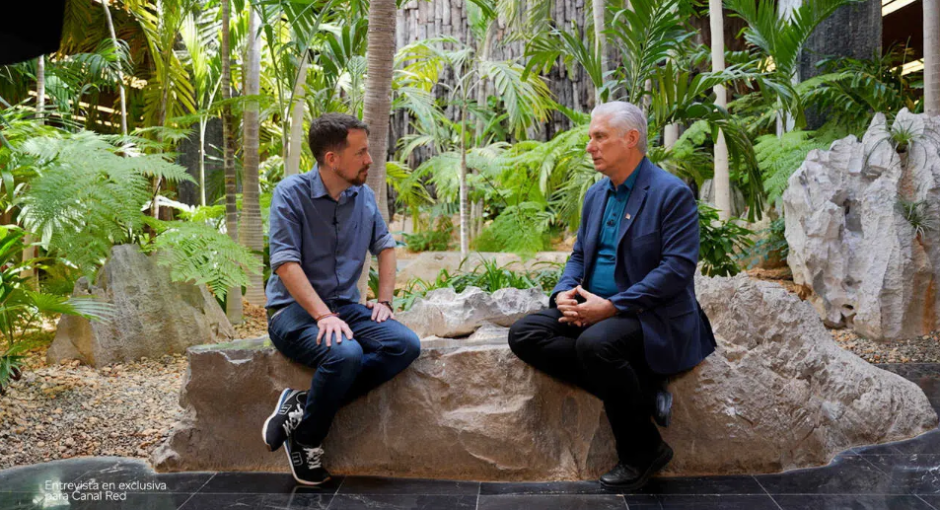
Interview conducted by Spanish academic, politician, and communicator Pablo Iglesias with Cuban President Miguel Díaz-Canel Bermúdez
Miguel Díaz-Canel Bermúdez, First Secretary of the Central Committee of the Communist Party of Cuba and President of the Republic, recently gave an interview to Spanish political scientist Pablo Iglesias Turrión on the digital platform Canal Red, which was broadcast on the Mesa Redonda program.
The dialogue addressed issues related to the current situation in Cuba, the impact of the economic, commercial, and financial blockade imposed by the United States government, and recent acts of international solidarity.
The conversation offered insight into the internal and external challenges facing the Caribbean nation, as well as the government’s stance regarding the humanitarian flotilla announced in recent days.
0-0-0-0-0-0-0-0-0-0-0-0-0-0-0-0-0-0-0-0-0-0-0-0-0-0-0-0-0-0-0-0-0-0-0
Pablo Iglesias: The fascists who are in power in the United States today learned very well from their Nazi role models the Goebbelsian principle that a lie repeated a thousand times can become the truth.
Miguel Díaz-Canel: We are very grateful for this opportunity you are giving us to speak to the European public, to the Spanish public, because these truths are constantly being undermined by media manipulation, by this narrative of lies and slander.
THE PALACE OF THE REVOLUTION
Díaz-Canel: Pablo, we are entering the Palace of the Revolution, a place where the footsteps of Commander-in-Chief Fidel Castro Ruz can still be felt today. This was his workspace, the place where he received delegations, held important meetings, and we always keep him as a point of reference in daily life, especially in these difficult times.
Pablo Iglesias: I wanted you to explain this to me because there are some plants and rocks here that aren’t merely decorative.
Miguel Díaz-Canel: This is a very subtle observation of yours. Fidel had a comrade-in-arms in the Sierra Maestra, Celia Sánchez, one of the heroines of the revolution who was his collaborator for many years. And Celia had a particular sensitivity to Cuban culture, to Cuban identity, and she wanted Fidel and Raúl to have a reference point from the Sierra Maestra in this space. Therefore, these stones were brought from the Sierra Maestra, and this is the vegetation of the Sierra Maestra, the mountains where the rebel army launched its offensive against Batista’s tyranny. Everyone who comes here is amazed by the vegetation; it’s a very unique palace, a palace with its own vegetation and rocks, and I think it demonstrates a bit of Cuban identity.
ANOTHER SPECIAL PERIOD
Pablo Iglesias: Miguel, Cuba is in the spotlight because of a situation that everyone tells me is terrible. I was here for the first time in ’94, right in the middle of the Special Period, and people tell me, “Now we could say we’re in another Special Period.” That observation is clear.
Miguel Díaz-Canel: Look, Pablo, I think we’ve always been in a complex situation. For example, I’m part of a generation that was born in the early years of the revolution. I was born in 1960. I turned one the day after the victory at Playa Girón, and 80 percent of the Cuban population was born after the revolution. Therefore, we are generations that were born under the blockade. My children were born with the blockade. The children of our generation, our grandchildren, were also born under the blockade and have been developing their lives until now under the conditions of the blockade. The thing is, the effects of the blockade are also closely related to the times that came before the Special Period.
That experience you have of the 1990s in Cuba—there was a socialist bloc that greatly supported Cuba, and we can never deny that. Then that socialist bloc collapsed. We had to, under the conditions of the Special Period, in the midst of that blockade, create, be creative, move forward, and then came times when the relationship with Venezuela, the Bolivarian Revolution, the support of China, Vietnam, and other countries allowed us to move to a different situation. But there is a point that I would say is a watershed moment, which is the year 2019, in the first stage of the Trump administration.
FIRST STAGE OF THE TRUMP ADMINISTRATION
Miguel Díaz-Canel: At the end of 2019, in the second half of 2019, the Trump administration intensified the blockade. That is, the blockade began to take on a qualitatively different character. It was intensified. Why do we speak of intensification? Because Title III of the Helms-Burton Act, which internationalizes the blockade, was applied for the first time. You see, the blockade is a policy of coercion, of maximum pressure, entirely unilateral, which the United States unilaterally applies to Cuba, but with the Helms-Burton Act, it internationalizes it because it then applies the restrictions and sanctions, the pressure, to other third parties involved in a commercial or financial relationship with Cuba.
It is a law, therefore, this blockade law negates the very precepts of capitalism and imperialism that speak of the free market (in parentheses). It is a completely absurd thing, I would say aberrant and very perverse. Very perverse. First, because they base it on a concept of slander, lies, and double standards. What they criticize you for, they don’t criticize others for. What’s unacceptable to us is acceptable to others. So, at that stage, Chapter 3 of the Helms-Burton Act is applied, but it also includes us on a list of countries that supposedly support terrorism. When you’re put on that list of countries that supposedly support terrorism, all your financial operations are cut off. Most banks stop giving you credit, and financial transactions become very complicated.
So, all of this is expressed in financial and energy persecution. That’s why I say it was a watershed moment, because from then on, the situation began to worsen. Today, the situation we have today is one that has been building up and is being further exacerbated by the executive order, the events in Venezuela, and the current position of the Trump administration. Even then, our main sources of foreign currency financing began to dry up. Exporting became very difficult, tourism was blocked, and travel was prohibited for U.S. citizens and severely restricted for even Cuban citizens residing in the United States. This cut off a significant flow of tourism and sources of income.
Without access to that foreign currency, we began to have problems acquiring the fuel we needed to purchase spare parts and maintain our power system, which consisted of thermoelectric plants that were also obsolete and overused. Shortages of food and medicine began, along with transportation problems and the paralysis of a portion of our economy.
Pablo Iglesias: And all of this has very significant implications… I want to ask about this because, of course, many people say, well,
BLOCKADE AGAINST CUBA; WE ARE PART OF THE SAME PEOPLE
Pablo Iglesias: These are measures against the Cuban government, against a social government, but what does this mean for the people? Economic warfare, a blockade, and now practically no fuel, no oil. What does this mean for the lives of Cuban men and women, that the lack of oil is not arriving?
Miguel Díaz-Canel: There are several things you’re pointing out that are very important to clarify. First, in this attempt to say that it’s to affect the government and not the people, they’re trying to divide the government and the people. I am part of the people. I wasn’t born into an elite. I’m not from an elite family. I was born into a working-class family. My mother was a rural elementary school teacher, my father worked in a brewery, and that’s how the leaders are. We are part of the people. Why this attempt to separate the people from the state or the government in the leadership, to separate it from the people? We are part of the same people.
Our children, our families live together, like everyone else. One has that feeling of belonging to the people, one also suffers the problems of our people because of the responsibilities we have representing those people. So there is a primary framework there because remember that all this economic coercion and all this maximum pressure policy also has an ideological component.
So, what’s being defended is the hegemony of a power that wants to exercise it in an extreme way against a small island, but it also has a media component of media manipulation, and there are all those codes of media matrix that they try to construct. In other words, it affects everyone. How does it affect the government? It hurts us deeply that our dreams, programs, and projects for the benefit of the people can’t move forward as we want. It bothers us to see the people suffering.
CREATIVE RESISTANCE
Pablo Iglesias: But so that people understand, for example, there are students who can’t go to university, there are hospitals that… we haven’t reached those extremes yet.
Miguel Díaz-Canel: I always say that there’s a concept of creative resistance, which isn’t just resisting the blows of the blockade, but growing and trying to move forward in the midst of that situation. So, we’re constantly reorganizing, but there are indeed impacts. For example, impacts on daily life, like having to sleep without electricity. It’s a hot country, the children sleep uncomfortably, and they have to get up early in the morning to go to school. We’ve taken organizational measures so everyone can get to school. When you have the problem of distance these days, with no transportation, you start to run into another problem: how do you get around? How do you get to work? How do you get to school? How do you get your children to school?
So they start to organize themselves, and in some places we’ve changed the settings. The school setting then shifts to the community setting, the local setting, and it’s reorganized there, but the curriculum continues. Universities have moved from in-person classes for regular courses to a hybrid model, connecting university students with community issues and also taking advantage of the resources available in different institutions, and that’s how their education continues. We have a healthcare system that is capable of facing epidemics, as we were able to do with COVID-19, which we were able to manage.
THE CONSEQUENCES OF THE BLOCKADE ON HEALTH AND EDUCATION
Pablo Iglesias: Many people outside of Cuba don’t know this, but you created your own vaccine.
Miguel Díaz-Canel: We are one of the few countries that created five vaccine candidates. Three of them became vaccines. And I’ll explain why, because it also has a lot to do with this concept of creative resistance. Well, health is a major issue. Today we have more than 120,000 people on a waiting list for surgeries because we’ve had to attend to emergencies because we don’t have electricity in the hospitals, in the operating rooms, because we lack the supplies to perform all the surgeries. But we perform those surgeries, that number of surgeries, under normal conditions, even under a blockade that wasn’t as severe as the one we have now with this energy blockade. Even under these conditions, we maintain infant mortality rates, maternal mortality rates, health indicators, and educational indicators comparable to those of developed countries.
In other words, they are being affected, but we’ve achieved so much in social terms that this deterioration hasn’t yet put us in a position of inferiority compared to other countries, but there are impacts. For example, in those surgeries we’re waiting for, there are more than 11,000 children, and there are children and cancer patients for whom we have difficulty guaranteeing the medications that Cuba provides free of charge. Education is affected. Many of our educational platforms rely on connectivity, on digital transformation platforms, and on artificial intelligence processes.
All of this is affected because when there’s no electricity, the cell towers for connectivity don’t work, there are transportation systems, and there’s the problem of supplying water to the population. When there’s a blackout, the water sources also stop working. Most of them run on electricity. So, you see, you already have the burden of transportation, you have the burden of healthcare, you have the burden of education, you have the burden of food, and now you’re lacking water. How many problems are converging at once? And I say, why?
It’s because the state lacks the capacity to provide our services. It’s not the state itself, it’s the blockade that prevents the state and the government—which is the people—from doing their job. I believe that many of the things we’ve set out to do, many of the ways we’re resisting and organizing, are primarily related to the people, not just to government management. This government management cannot be separated from the people, who possess a capacity for self-organization, creativity, resilience, and resilience. Let me give you an example. Right now, we’re lacking liquefied gas. Liquefied gas is one form of coercion, because the other form, electricity, is also difficult for us. People have created solutions in their homes; one person builds a charcoal oven, another a stove. They’ve developed highly efficient wood-burning stoves. Neighbors at the community level are able to create communal kitchens to cook for several households simultaneously.
Many families have been able to acquire photovoltaic panels or systems for their homes, right? And to be independent of the national power grid, but they don’t keep the solution just for their own homes. They share it because there’s tremendous community solidarity. I have panels at home and I give my neighbors an extension cord, and others then share it so people can charge their scooters, phones, or tablets. There are even homes that also make it available to the government and local authorities to set up what we call “viewing points.” It’s a place with audio equipment and a television, so if there’s a power outage, people still have a place to get information, watch the news, or see the television programming.
The concept of electric mobility is also part of our energy initiatives. We’ve also turned to electric mobility to become self-sufficient. So, for example, here we’re assembling a type of vehicle—many electric motorcycles and tricycles. Well, the electric tricycle we assembled came with a design. Now there are a multitude of designs because people are adapting the electric tricycle, so we have electric tricycles for transporting passengers.
In the cities, we have electric tricycles that have been converted into vans to transport goods. We have electric tricycles that people have adapted with a bit more comfort, for example, to help patients who need hemodialysis, who have to travel regularly to receive such a complex service. They’ve even adapted tricycles for funeral services, so they don’t have to rely on hearses. They’ve made electric tricycles with amenities, with televisions, screens, to also bring cultural and informational activities to the population. The way we’ve organized the school year in general education and the school year in higher education under these conditions is also innovative, I would say it’s creative. The people are suffering, there are limitations, there are shortages, but that Cuban spirit of overcoming adversity, the solidarity, the joy, is not lost.
Pablo Iglesias: I’m telling you, without that capacity, how long does Cuba need to achieve energy sovereignty in the sense of not depending on oil? Because I understand you’ve stepped on the gas; this transition, this strategic collaboration with China to support solar energy, was planned for a long time, but now you have to make it happen.
Miguel Díaz-Canel: I’m going to talk about that, but first, so I don’t leave out an answer to something you asked me when you spoke about vaccines, because that’s where the concept of creative resistance comes in.
SOVEREIGN VACCINE TO FIGHT COVID
MiguelDíaz-Canel: We were in the midst of COVID-19, as I already told you. In the midst of COVID-19, we were already experiencing the first stage of this intensification of the blockade. Furthermore, all the measures adopted at that time by the Trump administration were maintained by the Biden administration. In other words, the parties in power in the United States changed, but the policy toward Cuba did not. When we realized how the issue of vaccines was unfolding globally, we realized that we wouldn’t have the money, nor would we be able to acquire vaccines due to the blockade, so we called upon Cuban scientists.
We said, “It is necessary to have Cuban vaccines to achieve sovereignty in managing the pandemic.” Two months later, the first batch of a vaccine candidate was available. The rest, as we know, is history: five vaccine candidates, three effective vaccines that weren’t just for Cuba; we shared them with another country. This allowed us to control the disease on the day we vaccinated. We were the first in the world to vaccinate children over two years old with our own vaccines, and we achieved very high immunization levels after receiving them. That’s where I ask myself, why is it that the concept of creative resistance not only allows you to resist, but also to develop? You developed vaccines.
There are powerful nations that couldn’t develop vaccines, so you advance, you grow, and you develop. It’s not about resisting with submission; it’s about resisting with creativity. Then, speaking of these same concepts, well, we lacked medical oxygen, and the United States government pressured oxygen companies in the Caribbean and Latin America not to sell us oxygen, so we had to make a tremendous effort. We received help from Russia and other countries to overcome that crisis, and they denied us the sale of ventilators. Young Cuban scientists developed ventilators that are now high-performance, certified, and we can even export them. All of that is innovation, not just resistance.
THE ROAD TO ENERGY INDEPENDENCE
Miguel Díaz-Canel: Well, even back then, we began evaluating how to find a set of solutions to the country’s problems that would make us less dependent on the contributions and aid we could receive from other countries, such as the socialist bloc at one time, and Venezuela, China, and other friendly nations, to further guarantee the country’s economic sovereignty and sustainability. And within these issues, there are two fundamental ones: food production and energy. So, how have we approached the energy issue? Well, with a comprehensive government program to overcome the energy situation and provide energy stability for the country. One component of that system is that we still have to rely for years on baseload power generation from thermoelectric plants. The thermoelectric plants are in very poor condition. Therefore, we are implementing a program to recover the capacity of these plants. So, under these conditions, we have had to allocate funding to recover capacity.
For example, so far this year we have recovered 185 megawatts (MW). There is a full year-long program, but last year we managed to recover over 100 MW of distributed generation capacity—not thermoelectric plants, but island systems with equipment that generates using fuel oil or diesel—which we haven’t been able to use today because we haven’t had diesel or fuel oil. We haven’t received a single drop of fuel in the country for three months. But look, today the peak deficits during nighttime hours are between 1,800 and 1,900 MW. If we had distributed generation available at the peak, we would have 1,000 MW. That peak demand would be 500 MW, and it would only last a few hours at night, covering the entire deficit during the early morning hours.
With this distributed generation and the photovoltaic parks, we could eliminate any deficit during the day as well. So where is the deficit? It’s not due to the inadequacy of the energy program; it’s that we haven’t had the fuel to utilize the capacity we believe we could.
So, on the one hand, there’s the recovery of thermoelectric capacity; on the other hand, there’s the recovery of distributed generation, which had been severely degraded. And a third element is investment in renewable energy sources. They can’t block our sun, they can’t block our air. So last year, thanks to a business project that I can’t explain because they’ll persecute and attack it, we managed to install 1,000 MW of photovoltaic parks across the country in just one year. Therefore, we went from a three percent penetration of electricity generation from renewable energy sources to 10 percent. That is, we grew by 7 percent in just one year amidst intensified blockade conditions. We believe we should be—our calculations show we should reach at least 3,000 MW from renewable energy sources, particularly photovoltaics, since we’re also investing in wind energy. At the same pace as last year, if we can maintain it financially, we can reach that goal in two or three years.
This year, we’re going to prioritize investments in renewable energy sources, specifically photovoltaic parks with energy storage. This storage allows us to contribute to the system’s frequency stability, as frequency instability is what has caused the numerous blackouts we’ve experienced recently. Furthermore, it provides us with nighttime generation capacity based on the energy stored during the day from photovoltaic generation. For example, right now, during the day, we’re generating power with thermoelectric plants that run on Cuban crude.
Cuban crude isn’t very abundant; it’s heavy. However, we adapted the refining system here years ago—the system to adapt it, right? Now we’re moving towards refining. With this crude, requiring very little processing, the Cuban thermoelectric plants operate. Of course, they need more frequent, more systematic maintenance, especially on the boilers, due to the effects of the sulfur and gases emitted by this crude.
But under these conditions, we must understand that if we cannot import, if we cannot receive fuel—although we don’t relinquish that right, as it is a fundamental one for any country, and this right is affected by the energy blockade—we can operate our thermoelectric plants with domestic crude oil.
That’s what we’re generating electricity with today, plus the photovoltaic parks I explained to you. Therefore, for now, we are generating electricity with our crude oil and our solar parks, and while we can’t completely cover the deficit, we are generating our own. No one can take that generation away from us.
So, what have we planned? We are going to increase domestic crude oil production by drilling more wells and introducing technologies that will allow us to improve well extraction. Cuban petroleum scientists already have a refining methodology. As we become less dependent on international crude oil, but also on domestic crude oil, we will be able to process and refine a portion of our domestic crude to use in the rest of the economy, not just for electricity generation. Crude oil extraction also brings natural gas.
We have a power plant, a system called Energás, which also generates electricity using the associated gas from oil production. If oil production increases, oil production increases, and in fact, in January and February we reversed the decline we’ve been experiencing in oil and associated gas production, surpassing last year’s figures and meeting our planned targets.
Therefore, we have a component that allows us to move forward. This includes continuing investments in photovoltaic parks, renewable energy, and wind power. We are developing biodigesters; that is, by treating solid waste, especially in cattle-raising areas, we can implement systems that provide gas for cooking in communities and settlements. These systems, powered by gas generators, can also generate electricity, and we reduce pollution. It’s a completely sustainable approach. We are also introducing technologies to utilize biomass. For example, in the sugar sector, we can convert the electricity generation of sugar mills to biomass during the off-season, with very few modifications, so that they can also generate electricity using biomass. This is also entirely sustainable.
In addition to investments in power generation, we have incorporated electric mobility into this strategy. As we increase our use of electric mobility, we need less fuel for economic operations and transportation. So, we are building capacity through international economic partnerships, as well as with the private sector in the electrical systems assembly and production industry, in addition to other investments we are making in purchasing this equipment. We will soon be purchasing 400 electric vehicles to support the healthcare sector, which will provide stability in all the country’s polyclinics and hospitals. We have also implemented incentive measures for anyone—whether state-owned, private, or cooperative—who introduces renewable energy sources into the country, both for their businesses and for personal use.
We are applying incentives in terms of tariffs. Those who begin generating electricity with a system and supplying it to the national power grid receive a favorable rate, and if they maintain this for years, we eliminate import tariffs on these technologies. Furthermore, we offer a range of tax benefits related to services, profits, and installation for those who promote this. This has created an environment that I would describe as both participatory and supportive. For example, we have the example of a worker from a non-state micro, small, or medium-sized enterprise (MSME) who purchased all the photovoltaic systems needed by the social institutions in a municipality, such as the polyclinics. Therefore, if the power goes out, the polyclinics have energy, the bank has energy—in other words, the main energy services for the population are powered by the same model developed by this non-state entity. So, we have now acquired a group of photovoltaic systems. We are doing the same in all the municipalities across the country.
Now, thanks to solidarity aid, we are receiving a lot of equipment. Institutions from other countries are offering to provide us with all the photovoltaic systems needed by the health system. There are non-state entities that are buying and donating these systems to certain state social institutions. Many state-owned companies are already starting to make investments. Private individuals who have electric mobility equipment, such as tricycles and electric cars, have made them available for public services. So, all of this has created empathy, and I would say a movement that I believe will very soon generate significant power, which we will have to add to the state’s efforts, and we will gradually overcome this crisis. No, it’s not a problem that will be solved overnight; it will take us three years. But I believe it’s a more sustainable path.
That’s why I also say that we must see these challenges as opportunities, which is the concept of a revolutionary: not to give up and to see them as opportunities. We are heading towards a more sustainable path, but we will overcome it gradually, and we will have a stage where we will still experience limitations, as we are now. But, for example, thinking ahead, if we hadn’t invested 1,000 MW in photovoltaic parks last year, what would be happening in Cuba now? We would have almost no capacity to generate power during the day, and the system would be so unstable that we would be experiencing one blackout after another.
DIALOGUE PROCESS WITH THE US
Pablo Iglesias: Miguel, there’s an elephant in the room, and that’s Donald Trump. I have to ask you this question, which I don’t know if you can answer. Are you talking with the United States government?
Miguel Díaz-Canel: Look, there has been a lot of speculation and manipulation, and I’m going to explain the exact content of the information we responsibly provided to the Cuban people and the international community. Look, whenever there have been tense relations like those currently existing between the United States and Cuban governments, individuals and institutions—some governmental, others non-governmental—have emerged, seeking to establish channels for dialogue between the two governments and overcome any antagonism or pitfalls, above all, to avoid confrontation and find solutions. And that’s what’s happening right now. However, any level of conversation or negotiation that leads to an agreement is a long process.
First, a channel for dialogue must be established. Then, common agendas of interest for both sides must be developed, and the parties must demonstrate their intention to move forward and truly commit to the program. Based on the discussion of these agendas, agreements that are beneficial to both sides must be reached, and from there, we can conclude with results. So, in the first part of the information we provided, what did we say? That it was consistent with the policy of the Cuban Revolution. Why? Because this isn’t the first time in the history of the revolution that talks have been attempted.
There were attempts during the Kennedy administration. There were attempts during the Carter, Clinton, and even Reagan administrations, and some progressed further than others, and some failed along the way due to various circumstances. But this current attempt is not unique. Furthermore, the revolution, from its earliest years, has always maintained its willingness to engage in dialogue with the United States government, based on respect and equality, without pressure or preconditions, to find solutions to our differences. In other words, this willingness has been present throughout the entire history of the revolution.
Therefore, what we are proposing now does not contradict the history of the revolution in any way. Even one of the most far-reaching conversations, those between Army General Raúl Castro and President Obama, which resulted in concrete agreements, managed to ease some of the sanctions imposed on Cuba at that time. We are willing to build a civilized relationship between neighbors, regardless of our ideological differences. But we can do this because the United States, in fact, does so with some of those it considers its adversaries; it has relations with Russia, it has relations with China, it has relations with other countries. Why is Cuba the focus? So, why is Cuba the focus? What we are doing is not unprecedented in history; it reflects a historical position of Cuba.
We are not warmongers. We do not offend; we are not going to do anything against the United States; we do not blockade the United States. The blockade is a unilateral situation, a unilateral decision by the United States government. The other thing we have said, because it is the other narrative they have tried to create, is that there are divisions within the leadership of the revolution. There we explained that under the leadership of the army general, who has earned his standing in this country, he is the historical leader of the revolution, even though he has relinquished his responsibilities. But the prestige he holds among the people, his history, his contributions, his historical recognition—no one can deny it. This is similar to what happens in other parts of the world, where there are people who have leadership not because of their positions, but because of their history and experience.
Pablo Iglesias: I’ve been told that you speak with him frequently.
Miguel Díaz-Canel: We speak frequently. I share information with him; he’s keeping abreast of it.
Pablo Iglesias: What are his thoughts on the current situation?
Miguel Díaz-Canel: It’s a complex situation. He is one of those who, along with me and in collaboration with other party, government, and state bodies, has been guiding how we should conduct this dialogue process. If the dialogue process unfolds and he remains very attentive, he values it, and he encourages us when he sees that what we are doing is yielding results, and above all, there is his commitment to the people, to the revolution, to saving the country from aggression. So, under that guidance, under that leadership—a collegial leadership headed by him and me, and shared with the rest—our officials recently held talks with officials from the State Department aimed at discussing our bilateral differences in order to find a solution.
Pablo Iglesias: What do they want? What are they asking for?
Miguel Díaz-Canel: That moment hasn’t arrived yet. We’ve initiated the conversation so that, if there’s a willingness, we can then build an agenda for discussion and debate that could lead to negotiations. That’s why we’re proposing this, and it’s also been encouraged and facilitated by international actors.
Pablo Iglesias: Can you say what they are?
Miguel Díaz-Canel: No, I don’t want to say. We don’t want to jeopardize that. Besides, these things are always done with great discretion, and we’ve approached it with seriousness and great responsibility because it’s a very sensitive process. So, what are the objectives? First, to determine what bilateral differences we can resolve.
Pablo Iglesias: What could that be? I mean, what would we be talking about?
Miguel Díaz-Canel: There are thousands, thousands of issues, economic matters. We can talk about investments, we can talk about how the United States government can participate in the Cuban economy, but there are also migration issues, the fight against drug trafficking, against terrorism, for regional security, environmental issues, scientific collaboration, educational collaboration, cooperation—there are thousands of topics.
Pablo Iglesias: And what would be unacceptable to Cuba?
Miguel Díaz-Canel: For Cuba, first, that they condition us to adopt a certain position in order to talk. That they respect our sovereignty, our independence, and our political system as we would respect them. Those things are not up for discussion. Those things are not up for discussion. That we work with a criterion of reciprocity and adherence to international law.
So, let’s look for those bilateral differences where we can find solutions, let’s have the will on both sides to move forward in this process, let’s be able to find areas of cooperation that allow us to confront the threats and achieve peace and security for both nations and also for the region, because we are part of an agreement reached in the region at a CELAC conference, held in Havana, where a proclamation of peace for Latin America and the Caribbean was agreed upon.
And on the other hand, our conviction is not to respond to manipulation because this is a serious process that must be conducted with great responsibility and sensitivity, because it is a process that affects bilateral relations. Therefore, we must create spaces for understanding that allow us to move forward with solutions and that move us away from confrontation, and all of this must be done with a sense of respect, equality, equity, and respect for things that are fundamental, things that should not be included, and should not be included for anyone, in a discussion questioning the political system of imposition or the loss of sovereignty and independence.
SILVIO RODRÍGUEZ AND THE SYMBOLISM OF THE AKM
Pablo Iglesias: Of course, this is the ideal scenario, the one Cuba wants: a scenario of dialogue with respect for sovereignty. But we’ve seen that Trump uses military threats and sometimes carries them out. I understand that this is the most complicated scenario. There’s an image that’s gone viral, Silvio Rodríguez, saying, “If they come in, give me my AKM.”
Miguel Díaz-Canel: That’s it, that’s an expression that’s even symbolic. Silvio is a symbol of the conviction of the majority of the Cuban people. In other words, we don’t want war, we want dialogue, we want to reach that point of agreement, that space which you would say would be ideal.
But if that agreement doesn’t materialize, we are prepared. And I say this with the deep conviction that I share with my family: that we would give our lives for the revolution. Because there’s a history of more than 150 years of struggle, because this country has a lot of experience. When was it ever humiliated? When was Cuba colonized, when was it a neocolony, when Cuban governments were subservient to the United States government, when almost all our resources were plundered and dominated by American companies, and all the miseries and evils that the revolution eliminated in this country? And now we’re talking about difficult times, but even in these difficult times in Cuba, people have more things and more rights guaranteed than at any other time in history. And that won’t be lost, and the people are very aware of it. And that’s why one of the first things we, as revolutionaries, always do is prepare for the worst-case scenario. If you can overcome the worst-case scenario, you can overcome any scenario.
Right now in Cuba, a plan is being developed to enhance the preparedness for the defense of the entire population. Our concept of a people’s war, which is not an offensive concept, is a concept of defending the sovereignty and independence of the country, but with popular participation. And every Cuban knows what role, what mission they have to play in the defense, and the majority of our people are prepared to face that, right? That’s what we want to achieve, because we have never wanted to see the American people as an enemy. We even separate our view of the American people from that of the American government.
But the American government could build a neighborly relationship with Cuba that is entirely decent, based on cooperation that benefits both sides. We are a small island, but in the concept of socio-economic development of the revolution, we try to provide for everyone. Therefore, this is a market of 11 million people for the United States, a nearby market. We sometimes have to import rice from Asia. We could have the rice right next to the United States. We could have oil and fuel very close by, just 90 miles away, but the United States could also benefit from Cuban scientific advancements. We have crucial vaccines against cancer, and medications effective against other diseases.
Whenever I speak with visiting American delegations, I try to explain, somewhat symbolically, how the possibility of both our peoples enjoying a civilized relationship is being undermined. This stems from a personal experience: every year in Cuba, the Havana Jazz Festival takes place. On the festival’s final night, an orchestra of Cuban and American musicians performs. You’re there, and you leave with a surge of satisfaction, thinking, “How can the talent of two countries provide that level of satisfaction that our people could enjoy?” But even cultural exchange is hindered by the embargo. Just look at how far the embargo reaches.
PROBLEMS FOR SPANISH INVESTMENT IN CUBA
Miguel Díaz-Canel: And I’ll give you an example that affects Europeans, and Spaniards in particular. We have several Spanish companies with investments in Cuba. These businesspeople, who are committed to Cuba and respect it, have endured all kinds of pressure. Many face limitations on entering the United States, or many face restrictions as part of the U.S. embargo.
But, for example, in these recent pressures on tourism to Cuba by the United States, there’s a visa called the ESTA visa, which allows Europeans to enter the United States with certain ease. Well, if a European comes to Cuba, the U.S. government revokes their ESTA visa. They don’t do that to anyone else in the world. Why does it have to be Cuba? That’s what someone else was asking. Look, we’re not a threat to anyone, for the reasons I explained.
Furthermore, this nation has a strong sense of solidarity and hospitality; they welcome everyone who comes with open arms. You visit Cuba yourself, and if you go into any neighborhood, you’ll immediately find someone who offers you something, even their home, who shares with you. It’s a decent people, a peaceful people. Therefore, no one believes that Cuba is a threat, as some claim, an unusual one for the United States. So, that can’t be the reason. We don’t hinder the lives of Americans in any way. The only thing that could affect us is that the United States might view us with such anger. First, there’s their arrogant, hegemonic, and domineering mindset, and second, the fear of Cuba’s example, because Cuba has a different way of doing things. In any international forum, Cuba has its own perspective, its own truths, and can present its arguments without being subject to any kind of pressure.
We are capable of recognizing all the good that is done by anyone in the world, but we also have our own voice to denounce what is lacking. And we, with this economy that has been afflicted for so many years, and which they call a failed state—a failed state could have survived 67 years of a blockade like the United States’ or could be functioning under these conditions. This economy, which is often criticized, has been a war economy, but it has sustained social programs, and look at Cuba’s social indicators, which even powers with far more money haven’t achieved because social justice, equity, working hard, popular participation, and the unity of the Cuban people have prevailed.
MEDICAL BRIGADES AND ELAM
Pablo Iglesias: There’s something I’d like you to explain that many people don’t know. Cuba has sent medical brigades to many countries, and they’ve been incredibly important in bringing healthcare to social sectors in those countries that otherwise would never have had access to it.
Miguel Díaz-Canel: That’s right, we’ve seen that in Europe. The farewell after their experience in Italy was broadcast on many television channels, but for some countries in Latin America and the Caribbean, this has been almost a prerequisite for strengthening their healthcare systems and providing care to people who had never had access to it.
Pablo Iglesias: That’s coming to an end due to pressure from the United States. I’d like you to explain this, that is, that there are countries being forced to tell Cuban doctors and healthcare professionals to leave because the United States doesn’t want them there.
Miguel Díaz-Canel: Let’s look at some background information. There is a teaching by Martí that one’s homeland is humanity, and Cuba, the Cuban Revolution, has been consistent with that teaching. For us, there are no distinctions of race, skin color, ethnicity, or nationality. We see the world as a community that must live in harmony, in balance, where each person contributes to others according to their abilities and potential. And by virtue of this, we have experienced scientific development under the Revolution, and we have also seen development in areas such as education and healthcare that set us apart. Furthermore, the training of our healthcare personnel is a humanistic one, based on ethical principles. There is no princely arrogance of an elite of doctors or healthcare professionals who see healthcare as a means of enrichment.
Our people see it as a way to contribute, to save lives, as a social commitment, a human commitment. And from the early years of the revolution, a group of countries facing certain disadvantages and wanting to develop social programs tailored to their communities requested medical assistance. The first mission was to Algeria during the Algerian revolution, and this practice became systematic.
The world also began to understand how Cuba provided these resources and opportunities, and increasingly, countries and governments with a humanitarian and social vision, seeking social justice, requested medical brigades from us, especially to serve underserved areas in their countries. Doctors in those countries often preferred to work only with the urban elite, neglecting the most disadvantaged sectors. Thus, the concept of medical brigades emerged—groups of Cuban doctors, nurses, and healthcare professionals who, of their own volition, are willing to serve in another country. These medical brigades operate in several formats. In some countries, we’ve gone free of charge, and we don’t charge anything for the medical brigade, except that the host country guarantees the personnel’s living expenses.
In other countries, we have different formats, and they also depend on the government’s ability to contract these services. But all Cubans participating in a medical mission abroad continue to receive their full salary for the duration of their service. Then people say it’s human trafficking and exploitation. No, we’re paying their full salary in Cuba while they’re on a medical mission. In many of the medical mission contracts, they also receive a stipend, or a redistribution, meaning they receive their full compensation from the mission plus what they would receive if they were working in Cuba, which they aren’t doing at that moment. In other words, they have salary security, so there’s no exploitation involved, and they are willing to participate. And in addition to that, some of these agreements include a sum of money that the Cuban government or the Ministry of Public Health receives for those services provided.
But what is that money used for? To enrich an elite? That money is used for the expenses that this country has to maintain in its healthcare system. Because we, being a poor country, have a world-class healthcare system. We have some of the most advanced technologies, an advanced and coordinated primary, secondary, and tertiary healthcare system that reaches the entire population, is completely free, and also supports high-level scientific research. So, it’s all a fallacy to say that this is slave trafficking, human trafficking, that it’s exploitation, and there is simply pressure now. Pressure has been exerted.
We are aware of actions by the U.S. State Department that have pressured Caribbean and Latin American leaders, even going so far as to visit countries in other parts of the world to inquire why those countries have this agreement. Most of the responses in those countries are that they cannot do without the services of Cuban healthcare personnel. But some have unfortunately succumbed to these pressures, and we have had to withdraw our doctors because of these demands. This has left a significant portion of the population in those places unprotected, unable to cover their needs with other doctors, and it is not the United States that will provide them with doctors to fill the gaps previously covered by Cuban collaboration. Furthermore, Cuban collaboration extends beyond these medical security services. We have a Latin American medical training school.
Almost all of us provide it free of charge. Some participate through self-funding. Hundreds of thousands of doctors from Latin America, the Caribbean, Africa, and even the United States itself have been trained there. There are very poor areas in the United States that I met in New York during one of my visits to the United Nations, through an agreement with peace pastors. These doctors from humble backgrounds received free training in Cuba and today serve those communities with a humanitarian vocation, devoid of any desire for personal gain, so dedicated are they to their people. At one point, during Dilma Rousseff’s government in Brazil, we had almost 15,000 Cuban healthcare workers and we were able to serve entire populations—I’m not saying this out of Cuban chauvinism, far from it; it’s what Brazilians tell you, it’s what Dilma and Lula acknowledge. They even reached areas of that vast country, a continent that Brazil is, where medical services had never before been available. And then suddenly the Bolsonaro government came along, a completely neoliberal government, and erased that collaboration.
Brazilians still lament that and our willingness to help. Furthermore, we harbor no feelings of revenge or hatred. We analyze the conditions under which a group of countries have decided to discontinue our services, but the day they ask us again for doctors, we are always ready to help. That is the concept behind our medical brigades. That is our commitment, that is the willingness of our people. Those who join a medical brigade don’t get rich. Moreover, it demonstrates a sacrifice; they are separated from their families for years, whom we try to have visit during vacation periods. Often they are in the most remote areas of those countries, in challenging living conditions, and yet they carry out their work with dedication.
How many lives have they saved? When the ALBA project, in conjunction with Venezuela, was called Operation Miracle, millions of Latin Americans with vision impairments and diseases that had left them nearly blind — diseases that could be treated — regained their sight free of charge, thanks to Cuban doctors.
DUCATIONAL BRIGADES AND LITERACY
Miguel Díaz-Canel: We also have our educational brigades. In Cuba, in 1962, in the early years of the revolution, we managed to declare ourselves a territory free of illiteracy. More than 40 years later, with a Cuban method called “Yes, I Can” and the presence of Cuban educational brigades in Latin American countries, several more Latin American countries managed to eradicate illiteracy. And yet, how many countries in the world today, in Africa and on other continents, have not been able to overcome the scourge of illiteracy, which is to brutalize their people, to deny them the opportunity to think, to have critical thinking, to contribute, to achieve scientific and cultural development?
These are our truths, and these are the truths. That’s why we are so grateful for this opportunity you’re giving us to speak to the European public, to the Spanish public, because these truths are constantly being fractured by media manipulation, by this narrative of lies, slander, and character assassination, which is one of the components of this ideological, cultural, and media war we are facing.
And this is why I always use the expression “the perversity of the United States government’s policy toward Cuba.” Why does a superpower, the world’s leading superpower, have to resort to such perverse, dark, immoral, and indecent practices to portray a small island in this way? And there we return to the answer to your question. Because it is the example.
THE IMMORALITY OF THE US WITH THE ENERGY BLOCKADE
Pablo Iglesias: There’s something I learned today that caught my attention, and I’d like you to explain it. Of course, the United States isn’t letting oil in. So, for Cubans, it’s very difficult to get gasoline, difficult because you can wait many days for a car, or because of the limited availability. We’re practically working with what little we had. But it turns out that the United States embassy has asked the Cuban government, “Hey, can you let us import gasoline for our embassy cars?” How did this happen?
Miguel Díaz-Canel: Immoral, isn’t it? The issue isn’t whether the entire population is living with the restrictions you imposed and you want to save yourself. No, no. Find a solution to the energy blockade, and we’ll all have fuel. The Cuban people will have it, all the country’s institutions will have it—private, state-run—all the embassies will have it, but it has to be on equal terms because it can’t be that the one responsible for this is now the one who appears as the victim or takes advantage of the situation. That’s immoral, that’s indecent.
THE HISTORICAL RELATIONSHIP BETWEEN MEXICO AND CUBA
Pablo Iglesias: Yesterday, President López Obrador, who is now retired, wrote something on his social media and said, “I feel very hurt by what is happening to the people of Cuba.” There is something that always happens with the Cuban people and with Cuba itself, which is that it continues to be a significant force that mobilizes consciences throughout the world, and years may pass, many things may change, but it continues to happen, as with the Palestinian cause.
In other words, there are things that make many people say, “This can’t be.” Andrés Manuel López Obrador, who says nothing—I mean, he’s a former president of Mexico who says, “I’m leaving, and I’m leaving.” And he’s practically disappeared from the public eye and doesn’t use social media. And he breaks his silence for the second time after more than a year to speak about Cuba. And he’s the voice of many more people who have come here with the flotilla, with the meeting of the Progressive International. What do you feel when you see this solidarity that emerges despite the fact that many states are still hesitant, that they’re afraid of the United States, and that there are still people who say, “We are willing to show solidarity with Cuba”?
Miguel Díaz-Canel: It stirs up a mix of feelings. First, there’s a feeling of admiration, respect, and commitment for those who help us, for those who show solidarity. I have firsthand experience of this when we’ve met with people who come to show solidarity with Cuba, or when, on work trips, we always have the opportunity to meet with friends of Cuba in other countries. Seeing how Cuba is the center of life for so many people in such diverse parts of the world, and how the Cuban issue is even capable of uniting different perspectives.
And I believe in humanity, in the human condition. I believe that most people in the world, regardless of creed or ideology, are good people. And I believe that Cuba has proven to be a just cause. I would say a cause that could be embraced by most of the planet, and so the way Cuba supports and shows solidarity also awakens a lot of sympathy. So, that initial commitment, that initial feeling of respect, commitment, and admiration—because you ask yourself, how is it possible that in such a place in the world there are people whose lives revolve around defending Cuba?
Furthermore, they do it with tremendous will and systematic dedication, and commitment, because we know we cannot let down those who do it because they see hope in Cuba, or because they see the triumph of a utopia, or because they see in Cuba what they would like to have in their own countries. There’s also that feeling of intimacy, of a relationship forged through these attitudes. For example, there are relationships between countries that are historical. Mexico, Mexico. I believe that AMLO is a loyal follower of Mexico’s consistent policy in the international arena and of Mexico’s consistent policy with the Cuban Revolution.
Mexico and Cuba are united by historical ties of all kinds. Mexicans participated in our wars of independence. Cubans were people who were linked to Benito Juárez, they were in the Mexican Revolution, they were part of the inner circle of Benito Juárez, Fidel Castro, the Granma expeditionaries in exile in Mexico organized the revolution. The Granma came from Mexico. Cuban artists and intellectuals have always had a connection with Mexico. In Cuba, on every radio station in every community, there is at least one program a week that features Mexican music. In other words, culturally we are very closely linked. And in the early years of the revolution, in the 1960s, when the United States also pursued a policy of pressure to isolate Cuba, the only Latin American country that did not break relations with Cuba was Mexico, and it seems that history is repeating itself now. They are pressuring, they are seeking isolation, they want Cuba to be alone. And AMLO is coming out of retirement to support Cuba with a sense of responsibility, loyalty, originality, and feeling—we know his honesty. But Claudia, the president of Mexico, whom we admire and love and who is increasingly admired by the Cuban people—I don’t know how many Cubans would like to be able to tell Claudia personally how much they admire and appreciate her.
Claudia is defending Cuba every day, every day she’s looking for ways to help us. Every day she’s challenging the lies of media manipulation against Cuba. So, that also weaves a relationship of understanding, integration, and responsibility. And why not say it? I say this without any vanity. It also gives you a feeling of satisfaction because you say, “We haven’t been wasting our time, we’ve given, but we’re also receiving.” Not because we’re doing it in exchange, but because I think what you’re about is this idea that we can all help each other, that if we all help each other the world is a better place. And I think that’s how we also contribute a little to defending that idea.
And now, well, we’ve been talking with you this morning. I just got back from the welcoming ceremony for the convoy. Yesterday we were at a meeting with the participants of the convoy. I was completely moved yesterday. I left that event completely moved today. In such a short time, so many people from diverse backgrounds, many of them from humble sectors of society, have come together. They’ve organized themselves, paid for their own travel, collected solar panels, food, and medicine, and are coming to Cuba with the intention of doing so, but also with a sense of altruism. They’ve rented motorcycles and electric vehicles so as not to, as they say, hinder any of the problems you’re facing.
They’ve stayed in the most modest accommodations possible and are interacting with the people to truly understand the realities firsthand. I can tell you that this strengthens convictions, reinforces commitments, and fosters a sense of loyalty and fidelity. We cannot betray them, we cannot let them down. I believe all these feelings are present, and above all, an idea has triumphed: Cuba is not alone. How can Cuba be alone when there are these demonstrations from different parts of the world?
BALANCE, RESPONSIBILITY, AND POSTPONED DREAMS
Pablo Iglesias: I’ve spoken with some Cubans who tell me, “I’m not far-right, I recognize the advances of the revolution, and regarding Trump, I am first and foremost Cuban, but I would like our government to sometimes engage in self-criticism as well because we don’t always understand that it has done everything right.” Of course, it’s very difficult to do everything right when you’re in government. If you had to take stock of, let’s say, the things you would do differently if you could go back.
Miguel Díaz-Canel: Look, we are constantly looking inward and criticizing ourselves. Even the debates we’ve had recently have been very fundamental debates about the situation in the country, not so much to always look for blame, right? What responsibility has one had in things not going one way or another? Because there’s always the stigma of the blockade and of being a besieged city under the blockade, but if not, what’s the point of promoting further progress? And in that sense, there’s a whole series of transformations we’ve initiated that aren’t recent; they’ve been underway for years. The thing is, besides any shortcomings or inadequacies on our part, it also has to do with the limitations imposed by this blockage. We have postponed dreams, pending achievements, things that haven’t progressed at the pace we wanted.
But, for example, we have been very critical of the bureaucracy, we have been very critical at times of the comprehensive way in which a problem is addressed to solve it, right? Of the speed of procedures, of the speed of providing responses, of some organizational problems in certain sectors, or of a lack of creativity in certain sectors, and above all, we are subject to the criticism of the people. We all have to be accountable at different times of the year to the public, to governing bodies, and that always leads you to constantly review yourself, and we take everything very seriously.
We are constantly monitoring public opinion, trying to find the right answers. Many recent, momentous decisions, such as the Constitution, the Family Code, the Children, Youth, and Adolescents Code, and the government program to address the economy, have been subject to a process of public consultation. In some cases, we have even held two very democratic exercises: a public consultation and a referendum. And yet, some people say that we are not a democracy, that we don’t take into account the participation of the people.
And I always ask my colleagues on work teams, in government, in the party, in institutions, that everything we set out to do must be approached with popular participation and oversight. Popular participation and oversight. And within that participation, young people must feel that they are contributing, that they can participate, that their ideas and contributions are valued, and none of this is ideal. These are very complex processes, and we carry them out in very complex situations.
THE 32 CUBAN HEROES
Pablo Iglesias: I want to conclude with something we’re discussing here on this rock in the Sierra Maestra. In the kidnapping of Nicolás Maduro, 32 Cubans gave their lives defending a political leader from another country. It’s not the first time Cubans have protected political leaders from other countries. I’d like to ask you to say a few words about those men.
Miguel Díaz-Canel: I believe that this was an event that deeply moved the entire Cuban community in the country. I remember that in the early morning we started getting the first news of what was happening in Venezuela. The news was very vague until we learned that 32 of our comrades had died. And I remember that we immediately went to the Presidential Palace, called together our party members, and organized a group to brainstorm ways to support Venezuela, to denounce what was a completely brutal and illegal act of aggression: kidnapping a president and taking him out of the country to the United States.
And I remember that at 8:00 a.m. we started calling on the people for an open forum at the anti-imperialist platform to denounce the situation, hoping to gather thousands of people by 10:00 a.m. We kept working, and meanwhile, people were preparing. I arrived at the anti-imperialist platform with some of my family and other coworkers at 9:30 a.m. It was overflowing, Pablo. The people were fired up, people with a very strong feeling and a deep commitment, on a scale I didn’t think was possible in just two hours. So much so that we had to delay the start of the event because there hadn’t been enough time to prepare it technically—to set up the screens, the sound system—the people moved faster than anything else we could do to ensure the event could take place. And it was a very heartfelt event, very deeply felt. And then, the reactions of the townspeople to that were profound, and a few days later, the remains of our people returned. A march of a fighting people.
We passed in front of the United States Embassy in Cuba. It was a ceremony. From there, I gave a speech, and then the march began. It was a truly powerful event, emotionally, in terms of unity, and in terms of the fight. What was marching was not a defeated people, but a resolute people reaffirming their convictions.
And I believe there is much symbolism in that event, and time will tell when history unfolds. What was the true magnitude of what those Cuban heroes accomplished? For us, they are heroes because 32 Cubans were able to overcome a United States elite force, despite being outnumbered, out-technically disadvantaged, and out-of-control in every way, and moreover, they were caught by surprise. This demonstrates what millions of Cubans are capable of doing when defending the island, defending the revolution, defending the homeland.
I recall that initially, in some statements, the President of the United States acknowledged that they had fought hard, that there had been resistance. Afterward, those comments were lost; perhaps they regretted what they said, but I believe they taught a lesson. Many of them were young, many were young men who had never been in combat, but they were trained and demonstrated that they were prepared to face that. I’ve spoken with several of them, even some who were recovering from their wounds.
And when you see those young men, when you go to see them in the midst of their convalescence, and they don’t talk about anything they’ve done, but rather about the pride of a duty fulfilled and what they were capable of doing, you say, “There is no alternative here. There is no alternative. We have to defend this to the very end.” And I believe it’s such a powerful, such a stark, such a necessary symbol for these times of defining moments that we will always have to be grateful for the example they gave us.
Pablo Iglesias: Miguel, thank you very much.
Miguel Díaz-Canel: Canal, I hope we can meet again.
Pablo Iglesias: Sure.