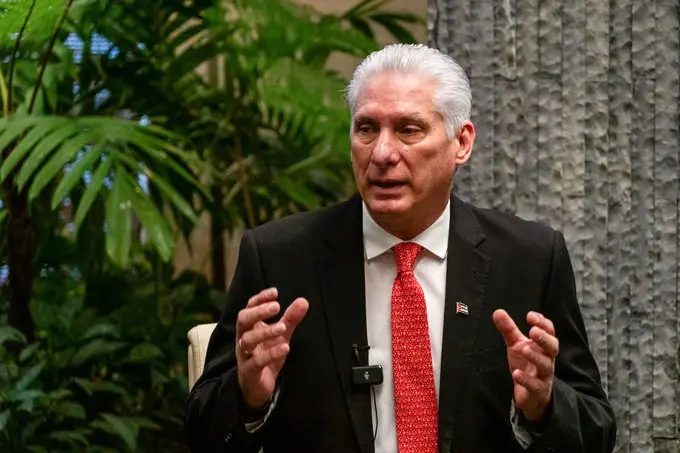
Cuban President Miguel Díaz-Canel affirmed that the largest of the Antilles is a country of peace that promotes solidarity and cooperation, but assured that the nation does not fear war. In an interview with the US publication Newsweek, the head of state maintained that the Caribbean island does not represent a threat to the United States, “much less an unusual and extraordinary threat as has been claimed,” and that there is no excuse for the US to resort to military aggression as a means of resolving bilateral differences.
“In recent months and weeks, we have witnessed all this (bellicose) rhetoric from an official representative of the United States government who announces military aggression against Cuba, sets deadlines for how long the Cuban Revolution will last, and sets dates for how long we will resist before they invade us.”
The Cuban president stated that the country has a defense doctrine called “War of the Entire People,” which he described as a defensive, not aggressive, stance that involves the participation of all citizens.
“We are not worried about our personal safety. We will always strive to avoid war. We will always work for peace. But if a military aggression occurs, we will respond, we will fight, we will defend ourselves, and if we fall in combat, to die for the homeland is to live.”
Díaz-Canel stated that dialogue with the United States is possible to reach agreements in areas such as science, migration, the fight against drug trafficking, the environment, trade, education, culture, and sports.
He reiterated that the dialogue must be “respectful,” “on equal terms,” and with full respect for sovereignty, the political system, self-determination, and international law. He criticized the inconsistency of the United States, which has failed to uphold previous agreements, generating distrust among the Cuban people.
The Cuban president mentioned the advances in biotechnology and the production of Cuban vaccines during the COVID-19 pandemic. A recent example is the development of a Cuban Alzheimer’s drug, whose results in American patients surpass those of traditional medications, with the director of a clinic in Colorado condemning the blockade that prevents greater cooperation.
However, he pointed out that the relationship with the United States is asymmetrical and that the Caribbean nation suffers multidimensional aggression with devastating effects on the Cuban population, the product of an economic, commercial, and financial blockade “reinforced, and now, much more seriously intensified with a cruel energy blockade,” referring to the executive order signed by President Donald Trump to sanction countries that supply crude oil to Cuba.
The Cuban leader acknowledged that the blockade prevents obtaining basic supplies, which keeps more than 90,000 Cubans on waiting lists for surgical operations, including 11,000 children. The President explained that the government is promoting transformations in the direction of the economy, seeking a balance between planning and market forces, greater business autonomy, growth in the private sector, and a profound transition to renewable energy sources.
Faced with media manipulation and the «ideological, cultural, and media war» that seeks to sow hatred, especially on digital networks, Díaz-Canel asserted that Cuba continues to fight and dream of the continuous improvement of its socialist model.
Finally, the Cuban president questioned the persistence of the United States’ hostile policy for 67 years, asking why, if they consider the Cuban model incapable, they invest millions of dollars in blocking and subverting it.
President Diaz-Canel emphasized that the majority of the Cuban population was born and raised under these sanctions, and that the country is committed to defending its sovereignty and independence. Díaz-Canel concluded that both peoples deserve to work in a climate of peace and friendship, with an emancipatory vision that allows them to resolve bilateral differences through genuine dialogue and good neighborliness.
IMAGE CREDIT: The Cuban leader questioned the persistence of the United States’ hostile policy for 67 years, asking why, if they consider the Cuban model incapable, they invest millions of dollars in blocking and subverting it. Photo: Newsweek
[ SOURCE: teleSUR ]