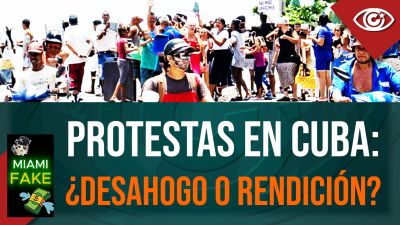
Miami Fake Special
May 15, 2026
Cubainformación.- In this new episode of “Miami Fake,” a Cubainformación program dedicated to analyzing fake news and the media war against Cuba, we review how various media outlets funded by the United States government attempt to manipulate the reality of the island to justify Washington’s policy of blockade, economic strangulation, and interference. From the protests sparked by the oil embargo to the campaigns against Cuban medical cooperation, and including the media cult of figures like Marco Rubio and Donald Trump, the program dismantles the narratives of a network of media outlets based primarily in Miami that presents a coordinated propaganda strategy against Cuba as “independent journalism.”
1. Protests on the Island Generated by the Oil Blockade Are “Against the Regime”
Anti-Cuban media outlets funded by the United States government have attempted to portray the protests and expressions of discontent that have occurred in some neighborhoods of Havana and Santiago de Cuba as a supposed political rebellion “against the regime,” deliberately concealing the main cause of these social tensions: the extreme intensification of the economic blockade and, especially, the current oil blockade imposed by Washington.
Cubanet ran the headline “Havana Can’t Take It Anymore: Protests Erupt in the Cuban Capital,” while Periódico Cubano published “Protests Erupt in Havana Over Blackouts: Pot-Banging, Blocked Streets, and Burning Garbage,” asserting that “the protests demonstrate that social patience is running out in the face of a regime that fails to guarantee basic services.”
For its part, Asere Noticias reported in “Residents of San Miguel del Padrón Protest in Front of the Government Over Blackouts” that “citizen discontent is growing as the regime insists on justifying the crisis with external factors,” while 14ymedio asserted in “In Broad Daylight, Residents of San Miguel del Padrón Protest and Demand Electricity” that demanding “electricity and food” amounts to “pointing out the failure of a state” that “can’t even guarantee light.”
However, neither of these media outlets explains that Cuba is suffering brutal financial and energy persecution, designed precisely to prevent fuel from reaching the country. The oil blockade imposed by Washington aims to cut off all sources of supply, sanctioning ships, companies, and insurers, with the explicit objective of provoking blackouts, desperation, and social unrest.
The media outlet elTOQUE even went so far as to publish openly inflammatory articles such as “Havana and Santiago protest at night: they burn trash and shout ‘down with Canel’,” asserting that “the Cuban people are angry” and that “Cuban destiny ignites and awakens with every pot that clangs in the darkness of the night.” This was language of blatant political and emotional agitation, aimed at legitimizing scenarios of destabilization.
And then the usual Washington-funded “NGOs” enter the scene. Cubanet, in “Protests in Bahía, Marianao, and Diez de Octubre shook Havana this Tuesday,” quoted Cubalex, a US-funded organization, which denounced an alleged “social militarization.” Meanwhile, Cubans Around the World published “The Castro regime trembles: Cubans tired of misery protest in San Miguel del Padrón,” giving voice to another “NGO” supported by White House funds, the Cuban Observatory of Social Conflict, which “documented a sustained increase in protests in 2026.”
The same article celebrated that “the United States continues to exert pressure in order to achieve change.” In other words, they openly acknowledge that Washington is applying economic pressure measures against Cuba and, at the same time, hold the Cuban government solely responsible for the social consequences of those measures.
2. Sanctions against investors and destruction of all sources of foreign currency, but the blame lies with the “regime”
The economic war against Cuba includes the systematic persecution of any source of income for the country and any foreign company that maintains economic relations with the island.
ADN Cuba celebrated that, thanks to the sanctions approved by Trump this month, the Canadian company “Sherritt is suspending operations in Cuba and will evacuate its workers from the island,” while Cuba Noticias 360 noted in “Sherritt’s departure from Cuba opens a new stage of economic uncertainty on the island” that the Cuban economic situation “may be the most difficult, and the last.”
But these media outlets never explain the context: Washington’s ongoing policy of sanctions and threats against any foreign investor operating in Cuba. Canadian, European, and Latin American companies face constant pressure, financial sanctions, and obstacles to their operations. In fact, Trump has given all foreign companies one month to withdraw from the Cuban economy if they don’t want their assets in the U.S. frozen.
Martí Noticias published “The Loot and Faces of GAESA, the Kleptocratic Heart of the Cuban Regime,” reproducing statements by Marco Rubio, who asserted that the U.S. sanctions GAESA because “it appropriates everything that generates money in Cuba.”
The article repeated the official U.S. narrative that the sanctions aim to prevent the Cuban government from accessing financial resources. But therein lies the key: Washington seeks to destroy all of Cuba’s sources of foreign currency, from tourism to remittances, including international medical agreements, which are the heart of the island’s public budget and the foundation of public health, education, culture, and housing construction.
In fact, Asere Noticias published (and celebrated) that “More than 40 Cuban doctors remain in Jamaica after the end of the agreement with Havana.” Washington’s campaign against Cuban medical cooperation aims to eliminate one of the main sources of income for Cuba’s public health system. Then, these same media outlets blame the “regime” for the health and economic deterioration caused by these very sanctions.
3. The savior arrives: the same one who has destroyed Cuba’s economy.
The same US officials responsible for tightening the blockade to its maximum extent are now presented by these media outlets as supposed “saviors” of the Cuban people.
ADN Cuba published “Trump: ‘Cuba is asking for help and we’re going to talk,’” also recalling that the president had described the island as “a failed state.” Periódico Cubano reported “Rubio says Cuba is trapped: ‘With the current rulers, it’s impossible to prosper,’” quoting Rubio’s statement: “Cuba shouldn’t be poor” and “people shouldn’t be going hungry.” When he is the number one culprit!
It’s an extraordinary exercise in cynicism: those who design and implement a policy of economic strangulation that causes blackouts, shortages, and social deterioration then appear lamenting the consequences of that same policy.
4. No blockade: frozen chicken is back! One of the favorite arguments of these media outlets is to deny the impact of the embargo by showing that the US sells certain agricultural products to Cuba under a small, conditional humanitarian license from 2000.
Diario de Cuba published, “Despite the bilateral conflict, US sales to Cuba are worth millions and include surfboards,” highlighting that US exports amounted to almost $490 million.
What they conceal is that these sales are subject to absolutely exceptional conditions: Cuba must pay in cash, in advance, and without access to international credit, precisely because of the US financial sanctions.
Furthermore, the volume of trade with Cuba is minuscule compared to other countries in the region. While the Dominican Republic trades close to $7 billion with the US under normal conditions, Cuba is subjected to a regime of financial strangulation and banking persecution unparalleled in the world.
But anti-Cuban propaganda once again resorts to the old “frozen chicken” argument to deny the existence and devastating effects of the embargo.
5. The Obligatory Letter: In Search of Traitorous Military Officers
A common element in the anti-Cuban propaganda strategy is the open call for a fracturing of the Cuban Armed Forces.
The Cuban newspaper Periódico Cubano published “Former General Rafael del Pino Sends Harsh Message to Cuban Military: ‘The Enemy Is Within’,” while Martí Noticias disseminated “Former Cuban General Calls on Military Officers Not to Shed Blood to Defend GAESA and the Castro Family.”
This latter article asserted that “the United States could collaborate with a new generation of military officers willing to protect the people” and explicitly encouraged “removing the ruling elite from power.”
In other words, media outlets funded by the U.S. government openly promote a scenario of military rupture and regime change in Cuba, while presenting these propaganda operations as mere exercises in “independent journalism.”
Team: José Manzaneda, Egoitz Santos, Hafed Mohamed Bachir.
IMAGE CREDIT: Cover photo: Periódico de Cuba.
[ SOURCE: www.cubainformacion.tv ]