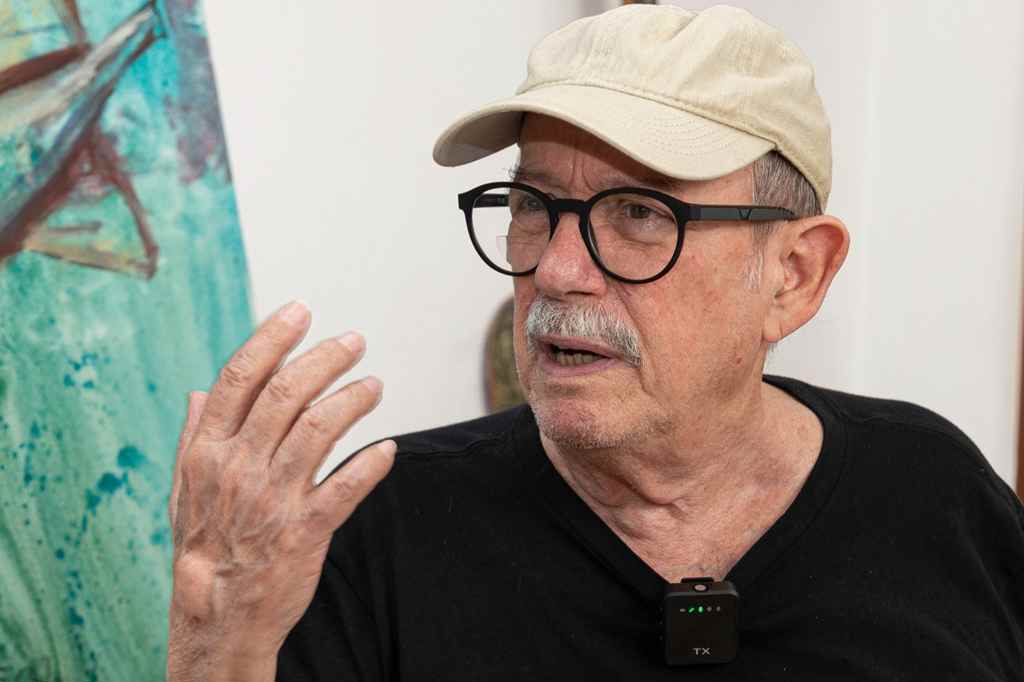
Art is freedom, affirmed renowned Cuban singer-songwriter Silvio Rodríguez, who at 79 years old announced the release of his latest version of “Sueño con serpientes” (I Dream with Snakes), alongside the great Brazilian musician Chico Buarque.
“I believe that art should be as each artist feels it; art is freedom, and if there is no freedom, it’s not worth it,” the legendary troubadour stated in an exclusive interview with Prensa Latina.
At Ojalá Studios in Havana, where time flows amidst chords and the yearnings of a tireless creator, the artist spoke with this reporter, eager to meet the author of songs that accompany several generations of Cubans and Latin Americans in their dreams.
-What remains unchanged in you as a creator?
“The desire, more than anything, the desire.
“The possibilities have diminished in some ways; there are respiratory problems, projection issues, and a lack of strength,” noted one of the key voices of the Nueva Trova movement.
“It takes a lot of strength to sing; the whole body concentrates energy on projecting the voice, and countless muscles contract, and that’s affected by age.”
Cuba and music reside in this dignified man who raises the banner of creativity and virtuosity, because he possesses the ability to captivate with every melody and the sincerity of a true artist.
“I am a grateful and very lucky person,” declared a figure whose simplicity seems to ignore the immensity of the one who — guitar and inspiration in hand — summons thought in an act of poetic sensitivity.
-Where do you find inspiration to compose, and what do you seek to evoke in the audience?
“I don’t try to provoke anything in the public at all. I don’t compose for the public; I’ve always composed according to my thoughts, my concerns, and the things I notice and find interesting.
“Many times, even those lyrics of mine that are so celebrated, I start because I had an interesting melody, and then I suddenly realize that I’ve written something with a bit of coherence, and I leave them as they are,” he explained.
“Don’t go thinking I’m a planner; I believe strongly in inspiration and also in hard work, because I work quite a bit on everything I do.”
Hearing him sing is a privilege treasured by his many admirers, in Cuba and in other parts of the world. Wherever his lyrics captivate, poetry becomes an accomplice in singing to the homeland, to love, and to life.
-Your lyrics are often very poetic. What role does literature continue to play in your work?”
“As a child and young man, especially, and even as an older person, I read a lot of literature; I’ve always loved it.”
“In my early teens, I worked in journalism; I was at the weekly newspaper Mella and later, in the Army, I was involved with several military magazines, he recalled.
When Silvio began composing, he never imagined he would dedicate himself to it, he confessed. Circumstances played a role, someone who heard him and put him in front of a television camera.
It was an interesting experience for a 20-year-old who had just left the Revolutionary Armed Forces, he explained. “It opens up a number of perspectives you can’t even imagine, which is why I abandoned everything related to journalism.”
As a young man, he also dabbled in drawing and design, disciplines he later left behind “for music, for the guitar, for songs, and the influence of what I read.”
Those compositions, conceived in his early youth, paved the way for what would soon become the soul of his existence. Stumbling upon a guitar — as he expressed in an interview — became a chance encounter that liberated the artist within.
-The music industry has changed drastically with digitization and global access. How have you dealt with these changes?”
“I’ve never concerned myself with that; my work has always been artisanal, not industrial. People I know call me and propose something, and then we decide whether to do it or not.”
“I have nothing to do with the big music industry. Once, I was nominated for a Grammy Lifetime Achievement Award, and I was very grateful; it was a nice gesture to remember me.”
He was supposed to go to Las Vegas to receive it, he recounted, but it was impossible because he was in the middle of the Tour of the Neighborhoods, an initiative he led from the end of 2010 until February 2020 with a group of musicians, artists, and writers whose art filled the most disadvantaged areas of Havana and other provinces of Cuba.
“It’s been a relationship problem,” asserted the renowned Cuban troubadour, while attributing a special significance to luck in his life. In his opinion, there are many talented people who deserve to be recognized, but it doesn’t happen.
On the other hand, this journalist believes that happiness without talent is not enough. His lyrics demonstrate an ingenious command of language, and his musicality bursts forth as an invitation to appreciate beauty, stemming from a commitment to bold and intelligent words.
-His music, admired in many parts of the world, is sometimes misunderstood. How does he deal with criticism, both inside and outside of Cuba?
“Jt’s something that doesn’t keep me up at night. I’m a critic too; it’s inherent to perception, to human consciousness, to intelligence, and to the capacity to have options and opinions. “Criticism? Let whoever is bothered by that deal with it,” he said.
Despite disagreements and misunderstandings, Silvio Rodríguez is considered one of the most important Cuban musicians of all time. Embracing his guitar, he invites us to believe when he speaks of the future, to live without price, to dream of snakes and unicorns, to enjoy every harmony from the sensitivity of the expression and of the one who cultivates it.
-What excites Silvio and what displeases him?
“I’m passionate about work; I can’t live without it. And I don’t like sterile idleness, and I say sterile idleness because there are very productive forms of leisure.”
-If you could speak to your younger self, what would you tell him?”
“Keep going.”
This performer is defined by his constant activity, and — beyond raising a song to the heavens — His words don’t tremble when it’s necessary to defend the Cuban Revolution. He confirms this to this reporter and when he expresses his recent willingness to take up arms if the United States decides to attack Cuba.
-If I mention two words: Revolution and Culture, what thoughts come to mind?”
“The first is a circumstantial word. There is a Revolution when there can be a vanguard, and Culture is practically everything; even the most insignificant customs are considered as such.”
-How much and for what does Silvio thank the Revolution for?”
“I have the privilege of having been born in this country and then witnessing the revolutionary process, in January 1959, when I was 12 years old.”
“That allowed me to join in many of the tasks that young people were undertaking at that time, such as the Literacy Campaign and the defense of the country. All of that became a natural thread in my way of feeling, of being, of projecting myself.”
“I am largely a product of that, of having had that experience during those years, especially the first 20, which I think were fundamental,” he emphasized.
-Regarding the preservation and promotion of Cuban culture, what do you think is needed to achieve a greater international impact?”
“I couldn’t say, more opportunities would be needed, I suppose. Cuba is blacklisted in a number of ways, and that limits the projection of aspects of Cuban culture abroad.”
In the artist’s words, the music that was danced here was suddenly launched in New York and had another name: it was salsa.
It’s complex,” he said, “because it’s related to international politics and the hegemony of the United States, whose disseminative power is very strong in the world, ‘not only in the West, as is often said.’”
“Even so, I think Cuban culture makes its presence felt in sports, because that’s also culture; in music it’s unavoidable, whether or not those who create it live here, he affirmed.
There are other art forms that Silvio considers more costly, such as film. “There we haven’t been able to achieve a broader, more numerous, and more varied reach,” he reflected.
“But in general, our culture is a culture with strength, with personality, with character.”
-In the midst of a battle against cultural colonization and the real danger of a US intervention, it is necessary — perhaps more than ever — to defend our sovereignty and that which identifies us as a cultured and free society. What would you add in this regard?
“Cuba’s history has been a struggle for sovereignty. When we began to be a nation, it was from the moment we began to fight to be ourselves, for our characteristics as a people, which were the result of the fusion of different peoples.
This difference and stubbornness with the United States cannot be remedied until they change or we change, he asserted. “I would take charge of changing what we have that prevents us from advancing, from developing,” he opined.
“I would take charge of the part that pertains to us, because with them we don’t know what to expect, and we have many shortcomings and things to overcome, truly.
“In 1993 or 1994, Fidel told an American journalist that our model no longer worked for us, not even for us. That’s a fact, it’s not something I made up.” Shortly after, he expressed that Revolution meant changing everything that needed changing.
“So, if the Americans invade us, we’ll defend ourselves; we know how, and we’re trained. But when will we defend ourselves against ourselves? I think that’s very important, as important as, or even more important than, knowing how to defend ourselves against the Americans.”
-You’ve spoken about the Commander-in-Chief in numerous interviews. Of all of them, I’m most struck by the one in which you mention that he was never afraid to speak his mind because he always believed in him. What stands out for Silvio about Fidel Castro?
“His sincerity. Revolution means not telling lies, was one of the things he said.
-If you had the opportunity to talk to him again, what would you say to him?
“I’d really wait to see what he’d say to me. Maybe I’d say: Damn, you should have tried a little harder to change things; who knows why you couldn’t.
“He may have been temperamental, to a certain extent, but he was very aware of his surroundings, and I saw that, I was able to confirm it.”
-You mentioned that you sympathize with those who understand and respect Cuba, regardless of their origin or political affiliation. What is your message to those who hold a different position than yours?
“They know why they hold that position, and I can’t put myself in their shoes; I am different and I have a different life. I am the product of my experiences, and each person is the product of their experiences and circumstances.
“Even though we have different experiences and circumstances, if we talk and look each other in the eye, if we share a coffee and create empathy, many things that seem unsolvable can be resolved.
“Seeking human empathy is very important, beyond ideologies; getting to know people, talking about who we are and why we are the way we are.” “If we try to get along, we can achieve it, why not?”
-Let’s suppose you could travel back in time to rewrite your story, what would it be like?”
“I was thinking about that a few days ago. Maybe I would have continued in journalism, writing, although making songs is also a form of journalism, especially if you recount what you see, what you think. I really liked the world of publishing and also drawing.”
-Do you feel that new generations read you differently?”
“I don’t perceive whether they interpret me or not. When you’ve been around for so long, you have, whether you like it or not, a kind of image, and the world sees you in a certain way; sometimes that helps, sometimes it doesn’t, unfortunately, that’s how it is.”
-Do you think an artist should take a political stance or is the work enough?”
“The work can be political or sexual, or of any kind; it depends on the artist and what each person wants to express.”
At the time of the interview, Silvio had just finished post-production on “Sueño con serpientes” (Dream with Snakes), included on his album, Días y flores (1975), was recorded while the studio was being repaired, “something very important because we have a culture of building but little of maintaining things in general in our country.”
“We are rigorous in our maintenance, because if you don’t take care of what you have, don’t check it, don’t repair it, where are we going to end up?”
-Will we hear you play in Cuba again?
“I hope so, I would like to. I used to give concerts in the neighborhoods every month, but we had to stop due to the electricity and fuel problems. As long as this situation continues, it will be difficult.”
-Is there anything you feel is unfinished in your artistic career?
“Imagine, different things happen every day, but it’s not up to one person to tell the story of the world; the world is told little by little, and I tell what I’ve experienced.”
-In one word or phrase, how would you define Silvio Rodríguez?
“Very lucky, I’ve been very lucky.”
-And if I asked you to use one of your songs for that, which one would you choose?
“The one I’m working on now.”
IMAGE CREDIT: Photo: Panchito González
[ SOURCE: PRENSA LATINA ]