By José R. Cabañas Rodríguez on May 27, 2026 from Havana

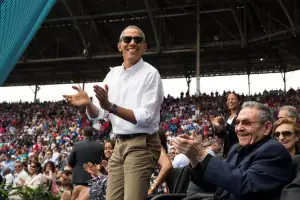
March 22, 2016, President Barack Obama enjoys a baseball game with Raul Castro in Havana.
The statements made on May 20 by U.S. Secretary of State Marco Rubio, along with the decision by the so-called Department of Justice to file charges against former Cuban President Raúl Castro Ruz, were just two of the “news items” that in recent days have contributed to building a case against Cuba, which would eventually be used as a pretext to launch military action against the island.
This so-called “legal” action was announced just hours after the head of the Central Intelligence Agency visited Havana, following the circulation of various reports regarding an alleged offer of U.S. humanitarian aid, and in parallel with the announcement of new sanctions against high-ranking officials of Cuban institutions.
The diversity of topics publicly discussed to demonize Cuba would indicate, among other signs, that the U.S. government—or specific representatives thereof—is attempting to communicate with multiple audiences simultaneously, seeking to achieve specific objectives with each one.
The first is the Cuban public within its own country. Until very recently, the purpose of inflicting human and material losses on the enemy in wars meant causing deaths and injuries, plus the destruction of combat equipment or military installations.
Today, casualties are counted from the moment those who must participate in the defense of their country begin to have doubts, feel intimidated, or lose their so-called fighting spirit. In this regard, U.S. forces have spent five continuous months firing all manner of cognitive artillery, which is having a cumulative effect on a segment of Cubans who face daily shortages of every kind and magnitude.
Another target audience for these bursts of disinformation is Cubans living in South Florida, who consume this news almost as an alcoholic distraction from the question thousands of them ask themselves every day: when will they be deported and under what conditions.
In fact, the anti-Cuban animosity of recent months has allowed the three House members who claim to represent them in the U.S. Congress to bask in the spotlight of newspaper front pages and prime-time TV—a spotlight they would have been unlikely to enjoy had their workdays been dedicated to assisting their constituents in dealing with U.S. Immigration and Customs Enforcement and other hardships.
They have not explained to their constituents that, precisely, one of the main reasons for the push for “regime change” in Cuba is to bring about the hasty, massive, and disorderly return of all those Cubans deemed expendable on the mainland.
The barrage of messages reiterating the narrative of a “failed state” and “Cuban government incompetence” creates a smokescreen for the real disasters that various Latin American governments—elected with the blessing or complicit silence of the State Department and the Southern Command—create day after day in their respective countries. The rise in public insecurity, the control of larger territories by drug traffickers, and rampant corruption in official institutions find no room to displace the headlines generated by the “Cuban crisis.”
Not to mention how many ears listening to this anti-Cuban symphony stop paying attention to the rock-and-roll disaster of the operation called “Epic Fury” against Iran. How many journalists are still covering the crimes against Palestinians in Gaza from newsrooms in Houston, Chicago, or Los Angeles?
But there is still a deeper audience that is reached by these bursts of news. Why, 30 years after the fact, has an irregular incident been seized upon to try to justify a legal indictment against a former head of state who will soon turn 95 years old?
Why didn’t content creators in Washington target Commander-in-Chief Fidel Castro, who was at the helm of the government in 1996? Why wasn’t a case built against the current Cuban president, Miguel Díaz-Canel, in the style of what happened in Caracas?
The targets of these missiles appear to lie more within the depths of U.S. society than in the wall of Havana’s Malecón.
They are attempting to use the opportunity presented by the chaos of the Trump era to rewrite a part of bilateral history and, in the process, demobilize many people and institutions that played a significant role in the rapprochement that took place during the 2015–2017 period.
Raúl Castro is the one who, alongside Barack Obama, made the announcements on December 17, 2014; who was received triumphantly by the United Nations General Assembly in New York in November 2015; and who extended full hospitality to the U.S. president in March 2016 in Havana. Thousands of photos capturing those moments circulated in the public imagination and still linger in many people’s minds.
These three events and all the symbolism associated with them set the stage for the greatest human exchange between the two countries in recent decades. Millions of people traveled back and forth between U.S. and Cuban cities between 2018 and early 2019, the second and third years of Trump’s 45th presidency.
A “need” has arisen to demonize those who personally welcomed the leaders of the U.S. Chamber of Commerce, particularly the top executives of U.S. airlines and cruise lines and the most important agricultural organizations—all of whom have long-standing Republican affiliations and financial contributions.
Thirty years later, they are resorting to the episode of the so-called “shooting down of the small planes” by the counterrevolutionary organization Brothers to the Rescue, in an attempt to return to the atmosphere that prevailed before and immediately after the passage of the so-called Helms-Burton Act, which justified the slogan “anything goes against Havana.”
For the two generations of Americans who are only now learning about “Cuba’s macabre action against civilian light aircraft,” it suffices to clarify that it is duly documented by U.S. news media and official U.S. documents that the provocation against Cuban sovereignty and the consequent response to confront it were only possible due to the federal authorities’ failure to take preventive action against the main perpetrators, despite repeated warnings from the Cuban side that no new illegal entries into the territory or territorial waters would be permitted. He who plays with fire and gunpowder cannot fear the explosion.
In the web of interests that always forms in Washington behind every political project, there are always diverse priorities and personal agendas. Despite the histrionic skills of the current Secretary of State and other officials in attempting to pass off lies as truth, there are elements in their circle who cannot contain their frustration—or their desire for the limelight—and make statements that reveal the real objective of the actions being carried out under the guise of something else.
On May 26, two low-ranking conspirators within the army of bureaucrats that Marco Rubio has recruited for actions against Cuba let slip the real purpose of all the fuss against the symbolism of Army General Raúl Castro Ruz in the eyes of the American public.
In an opinion piece for the far-right media outlet Fox News, after calling President John F. Kennedy a “traitor” in light of the Bay of Pigs invaders’ aims and labeling Ronald Reagan, the “elder” Bush, and the “younger” Bush as cowards for their actions against Cuba, they got straight to the point.
The authors concluded that: “Between 2014 and 2017, the Obama Administration carried out the most reckless experiment in engagement in the history of U.S.-Cuba relations (…) The theory was that the opening would empower the reformists. The theory was a fantasy.”
The text contains not a single factual comment on the 22 memoranda of understanding signed between the parties, nor on the tangible benefits enjoyed by business people and entrepreneurs, nor on the number of scientific, cultural, or religious projects that were organized, much less regarding the so-called Cuban family agenda that connects emigrants with their place of origin.
While Trump’s current supporters speak of their intentions to wage war against third parties, collateral damage on U.S. soil is already beginning to mount.
José R. Cabañas Rodríguez is Director of the International Policy Research Center (CIPI) in Havana, Cuba and former Cuban Ambassador to the US.
Source: Resumen Latinoamericano – English