By Hedelberto López Blanch * / Special Collaboration for Resumen Latinoamericano.
There are countless stories of confessed terrorists who committed acts of aggression, attacks, and assaults against Cuban civilian facilities over the past 67 years, and who have lived and continue to live peacefully in the United States.
From the early days of 1959, countless murderers belonging to the defeated army of dictator Fulgencio Batista traveled to the United States, where they obtained safe haven and immunity for the crimes they committed.
Among them were Esteban Ventura Novo, Rolando Masferrer, and José Eleuterio Pedraza, to name just a few who had an extensive history of repression.
Later, the Central Intelligence Agency (CIA) took charge of organizing terrorist groups to carry out attacks against Cuba, training numerous individuals in the use of weapons and explosives with the aim of destroying the revolution.
Others, although not directly linked to the CIA, enjoyed the approval and complicity of the Cuban authorities, who allowed them to act and commit their crimes with impunity.
One of the confessed cases of working with the CIA on these actions is that of Eugenio Rolando Martínez, known in Miami as “Musculito” (July 8, 1922–January 30, 2021). This individual was one of the Cuban-Americans implicated in the Watergate scandal of June 17, 1972, which cost Richard Nixon the presidency.
After serving a light sentence for breaking into the building to steal Democratic Party documents, Martínez gave an interview to Réplica magazine in April 1974, which clearly defines the idiosyncrasies of this type of terrorist who, despite his dangerousness, enjoys a quiet life in Miami, supported by far-right forces.
Eugenio R. Martínez said he became involved in Watergate at the request of his boss, Howard Hunt, who was also one of the key figures in organizing the Bay of Pigs invasion. Richard Helm, former director of the CIA, stated in one of the Senate hearings during the Watergate case that Martínez had been a member of that organization since 1960.
Below are excerpts from the terrorist’s interview with Réplica magazine.
R- When you were called in for these jobs by Howard Hunt, did you believe you were working for the CIA?
ERM- The CIA is an acronym. It’s an agency of this country’s government. At that time, as Helm stated before the Senate Committee, I was a CIA agent. If Hunt called me, I had no reason to hesitate to cooperate with him; that was my duty.
Q: Were these contacts made through Bernardo Barker? *
ERM: Yes. Hunt spoke with Barker because they had close ties during the Bay of Pigs invasion. Furthermore, my 37-year friendship with Barker was more than enough of a guarantee for me. At that time, Barker and I had a business dealing in the sale of land and houses.
Q: Some people claim that you maintained close ties with the Cuban underground. Is that true?
ERM: Of course. My presence in the United States has had no other reason. When I came in 1959, it was on the express orders of clandestine organizations in Cuba, which were fighting against Castro. The leaders were Manuel Artime and Rogelio González Corzo.
Q: You went to Cuba many times; what was your purpose?
ERM – I have been accused many times by that government of having taken part in numerous operations against that country. I was accused of having carried out many paramilitary operations and of smuggling people out of Cuba.
R – Barker has publicly stated that you made more than 300 clandestine trips to Cuba. What can you say about this?
ERM – I don’t want to give details about these operations because it would jeopardize the methods being used and the “patriots” who are fighting inside and outside of Cuba today using similar methods. My hope is that this struggle will intensify and that my experience will be useful.
R – You have been imprisoned in a U.S. jail. How can the government use you and, at the same time, allow you to be imprisoned? What explanation do you have?
ERM – I haven’t dedicated my time to prosecuting Americans. I have dedicated all my energy to the active struggle for the freedom of Cuba. I haven’t taken part in shaping any policy. But I’m sorry to say that I have no explanation for the question.
R- What is your opinion on the fate of two young Cubans—López and Crespo—whose hands were recently injured when a bomb exploded here in Miami? What can you say about this method of struggle?
ERM- Terrorism has been used by all revolutionary organizations in the world for a long time. It was used repeatedly in the struggle against Castro. Organizations sent explosives to Cuba, specifically the sophisticated C-4. As a rule, those who handle these explosives run terrible risks. I believe these young men were among those who sacrificed themselves and risked their lives. Let’s see if this is clearly understood by those who need to understand it. This is not a trivial game. It is not a crime. According to the mindset of these young men, it is a patriotic and courageous act.
These are the statements made by this notorious terrorist to the aforementioned magazine in April 1974. Despite confirming his numerous actions and attacks against our country, he was never imprisoned for those acts, but rather for his direct involvement in Watergate.
There are countless stories of confessed terrorists who have carried out attacks and assaults against Cuban civilian facilities over the past 67 years, and yet they have lived and continue to live peacefully in the United States.
Note: Data obtained from Réplica magazine, Issue Number 186, April 1974.
* Bernard León Barker (Havana, March 17, 1917 – Miami, June 5, 2009) was a member of the Cuban secret police under the dictatorship of Fulgencio Batista, and later a member of the CIA. He was linked to Operation 40 and the Bay of Pigs invasion. He participated as one of the White House plumbers who broke into the Democratic National Committee headquarters in Washington, D.C., in the Watergate building in 1972, a crime for which he served only 13 months in prison and which forced Republican President Richard Nixon to resign.
(*) Hedelberto López Blanch is a renowned Cuban journalist. He writes for the newspaper Juventud Rebelde and the weekly Opciones. He is the author of “Cuban Emigration to the United States,” “Secret Stories of Cuban Doctors in Africa,” and “Miami, Dirty Money,” among others.
SPECIAL THANKS TO THE AUTHOR: Hedelberto López Blanch
[ SOURCE: RESUMEN LATINOAMERICANO Y DEL TERCER MUNDO CUBA / EN RESUMEN ]
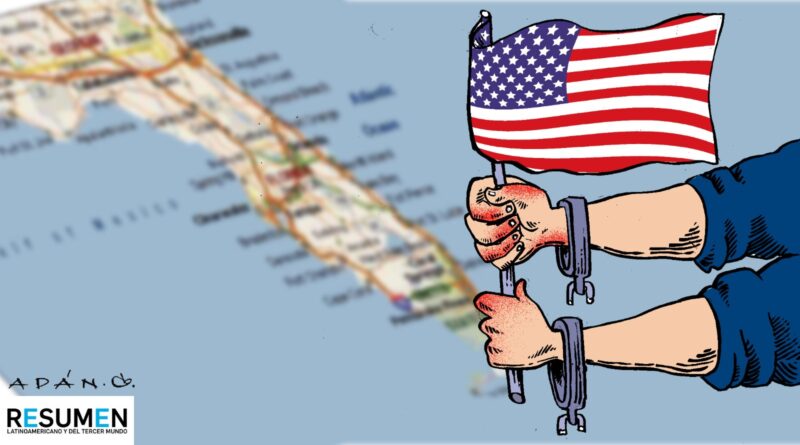
Cover illustration: Adán Iglesias Toledo