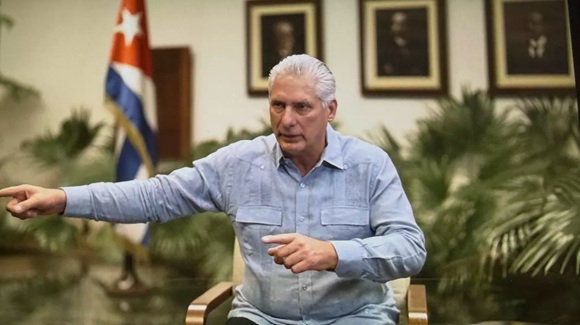
Miguel Díaz-Canel (1960) is the President of Cuba. He leads a country of just under ten million inhabitants, 90 miles from Florida. Since the 1959 Revolution, Cuba has been in the crosshairs of every US administration. But now the situation is particularly extreme and tense, to the point that some are comparing it to the Cuban Missile Crisis (1962), following the tightening of the US embargo with energy strangulation and secondary sanctions against companies that deal with Cuban state entities. This latest tightening of the screws, on May 1st, has meant that, as of this week, Visa and Mastercard payments can no longer be made in Cuba, and that Spanish hotel companies like Iberostar and Meliá have decided to abandon their hotels on the island after several decades in the country.
The blockade that Cuba is experiencing is felt in the country’s daily life, in the power and water outages that cause communication problems, streets without traffic lights, uncollected garbage, roads without traffic, and hospitals unable to operate normally. And with each passing day, the situation grows more critical, because it’s another day of the blockade, the uncertainty weighs heavily, and the suffering intensifies for a population that sees the hottest months approaching without fans to help them through the night and forced to cook with charcoal.
In this context, the President of Cuba receives elDiario.es in a room at the Presidential Palace, transformed into a garden reminiscent of the times of the jungle struggle, with plants and rocks brought from the Sierra Maestra mountains, designed by Celia Sánchez, a combatant in the Revolution led by Fidel Castro.
“Invading Cuba would cost Cuban lives, hundreds of thousands of Cuban lives, but it would also cost the invader great human losses in all kinds of cases,” the Cuban president states regarding the possibility of a US attack, which US President Donald Trump has threatened in recent weeks.
The interview took place Wednesday afternoon, just hours before the Trump Administration intensified pressure on Havana with sanctions against the Cuban president, his family, the Armed Forces, the Committees for the Defense of the Revolution, Raúl Castro’s family, and other individuals and entities in the country.
During our time in Cuba, we were able to visit schools, hospitals, and rice fields, and we saw firsthand how this blockade affects people, especially the most vulnerable. Given this situation, what can the government and you, as president, do to improve people’s lives?
The blockade today is brutal, criminal; it’s something the Cuban people don’t deserve. The most egregious aspect of the blockade is its duration—more than 60 years—and the greatest cynicism lies in how this blockade is accompanied by a narrative that attempts to obscure the true culprit and distort reality by blaming what they call the failed state. What we are experiencing is an accumulation of the blockade’s effects. We had other options for survival, progress, and work.
But after 2019, the blockade took on a different character when the Trump Administration imposed 240 new measures: financial and oil persecution intensified, and Cuba was included on a list of countries that supposedly support terrorism, cutting off all possibilities of accessing credit and making relations with international financial institutions extremely difficult.
In the midst of all this, COVID-19 arrived, and Biden, a Democratic administration, maintained the same conditions of a tightened blockade. And now, this second Trump administration has been extremely aggressive toward Cuba, especially in recent months.
The blockade against Venezuela was already being implemented, the military presence in the Caribbean was increased to unprecedented levels in the last ten years, and Venezuela was blockaded, with fuel shipments ceasing. We’re talking about December of last year. Then came the entire media campaign to attack Venezuela, the kidnapping and extradition of the president and his wife to illegally try him in a U.S. court.
And then came the first executive order.
On January 29, Trump declared an energy embargo against Cuba, and on May 1, he signed another executive order internationalizing the embargo with the concept of secondary sanctions. These sanctions can now be imposed on those who intend to have relations with Cuba and those who already have: it’s no longer just against U.S. citizens or companies, but against companies or citizens from anywhere in the world.
This accumulated intensification has also led to a policy aimed at suffocating the Cuban people, creating a rupture within Cuban society, a social explosion, and a pretext for intervention with a narrative that obscures the true culprits.
Let’s talk about food production: there are no fertilizers, no pesticides, no agricultural inputs, no fuel for farm machinery, no medicine for animals. We are making use of science and innovation, employing agroecological techniques; we have to rely more on animal traction. And today we have a larger area of farmland planted than in the last 15 years.
But yields are lower, production is more difficult, and transportation is also a problem. For example, today we have a ship in port with more than 15,000 tons of rice. That’s enough to distribute three pounds of rice per capita to the entire population of Cuba this month. But now we can’t immediately transport the allotted amount to each province due to logistical problems affecting transportation.
Today it’s harder to find someone willing to sell us wheat for our daily bread, and to buy powdered milk for children on the international market.
Healthcare, one of the pillars of the country, is also being hit hard.
We have a robust healthcare system that has proven its effectiveness for years. We are able to share medical services with other countries and train doctors free of charge for students from other parts of the world. Even American medical students have graduated in Cuba. And today our hospitals don’t have the power they need because of the blackouts.
Therefore, there is a waiting list for surgery of more than 100,000 patients, and among them are more than 12,000 children. Just look at the devastating impact of the blockade. Our doctors and nurses arrive in the mornings to fulfill their humanitarian duty to their patients, perhaps having had a very poor night’s sleep due to the blackouts, or because, if they had power at home in the early hours, it was the moment they had to take advantage of to do everything they had accumulated at home. They also have difficulty getting around by public transport, because it is limited due to the lack of fuel. But they arrive and attend to their patients.
All of this is having an impact on some health indicators.
We have always had an infant mortality rate comparable to that of the most developed countries. That infant mortality rate, which at other times was around four, even reaching 3.6 [per thousand live births], has now doubled, standing at just over nine. And it remains a competitive rate internationally, but it’s not what we’re used to.
We have very effective programs for treating children with cancer, but they are limited by a lack of medications or supplies, and therefore, the survival rate of these children with cancer decreases.
In recent months, with enormous effort, through the export of medical services and biotechnology from our pharmaceutical industry, we have managed to produce a certain quantity of medications. Currently, we have approximately 50% of what we have produced in recent months that we haven’t been able to distribute to the most remote areas of the country, where these medications are intended, precisely because of the logistical challenges caused by the fuel shortage.
Despite having medicines produced by us, they are not reaching the population, which is affected by a shortage of more than 67% of essential medicines.
All of this also has repercussions for the economy, logistics, transportation, production processes, and service processes.
There has been a reduction in tourism because travel agencies have been targeted and pressured. Many agencies are withdrawing from the country against their will due to the pressure they have received. The fuel shortage prevents airlines from flying to Cuba and refueling their aircraft for the return flight. And all of this has limited tourism, which was one of our main sources of income.
All of this leads to a contraction in the supply of goods and services for the population, and inflation makes it even harder for our people to meet their needs. Salaries lose purchasing power, and the relationship between wages and prices becomes very unbalanced. This generates feelings of frustration and weariness among the people.
And how do you cope with that?
A key element is the shift in our energy mix. We are in the midst of an energy transition. Last year, we managed to increase the share of renewable energy sources from 3% to 10%, with over 1,000 megawatts of installed capacity in photovoltaic parks, which are generating more than 48% of the electricity during the day and, at times, reaching 50%.
Furthermore, we have been recovering unavailable power from thermal power plants through distributed generation (small-scale installations), with over 1,000 megawatts that could be generating electricity and reducing blackouts, but they are not operating because there is no fuel available.
We have to rely on our domestic energy source, crude oil, which powers our thermal power plants. This crude is heavy, and we have applied science and innovation to refine it. If we now increase domestic crude oil production, we can also generate surpluses for thermal power generation and other economic processes.
On the other hand, we are implementing the use of biomass and biogas. And we are not relinquishing our right to acquire fuel on the market, which is very restricted because of enormous pressure. The enforcers of the U.S. government apparatus exert pressure every time they learn that a ship is coming to Cuba.
Only one Russian ship has arrived in more than five months, and for 15 days it changed the energy situation, which demonstrates that we are not a failed state. A failed state could not be surviving in this situation, nor could it show that when it has resources it can do things differently.
We have also introduced changes in our marketing methods. We have opened up fuel imports to the private sector. But the Cuban private sector has only been able, in recent months, to import around 27,000 tons of fuel, of which 6,000 tons are gasoline and 21,000 tons are diesel. The 6,000 tons of gasoline represent less than half of the country’s monthly consumption, and the 21,000 tons of diesel are enough for a week of electricity generation.
The blockade is so brutal that the fuel we need isn’t arriving, but we won’t give up.
I was talking about the latest round of sanctions, the one on May 1st. This morning at the hotel, I went to pay for a drink in the cafeteria and my credit card wasn’t accepted.
Today it was announced that the company that processed the credit cards is withdrawing from the country.
And this week we also learned that Iberostar and Meliá are leaving the country. What do you expect from the Spanish government and the European Union regarding two leading Spanish tourism companies that are leaving Cuba as a result of the US sanctions?
They have been committed to Cuba for a long time, they have worked tirelessly with our tourism companies, they are businesspeople whom we greatly respect, and they are leaving against their will.
Just as they have been able to develop their businesses in Cuba, they have also brought knowledge to the Cuban tourism sector. And that’s why we have a hotel infrastructure, thanks to the investments made by the country, which can be used today, for example, as assets, to pay off debt or to generate business.
But, on the other hand, there is also the learning and professional development of our people.
There will be hotels that we will have to operate, and we are considering different business models with Cubans who want to invest in and manage hotels. We are open to that, and to people from other countries or entities that do not have accounts in the US or are not dependent on the US, and who are willing to work with Cuba. We have offered this business opportunity to Cubans residing abroad. I am sure that many will return to Cuba to continue their businesses, but it will not be easy at all because of the stubbornness with which the US administration has tried to hinder the development of tourism in Cuba, which it knows is a source of income.
“[Iberostar and Meliá] have been investing in Cuba for a long time, they have worked tirelessly with our tourism entities, they are businesspeople whom we greatly respect for the support they have always received, and they are leaving against their will.”
These are the most important countries in trade relations with Cuba. We are united by traditions, history, and family ties. The Spanish government has been very respectful of Cuba, and the European Union, for the most part, has always supported the Cuban resolution at the United Nations against the blockade. I believe that now the European Union and Spain must also understand that the blockade doesn’t only affect Cuba; it is affecting Spanish citizens, European citizens, businesspeople, and European and Spanish entities.
Spanish and European banks cannot have dealings with Cuba. Today, it is more difficult for a Spanish tourist to reach Cuba, and European and Spanish investors face coercive obstacles and pressure.
No country in the world has the right to be the world’s policeman or to dictate the fate of other countries. Therefore, the European Union and Spain itself must address this and protect their businesses and citizens. They cannot allow extraterritorial laws to be imposed on them from another country, laws that contradict the very principles enshrined in European and Spanish constitutions.
“The EU and Spain have to confront this and protect their businesses and their citizens. They cannot allow extraterritorial laws to be imposed on them from another country, laws that contradict the very principles enshrined in European constitutions and the Spanish Constitution.”
There was a declaration last April, at the IV Summit of Democracy in Barcelona, against military intervention in Cuba, in which Spain and other Latin American countries participated.
It was a moment of support from Spain, which has made some humanitarian aid donations recently.
You were just talking about that first Trump administration, which introduced the limitations on ESTA and represented a radical change compared to the Obama administration, which was one of the most open to Cuba in recent times. In fact, one of the consequences of those Trump sanctions was that the US did not supply ventilators to Cuba during the pandemic.
Trump intensified the blockade in the second half of 2019, and in January 2020, he included us on the list of countries that supposedly support terrorism. And Biden maintained it.
We received our first COVID case in March 2020, and we had already sent Cuban medical brigades to areas that were the epicenter of the pandemic. At the time, these were regions of Italy. The brigades supported local authorities, worked with the population, and earned tremendous respect and affection, and they learned how to manage the disease. In the first year of the pandemic, we were able to maintain control, and at the end of 2020, we reopened the border.
There were many Cubans who had been living abroad for a long time and wanted to return to see their families at the end of the year. With the arrival of this influx, cases began to multiply, and we experienced a very severe pandemic peak in 2021. By mid-2021, we realized that Cuba had no options with the vaccine distribution mechanisms available worldwide, and, moreover, we had to increase the number of intensive care units to prevent them from collapsing, as had happened in other parts of the world, including the United States.
This allowed us, by the end of 2021, when we had already vaccinated more than 60% of the population, to bring the numbers down and subsequently maintain control of the disease. We were the first country to vaccinate children over the age of two. We were among the ten or twelve countries that had administered the most vaccine doses per capita.
In the midst of this intensified blockade, with blackouts, shortages of supplies, and a lack of medicine, when we went to seek ventilators for the intensive care units, the United States government prevented American companies from selling this type of technology to Cuba.
We had to design our own ventilators, which allowed us to produce what we needed, and today we have the capacity to export them.
Once again, science and innovation, one of the legacies of the Revolution bequeathed by Fidel, enabled us to achieve these results.
And there is a third event that also demonstrates the brutality and perversity of the blockade. In the midst of this situation, with a high number of patients hospitalized, our medical oxygen production plant suffered a breakdown, and we had to send the replacement part to a European country. The United States government prevented entities in Latin America and the Caribbean that produced medical oxygen from selling it to Cuba. Other countries, including Russia, supported us; We were also able to receive ventilators and medical oxygen from China and other countries.
That shows you that they were condemning a group of patients to die for lack of oxygen. And that’s how the country faced the pandemic, and we were able to manage the disease better than other wealthy countries that weren’t under blockade. And that has a lot to do with our inclusive and free healthcare model. Given this whole situation, the wealthy were able to receive better care than the poor, but in the end, the pandemic didn’t respect or differentiate between rich and poor, and what it did was claim many lives globally. And I think that’s an experience from which humanity must also learn lessons.
In the United States, there’s a lot of talk about the possibility of an attack on Cuba. Various hypotheses are being discussed, from an operation like the kidnapping of Maduro, under the pretext of Raúl Castro’s indictment, to other types of operations. In fact, Democrats in Congress have introduced some resolutions on war powers to try to prevent that scenario. Do you think it’s possible?
Cuba is a country that wants peace; we are a country of peace. It is a lie what representatives of the US government say about Cuba being a threat to US national security.
Ten million inhabitants on a blockaded and harassed island cannot be an extraordinary and unusual threat to national security, as they have claimed, for the most powerful nation in the world. It is a pretext fabricated to inflame world public opinion and justify the possibility of military aggression against Cuba.
Aggression is increasingly present in the rhetoric of US government spokespeople. This rhetoric is being reinforced, and every day there are plans for aggression against Cuba; every day, in US media, how an attack on Cuba could occur is described. And they compare it to Venezuela, and we do not want war; we want dialogue.
But we are not afraid of war, and we are preparing to face military aggression. We are preparing ourselves with the concept of our military doctrine, which is the war of the entire people, a defense doctrine with the participation of the entire population in our defense.
This is also a deterrent, because invading Cuba would cost Cuban lives, hundreds of thousands of Cuban lives, but it would also cost the invader heavy human losses in any scenario. It would be a complex outcome for the United States and for our country, but it would also be a threat to the stability and security of Latin America and the Caribbean.
“Invading Cuba would cost Cuban lives, hundreds of thousands of Cuban lives, but it would also cost the invader heavy human losses in all kinds of cases.”
I believe the United States is betting on three scenarios: the first is economic strangulation, provoking social unrest, and using that social unrest as a pretext for intervening in the country under the guise of humanitarian aid. We have examples like that in Haiti, and Haiti is becoming an increasingly impoverished nation, and the Haitian people are living in an increasingly complex situation.
A second scenario is to pursue a coercive dialogue with Cuba, one of maximum pressure, to seize control of the Cuban economy in order to economically occupy the country and, subsequently, give them the opportunity to bring about a change in the political system. This is the great aspiration of the United States.
And a third scenario is military aggression.
But we haven’t created these scenarios; they are the scenarios present in their rhetoric. Therefore, we have the right to defend ourselves, to prepare to defend ourselves, so that there are no surprises and so that there is no defeat.
And we always try to avoid comparisons with other nations. Because to compare us with another nation would be to ignore the strength of our institutions, the unity of our heroic people, and the determination of the majority of our people to defend the Revolution to its ultimate consequences.
Our history and our traditions of struggle, our commitment to sovereignty, independence, and self-determination, which we fought so hard to achieve.
We will continue to defend peace, seeking dialogue and ensuring that dialogue allows us to resolve the contradictions in our bilateral relations and moves us away from confrontation. But for that to happen, there must also be a willingness on the part of the United States government.
And there is an example in Venezuela: 32 Cubans heroically gave their lives defending their principles, defending their convictions. What wouldn’t millions of Cubans do who are willing to defend the Revolution, sovereignty, independence, and who want to maintain the self-determination we have in this country?
You are mentioning the public statements of the U.S. government about Cuba, but you are talking with them. The CIA director was here, and, on the other hand, you also recently met near the Guantanamo base with the U.S. Southern Command. In other words, there are ongoing talks. And what are you willing to concede? What are they unwilling to compromise on? Where are the red lines?
We can have a civilized dialogue like the one the United States has with other countries it also considers adversaries, regardless of ideological differences. Furthermore, we could have trade relations, cultural, academic, sporting, and scientific exchanges… There could be unrestricted tourism between both sides.
Throughout history, there have been conversations or attempts at conversations, though not always through official channels. One of the most significant dialogues took place during the Obama administration, when we even re-established relations between the United States and Cuba. There was a complete opening in relations that benefited both countries.
We have always advocated for dialogue, and for this reason, our officials have held talks in which we sought to resolve our bilateral differences and find areas of cooperation where we can move forward with projects that benefit both our peoples and guarantee the security of both our peoples, of Latin America and the Caribbean, of the region in which we live.
These are conversations that must be approached with great responsibility, discretion, and sensitivity, because they deeply concern the relations between our countries and our peoples, and they allow us to build spaces for dialogue that facilitate progress in this relationship and move us away from confrontation.
But it must be a dialogue without pressure, on equal terms, without conditions regarding changes to our political and social system, without considerations concerning our independence, our sovereignty, and our self-determination; a dialogue that observes the principle of reciprocity and respects international law. Therefore, we are drawing red lines.
There can be no imposition of a change to the political system. The internal affairs of our country are not at stake. This dialogue cannot be based on a position of strength or pressure exerted on the country. And it must be approached with responsibility and discretion.
When distorted accounts of this dialogue process emerge, one wonders: why do they have to resort to such a shameful practice of saying things that weren’t actually discussed? Why do they feel the need to portray themselves as the ones pushing the conversation to a point where we have no way out, or as putting us under maximum pressure, or as imposing conditions on us?
We would never accept that. And when anything touches on those issues, there will always be a firm stance from the Cuban side and a refusal to continue dialogue under those conditions.
Now, we believe that dialogue is necessary. There are many things we are open to, for example, U.S. investments in Cuba, U.S. businesses operating in Cuba. But we are not the ones limiting them; they are limited by the laws of the embargo itself, by the embargo policy itself.
If the United States wants to have that kind of relationship with Cuba, it has to lift some of the limitations imposed by the embargo and the executive orders.
There has always been one country playing the role of aggressor and another the role of victim. The United States has always been the aggressor, and Cuba has always been the victim. There is also an asymmetrical relationship: the one who has pursued an aggressive policy, a policy of blockade, a policy of offense toward the other party, has been the United States toward Cuba.
At other times, we have had conversations on issues such as terrorism and transnational crime, migration issues, covert operations carried out against Cuba, and terrorist acts orchestrated in the United States against Cuba. We have also discussed aspects of law enforcement, and the dialogues at the Guantanamo Naval Base.
For years, we have held monthly dialogues with representatives of the U.S. Armed Forces. One month it takes place on the base, and the next month it takes place on Cuban soil. And that was suspended by the U.S. government.
But the truth is that during this second Trump administration, the blockade has intensified, and the threats have increased. What do you foresee between now and the end-of-year holidays, which are so, so important to everyone? What do you think might happen between now and the end of the year?
As a revolutionary, one always has an optimistic view of life. And without denying that we are living through a very complex, very difficult situation…
And the uncertainty weighs heavily.
We are part of a people who have set a global example of resistance and heroism. And one cannot betray that history. Furthermore, we trust in international support; there is a lot of support for normalizing relations and having a constructive dialogue.
There is also the possibility that dialogue will help overcome this situation. And, on the other hand, I believe in the human condition. There are many in the world who want a better world, who want a different international economic order that is fairer, more inclusive, and that provides opportunities for everyone. There are many in the world who do not agree with having a supremacist, hegemonic country that dictates the rules.
“There are many in the world who want a better world, who want a different international economic order that is fairer, more inclusive, and that provides opportunities for everyone. There are many in the world who disagree with having a supremacist, hegemonic country that dictates the rules.”
More and more people, more governments, more states, supported by their people, are defending multilateralism and greater inclusion, greater equality, and greater opportunities; they are not looking down on the peoples and countries of the Global South.
And this idea must spread throughout the world; it must be confronted with dignity. Because what is happening in Cuba is not happening only in Cuba. It happened in Venezuela, it has been happening in the cruel genocide being committed every day against the Palestinian people in Gaza, it is happening in Lebanon, with the aggression against Iran.
The world must realize that we are all facing a multidimensional aggression from the United States government, an aggression that manifests itself in a global war—an ideological, cultural, and media war.
It’s ideological because the United States is trying to impose its hegemony on the world; it’s cultural because, to impose its hegemony and make everyone think like the United States, it has to erase the cultural identity of all our peoples and our countries, our histories and our cultural roots; and it’s media-driven because, to achieve this, it develops a massive media strategy based on slander, character assassination, and repeated lies, as they are doing with Cuba.
What did they do with Venezuela? The narrative that it was a narco-state, that Maduro was a dictator, that there was no democracy in Venezuela, the infamous link between Maduro and the Cartel of the Suns. And when they unleashed all that media artillery, they attacked the country, even while they were in talks with it. And that’s where they demonstrate their treachery, how treacherous they are. They illegally kidnapped a president and removed him from his country to try him illegally in the United States. And two days later, the Cartel of the Suns was gone. All the evidence was lost.
Remember the war in Iraq, when they claimed there was a biological weapons program, and the biological weapons never materialized. Or the war with Iran under the pretext of a nuclear weapon, and there has been no nuclear activity on the part of Iran.
Will a dignified world allow this to be the way things are done, this perversity? Or is the world unable to learn from the lessons of history? This is the same as fascism, this is the same as what Hitler did in Europe. Will the world return to that barbarity? Because the issue isn’t just Cuba; what’s happening to Cuba could happen to any country.
“Will a dignified world allow this to be the way things are done, this perversity? Or is the world unable to learn from the lessons of history? This is the same as fascism, this is the same as what Hitler did in Europe. Will the world return to that barbarity? Because the issue isn’t just Cuba; what’s happening to Cuba could happen to any country.”
If you could change anything about the last five or six years — something you sometimes hear in certain circles here in Havana — instead of investing so much in the hotel and real estate sector, could more have been invested in energy and food sovereignty, and in education and healthcare, which are the symbols of the Revolution and are now being severely impacted? Or perhaps some economic reform that wasn’t implemented or was postponed, which would have put us in a better position to face this critical moment?
We’ve always been looking at our shortcomings and our mistakes, but they’ve also limited us. And many things are discussed, some more accurately than others, because many of the reforms we’ve proposed have been practically impossible to implement.
Because to invest, you need foreign currency; you need to operate within certain international financial and economic relationships. It’s not just about wanting to change, but also about having the possibility of change.
We have made mistakes, there are errors, and we must also consider the conditions under which those mistakes are made, in the context of a besieged city. There is also the fact that the numerous reforms implemented throughout the Revolution are not acknowledged.
Today, for example, the U.S. government does not recognize the opening that has existed with regard to the private sector and the incentives for foreign investment. It’s not that Cuba is changing; it’s that they want us to change according to their wishes, with total privatization and the adoption of a neoliberal model. That is not our model.
We don’t tell the United States what changes it should make; those are their problems. I believe that history will be able to tell how far we were wrong and to what extent, even if we hadn’t been wrong, the blockade has been the fundamental cause of our current situation: lift the blockade, and we’ll see how things work out. If you lift the blockade and we are unable to move forward with the country, to continue transforming, to continue perfecting our society, then one could respond that we were incompetent and that we didn’t do what we had to do.
But this country, despite the intensified blockade, manufactured COVID vaccines, and has health and education indicators that, while not satisfactory, are better than those of most countries in the world. The equality that exists in Cuba, the security that exists in Cuba, the respect for human dignity, the non-discrimination, the solidarity with other parts of the world…
The US government says that we receive fuel from Venezuela without paying, and that is another lie. We provided medical services, and they were compensated with fuel. The problem is that this way of being, of acting, of conceiving life differently, doesn’t fit into the mindset of a supremacist, of someone who thinks they are above others, of someone who treats Latin America and the peoples of Latin America as their backyard. And now, with the Monroe Doctrine updated with a Trump corollary, our people are being despised.
If we are so incompetent, why are they blockading me? Why don’t they let me collapse on my own? Because they have no interest in Cuba improving. That’s a lie. They want to seize Cuba, as they have wanted to seize other places in the world, to extract its resources, to take control of them, and not to improve people’s lives.
And what we always dream of is how we can overcome adversity with everyone’s participation.
You said that the United States was seeking, among other things, a social explosion. Now July and August are coming, a very hot season with power outages. And it’s the fifth anniversary of July 11th. Do you think the circumstances could arise for some kind of explosion? How do you plan to deal with dissent?
We have programs for each of those scenarios, to help us navigate them. But right now, we have a grassroots mobilization program with neighborhood-level projects, led by young people, focused on how, at the community level, we can improve food production, support vulnerable populations, and address issues related to energy, recreation, culture, sports, and spirituality.
There is a culture of resistance, a culture of creative resistance.
IMAGE CREDIT: The President of Cuba, Miguel Díaz-Canel, on June 3, 2026, in Havana Photo: elDiario.es
[ SOURCE: CUBA DEBATE ]