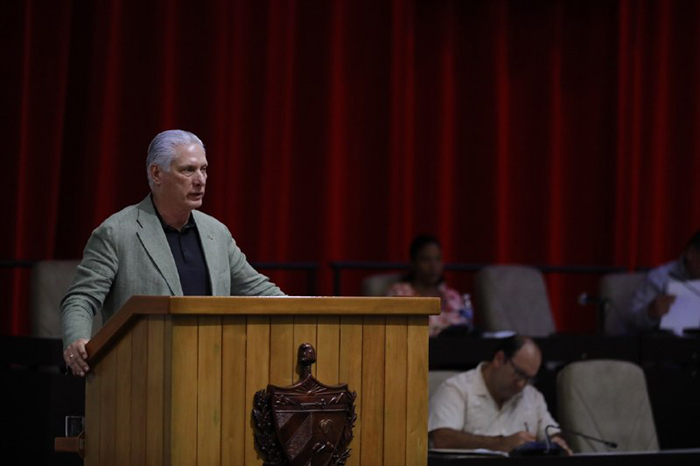
The full the speech delivered by Miguel Mario Díaz-Canel Bermúdez, First Secretary of the Central Committee of the Communist Party of Cuba and President of the Republic, at the closing of the Third Extraordinary Session of the National Assembly of People’s Power in its 10th Legislature, at the Convention Palace, on June 18, 2026, the Centennial Year of Commander-in-Chief Fidel Castro Ruz.
(Stenographic Versions – Presidency of the Republic.
Dear Army General Raúl Castro Ruz, leader of the Cuban Revolution;
Dear Deputies;
Comrade Lazo, President of the National Assembly;
Fellow Cubans:
The ideas I am about to express, as conclusions of this Extraordinary Session of our Parliament, are fundamentally directed to the heroic Cuban people, from whom we come and to whom all of us present have the duty and the honor to represent.
Cuba, our beloved Cuba, is living through the most difficult hours of this century, and we have the historic responsibility to save her.
The concept of Revolution that the Commander-in-Chief bequeathed to us, in his own words, continues to challenge us twenty-six years later: It is time to change everything that needs to be changed.
It is not just about breaking the siege of those who are determined to suffocate us and confess it without any scruples, while at the same time cynically blaming us for the crisis that this very siege causes.
It is about confronting the consequences of the colossal chaos generated worldwide by absurd wars of conquest, the breakdown of multilateralism and international law, and the fraudulent and arbitrary manipulation of the international financial system as a political weapon.
With full awareness of the moment we are living through and with the respect that every Cuban man and woman deserves for giving their all in these complex times, we cannot think and act as in normal times, because these are not normal times.
Nor can we believe that by doing the same thing and in the same way This is how we can overcome this difficult moment.
Cuba heroically and creatively resists a barbaric, undeserved, and unbearable punishment, to which is now added the threat of military aggression and, as always, lies—all within a framework that operates as a strategic weapon against collective resistance.
The harsh reality imposed by this collective punishment on the Cuban economy, society, and families stems from real, daily financial persecution that obstructs and drives up the cost of every drop of fuel, every medicine, every food product, every part, and every technology the country needs.
And when the life of the people becomes so hard, the first duty of the Party, the revolutionary government, and this Parliament born of the people, by the people, and for the people is to change everything that needs to be changed to move forward.
Today we are gathered in extraordinary session due to force majeure. Reality compels us to make urgent and necessary changes, but none will be implemented without the approval of this great representation of the Cuban people: the esteemed National Assembly of People’s Power, with its workers, its farmers, its scientists, its intellectuals, artists, athletes, and students—simply as a people, with our Cuban identity.
A few days ago, I told the press that we would discuss these changes in the Central Committee of our Party and in the National Assembly, and some people commented on social media about the risk of diluting the urgency that the situation demands in further consultation and discussion processes.
The expedited manner in which the proposals were discussed and approved in just two days, in both bodies, should have dispelled those legitimate doubts.
First, because we didn’t start from scratch. Everything approved today arrived here with the backing of successive analyses, debates, agreements, guidelines, conceptualizations, Party congresses, and government programs. What we are doing is settling a debt with our own previous decisions, pending implementation, and some new ones that, as we have seen, in no way contradict the letter and spirit of the Constitution.
At the closing of the 11th Plenum, it was made clear that postponing the Congress did not mean delaying necessary changes, modifications, and actions, as this falls within the powers of the plenary sessions of the Central Committee when dealing with agreements adopted by Party congresses, and also of this Parliament when dealing with agreements concerning the nation.
In keeping with this, and as our colleague José Luis Toledo, Secretary of the National Assembly and one of the most experienced deputies in the country’s legislative activity, reminded us, given his many years leading the Committee on Constitutional and Legal Affairs, Army General and leader of the Cuban Revolution, Raúl Castro Ruz, was a vigilant guardian and guide of the intense process that resulted in the Constitution approved in 2019, constantly ensuring that our fundamental law was flexible enough to facilitate the inevitable modifications it would require over time.
Today, the significance of that forward-thinking approach has been confirmed.
In the Extraordinary Plenary Session preceding this session of the National Assembly, it was agreed that while the people are aware of the objective causes of the difficulties we are experiencing, they will always need and demand, as a sovereign right, concrete answers, timely decisions, and results that begin to alleviate the harshness of daily life, marked by the prolonged blackouts caused by the energy blockade, from which many other difficulties and shortages arise.
No one even remotely informed is unaware of the suffocating plan designed for Cuba, which has been regularly and viciously implemented by the historical enemies of the Revolution to cause the country to implode from within. This must be stated every time the blackouts are mentioned, because behind the always insufficient power generation achieved, without a single fuel shipment entering the country, lies the colossal effort and heroic contribution of the managers and workers in the electrical power sector.
Returning to the reason for this extraordinary meeting, I will refrain from repeating what we said yesterday at the Central Committee Plenum, which has been widely disseminated by the media and social networks in recent hours, and where we elaborated more thoroughly on a set of criteria regarding each of the aspects encompassed by the transformations.
Now I will limit myself to emphasizing some central objectives of the approved measures, because we need each and every one of us to embrace them, to make them our own as a people, because these are transformations to rectify, but always in defense of socialism, to sustain and expand the social justice we have achieved, to create economic wealth and distribute it equitably.
First, those who cannot wait:
Actions will be implemented to prevent the widening of inequalities, through the application of social policies that promote equity and support those in vulnerable situations, with a fair distribution of taxes to develop social programs.
The food supply for the Cuban people will be treated as a matter of national security, and we will eliminate idle land in Cuba.
Every piece of land currently covered in marabou weed, when it should be producing food, will have to face a clear response: either it will be put into production, or it will be given to whoever is willing to do so.
Recovering energy capacity:
There are concrete measures to recover energy capacity, reduce external dependence, and accelerate decentralized solutions, speeding up the integration of solar energy and other renewable energy sources into the national economy. To achieve this, we will facilitate the direct entry of foreign companies that supply panels, batteries, inverters, and related solutions, reducing intermediaries that increase costs for the population and the country.
Tariffs on the import of solar technologies, storage systems, and energy-saving equipment have already been eliminated. Now we will also move forward with eliminating taxes on their sale and on services related to their installation and maintenance. Furthermore, we will create credit and financing mechanisms so that these solutions are not accessible only to a select few, but can progressively reach households, micro, small, and medium-sized enterprises (MSMEs), schools, medical offices, nursing homes, and other essential services.
Improving access to fuel:
We have authorized the sale of fuels by non-state management entities, under state regulation and control, and with reasonable and transparent profit margins. Initial pilot programs with liquefied gas and fuel sales points and digital payment platforms are already underway, which we will evaluate and expand where they demonstrate efficiency, transparency, and benefit to the population.
The goal is not to remove the state from a strategic sector, but rather to add capacity, streamline distribution, and improve access. And I want to be clear: this decision responds to a specific need at this moment in the country, but those who invest, work diligently, and abide by the rules will have security and stability. When the country regains greater capabilities, we will respect the investments made and the projects that have proven beneficial to Cuba and its people.
Subsidize people, not products:
We will concentrate every peso we have on those who truly need it. For those demonstrably vulnerable, direct protection in their pockets, without intermediaries.
Modernize the banking and financial system:
We need more agile, more digital banks, closer to the people and more useful to those who produce, export, import, invest, or start businesses, opening up space, under strict regulation, to state, private, and foreign financial institutions.
The goal is to ensure that collecting a pension, receiving remittances from abroad, paying for services, applying for a loan, financing a harvest, purchasing equipment, or transferring funds for production is not an obstacle course.
Autonomy for State-Owned Enterprises:
For socialist state-owned enterprises to remain the cornerstone of our economy, they must have the real capacity to manage, innovate, and be accountable for their results. Greater autonomy for these enterprises requires more professional management of state assets, which will be the responsibility of the National Institute of Business Assets. This institute is tasked with representing the owners of the means of production, evaluating performance, demanding efficiency, and better separating the business function from the regulatory function of government ministries.
Foreign Direct Investment in the Cuban Private Sector:
Any Cuban citizen residing in Cuba or abroad who is interested in investing, donating, contributing technology, opening a market, or developing a project in the country will have a clear, stable, and respectful framework, as will foreign investors.
I repeat what I said in the Plenary: to anyone who wants to build with Cuba, without intending to impose anything on Cuba, we say tonight with our hearts in our hands: here is your home and here is your open door (Applause), because this nation, at this time, cannot afford to lose any Cuban; we need them all! (Applause.)
Guaranteeing life projects within Cuba:
We cannot normalize the high emigration of young people. Cuba’s future depends on our ability to create the opportunities that young people are currently seeking outside their homeland. Every legal activity that contributes to the country, pays taxes, generates employment, and helps solve the population’s problems must have a legal space to develop in our country.
Protection of women:
With this, I am responding to the proposal made by the General Secretary of the Federation yesterday in the Plenary.
On this day, as we remember with particular emotion and nostalgia our beloved Vilma, a woman who was an underground fighter and guerrilla, an innovative engineer, and a founder of spaces and policies for the promotion and defense of women’s rights in Cuba and around the world, at the request of our comrade Teresa, secretary of the Federation of Cuban Women, and other women who have drawn our attention to the need to protect and promote their progress, on behalf of the Party and the Government, I reaffirm our commitment to ensuring that there is never any backsliding on the policies advancing Cuban women when implementing the new economic and social measures (Applause). Indeed, we rely on them, on their emblematic resilience, their creativity, and their sensitivity in a very special way.
After yesterday’s and today’s debates, the presentations by local leaders and all that we have seen and touched with our hands on our tours of the country or in exchanges with experts from diverse fields, I am deeply convinced that we will be able to overcome these difficult times, these hours fraught with threats and difficulties.
All we need is self-confidence, cooperation, alliances, creativity, sensitivity, solidarity, and control—a lot of control—and all of that is unity.
Let’s shed prejudices and preconceptions, innovate, connect, produce, and create.
It’s true that we lack everything; but we have an abundance of talent, pride, courage, audacity, and Cuban spirit (Applause).
The Commander-in-Chief placed his bets on these undeniable forces of our national identity in years as difficult as these, and even we ourselves are surprised today by the place that the name of Cuba and thousands of Cubans, scattered around the world, who were educated in our classrooms, scientific centers, and schools of art and sports, among others, have come to occupy globally.
We are a nation that has turned necessity into opportunity, and that more than once has transformed setbacks into victories. Today we cannot be any less; we only have one option: To win! (Applause.)
Fellow citizens:
I have mentioned only a few of the many problems we must and can resolve as soon as possible. Prime Minister Marrero’s presentation, the analyses in committees, and the plenary debates, along with the insightful interventions that took place in the Central Committee Plenum, and all the dissemination of the guidelines issued there, have, in my opinion, been sufficient to clarify the purpose of the measures you have approved today, in an expedited process, though not without thorough analysis.
In both meetings, the necessity of these measures was debated with solid arguments, but also the greater importance: that they be implemented, that those responsible be designated, and that deadlines be set for their fulfillment.
The Army General’s letter to the Plenum made this very clear when he warned that the proper and timely implementation, with well-defined priorities and the conscious participation of the people, will be just as, if not more, important than the approval of the document. This requires acting with our feet firmly on the ground and our ears firmly planted, taking into careful consideration the opinions and concerns of the population.
Comrades:
A nation that wants to change must also learn to listen to itself better. Cuba is seething with discontent and criticism, most of it justified and honest. It is up to us to listen to it with respect and respond as we would to a fellow citizen: with arguments, with solutions, and, whenever possible, with action.
But it would be naive, to say the least, not to distinguish between justified criticism and insults intended to undermine unity and commitment.
An economic, media, and psychological war is being waged against Cuba, instigated and financed from abroad, which aims to weaponize the people’s genuine suffering against themselves.
Behind many campaigns of hatred and discrediting against the Cuban government, there is sometimes just another citizen frustrated with the situation; but trends and experts have confirmed, through serious media and audience studies, that vast sums of money are being spent in laboratories designed to produce weapons and that there is a strategy, designed with astonishing cruelty, to drive us to despair.
It is one thing to criticize Cuba in order to improve it; quite another to work to destroy it for a handful of dollars—that is called mercenary activity. It is one thing to think differently; quite another to promote hatred, chaos, surrender, and the annexation of the nation.
Confronted daily by the actions of online haters, by the empire’s enthusiastic servants who lie, manipulate, demonize, and insult without the slightest ethical consideration, without verifying sources or facts, it is very easy to distinguish them from those who honestly disagree with the methods and timing of our actions.
The challenge of this new stage is to do both things better at the same time: defend sovereignty without silencing anyone; combat interference without mistaking those with differing opinions for traitors.
Cuba needs more debate, not less; more participation, not less; more accountability, not less.
And I return to the brief but very important letter that our Army General sent yesterday to the Plenum of the Central Committee, where he stated: I am convinced that the best ideas always emerge from collective analysis, and even from disagreements. That’s what he said, while also calling for building the necessary consensus at this crucial moment, because: “It is what is best for the Revolution today.”
No one in this land is persecuted for thinking differently, but this nation will not allow our own children to be used as cannon fodder against the independence of their homeland under the borrowed banner of a freedom designed from abroad (Applause).
A message to the world:
Finally, and from this same platform, with the respect and firmness that have always distinguished the dignified tradition of Cuban diplomacy, I want to address the international community, including the Government of the United States:
Cuba sovereignly designs and proposes the changes that urgently need to be implemented to overcome the crisis imposed by external aggression and internal shortcomings, with no permission other than that of its people.
Criticism and honest self-criticism are not new to the Cuban government; they have always been inseparable from revolutionary practice. We are not experimenting; we are applying a principle of the concept of Revolution that has guided us. Fidel bequeathed us: to emancipate ourselves through our own efforts.
In our commitment to correcting errors and shortcomings, while simultaneously confronting the external blockade, we have agreed to undertake the always delicate mission of further opening the economy, prioritizing Cubans residing in the country or abroad. These decisions are not related to negotiations. Cuba remains willing to engage in respectful dialogue on all possible issues with the United States government, and this willingness is not only expressed but historically proven.
The current changes and the course of dialogue with our northern neighbor are only related to the hostility that the enemies of any rapprochement between the two countries seek to impose on the relationship—those who constantly spread threats of imminent attacks, leak falsehoods, obstruct negotiations, and gamble on the perverse option of suffocation to provoke an explosion in Cuba.
Cuba denounces these infamous practices that sell the world the idea of a failed state, while tightening the noose around the neck of a heroic people. This is not how relations between sovereign and independent nations function. This is a condition we will always uphold.
It is dishonest to claim to want to help the Cuban people while simultaneously persecuting every banking transaction, increasing the cost of every import a thousandfold, blocking the purchase or arrival of fuel, food, and medicine, and punishing anyone who wants to invest or trade with the country.
One cannot speak of freedom while deliberately pushing an entire population toward despair due to a lack of resources that are now vital for survival.
To the United States government, we say, without hatred, but without fear: if you truly want to help the Cuban people, let us live! Let Cuba trade; let Cuba buy its medicines; let Cuba import its fuel; let Cuba receive investments, loans, financing, and maintain normal relations with its emigrants and with the world. Let Cuba show the world what this people is capable of when there are no obstacles to its efforts to rise up! (Applause.) That would truly be something novel and inspiring on the part of the adversary.
Cuba will not ask for permission to exist, nor will it surrender its sovereignty. Cuba is ready today, right now, for a civilized and respectful relationship that benefits both peoples. The door will always be open for those willing to come in with the same respect with which we open it.
Dear compatriots:
We are not naive. We know our country. We know about the obstacles, the corruption, the slowness, and the shamelessness. And you have every right to know, to ask questions, and to demand accountability.
That is why we are making a commitment, and I want you to remember this whenever you evaluate this government: every measure we approve today will have designated individuals responsible, deadlines, and performance indicators.
I reiterate a central message from the Party Plenum: we will report on progress, on any shortcomings, and on what needs to be corrected. There will be things that, to protect them from those who want to sabotage them, we must handle with discretion, as Martí taught us; but discretion will never be a license to withhold information from the people.
As part of this new phase, we will continue restructuring the government apparatus, the State, the Party, and the business sector. We will merge or integrate structures where necessary; review duplicate functions, reduce unnecessary steps, and continuously optimize how the country is governed and served.
But we must also say something just: our leaders and officials deserve recognition. Without them, there is no functioning government. Most of them are comrades selected for their abilities, who work more than two shifts a day, under enormous pressure and with great responsibilities, and we see them night after night fighting alongside the people against the enemy’s schemes. (Applause)
This is not a time to ask for blind trust; I ask for vigilant trust: Trust us, but hold us accountable. Support us, but hold us accountable. Participate, and never allow yourselves to be used by those who want to weaponize Cuba’s suffering against its people.
The call:
Compatriots, these are difficult times. I will not soften the reality or present you with an easy path, because the people always deserve the truth, however harsh it may be. But Cuba is not doomed.
We have land and sun; doctors and teachers; scientists and farmers; intellectuals and top-notch athletes; capable businesspeople; workers who do not give up; courageous women; young people with a talent that astonishes the world; An immigrant population eager to contribute, and a people who have endured much and, above all, deserve a better life.
We are not calling upon this people merely to resist; we are calling upon them to create, to produce, to decide, to transform, to oversee, to prosper.
Cuba is changing to rise up! Cuba is changing to live better! Cuba is changing to remain free!
History has taught us to resist. This time demands that we transform. And we will transform: with the people, by the people, and for the people, as Fidel taught us, as Raúl guided us.
Long live Free Cuba!
Long live the heroic Cuban people!
Long live the sovereignty of the Cuban nation!
Socialismo o Muerte! Socialism or Death!
Patria o Muerte! Homeland or Death!
Venceremos! We will win!
IMAGE CREDIT: ACN Newsroom | Photo: Luis Jiménez
[ SOURCE: AGENCIA CUBANA DE NOTICIAS ]