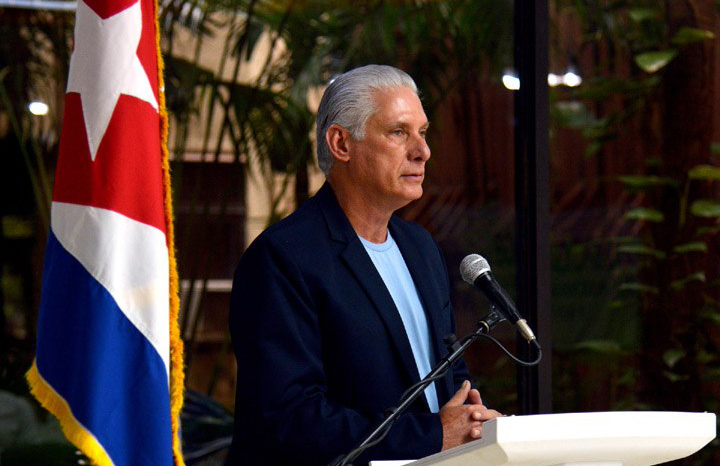
The Center for Genetic Engineering and Biotechnology (CIGB) is a bastion and an example of what the Revolution can achieve when it puts science at the service of the people, stated Miguel Díaz-Canel Bermúdez, First Secretary of the Central Committee of the Communist Party of Cuba (CCPCC) and President of the Republic, at the ceremony commemorating the 40th anniversary of this institution on Wednesday.
The president highlighted the vision of Commander-in-Chief Fidel Castro Ruz in founding this center, which demonstrated that a small island could solve its problems and develop with its own talent, at a time when biotechnology was booming in countries with greater resources.
Diaz-Canel also highlighted the center’s achievements in treating various diseases, including COVID-19, diabetic foot ulcers, hepatitis B, and other ailments. He further praised the research conducted in the agricultural sector, which contributes to food sovereignty.
The Cuban president added that over the past 40 years, the CIGB has transformed the challenges posed by the U.S. blockade against Cuba into stepping stones for greater growth and service to the Cuban people.
During the meeting, the CIGB recognized Army General Raúl Castro Ruz, leader of the Revolution, and Díaz-Canel for their support and guidance of the center’s work.
In her remarks, Marta Ayala Ávila, member of the Political Bureau, Hero of Labor, and Director General of the CIGB, emphasized the Commander-in-Chief’s role as the driving force behind the institution’s success. She also acknowledged the founders and employees who have contributed to the consolidation of this high-tech enterprise over the years. The director general of the CIGB emphasized that at a time when imperialist aggression is intensifying, this group is even more committed to improving the population’s quality of life through science and innovation.
During the event, tributes were paid to the pioneers of leukocyte interferon, which was used to combat dengue fever in the country during the 1980s, as well as to workers with outstanding careers and to CIGB-affiliated institutions with recognized contributions.
In exclusive statements to the Cuban News Agency, Eduardo Pentón Arias, founder and pioneer of interferon research, noted that more important than the distinction received is the daily scientific work done for the well-being of people.
Speaking of the CIGB, Pentón Arias described it as an important part of his life, to which he owes his professional growth and to which he will always be connected.
Also recognized was Eduardo Martínez Díaz, Deputy Prime Minister, who for many years was associated with the center as head of the laboratory, deputy director, president of the BioCubaFarma Group, and Minister of Science, Technology, and Environment.
The Cuban Workers’ Federation, at the proposal of the National Union of Health Workers and BioCubaFarma, awarded the CIGB the organization’s 85th Anniversary Seal for its outstanding achievements.
The Cuban Academy of Sciences recognized researchers from other countries who have distinguished careers in the scientific field.
On July 1, 1986, Commander-in-Chief Fidel Castro Ruz founded the Center for Genetic Engineering and Biotechnology, which has kept alive for four decades the call of the historical leader of the Revolution to be an institution that elevates Cuban science.
Those participating in the meeting included Manuel Marrero Cruz, member of the Political Bureau and Prime Minister of the Republic, other leaders of the Party, the Government, the Union of Young Communists, the Central Workers’ Union of Cuba, the management of BioCubaFarma, the Revolutionary Armed Forces, the Ministry of the Interior and organizations linked to the CIGB, among others.
IMAGE CREDIT: Jessica Jimenez Gainza | Photo: Omara García
[ SOURCE: AGENCIA CUBANA DE NOTICIAS ]