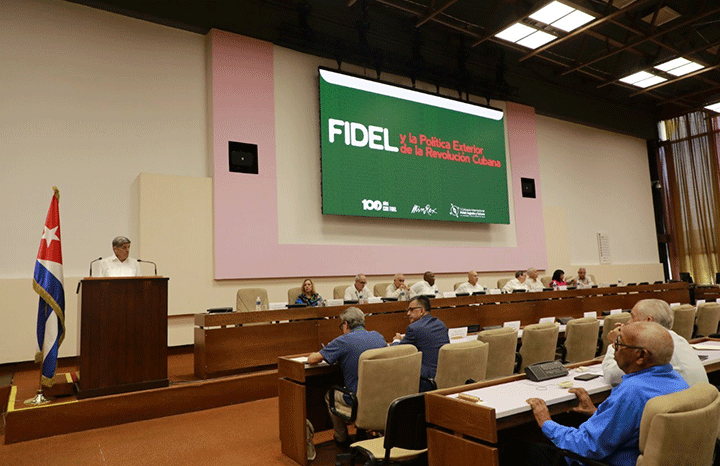
Carlos Fernández de Cossío, Cuba’s Deputy Foreign Minister, urged increased dissemination of Fidel’s thought to end injustice in every corner of the planet during the second day of the First International Colloquium “Fidel: Legacy and Future.”
With Fernández de Cossío’s remarks, the forum dedicated to the contributions of the historical leader of the Cuban Revolution to diplomacy was inaugurated, in the presence of members of the Political Bureau of the PCC: Roberto Morales Ojeda, Salvador Valdés Mesa, and Bruno Rodríguez Parrilla, Secretary of Organization of the Central Committee, Vice President of the Republic, and Foreign Minister, respectively.
The diplomat emphasized that Fidel Castro’s teachings are fundamental to clearly understanding Cuba’s positions on the international stage.
Before an audience that exceeded capacity and applauded his remarks on several occasions, the deputy foreign minister highlighted the Commander-in-Chief’s political and diplomatic management during the October Crisis of 1962, which led Che Guevara to write in his farewell letter: “Rarely has a statesman shone brighter than in those days.”
Regarding those events stemming from negotiations between the United States and the Union of Soviet Socialist Republics (USSR) without Cuba’s participation, Fernández de Cossío praised Fidel Castro’s defense of national sovereignty and recalled one of his key ideas, championed then and always: “For our rights, we are prepared to pay whatever price is necessary.”
He also referred to Fidel Castro’s principle of not negotiating with adversaries the solidarity commitments undertaken by the country, citing as an example Cuba’s responses to the United States government during negotiations in which they attempted to introduce issues unrelated to the bilateral agenda, including Cuba’s support for the independence movements in Puerto Rico and Africa.
Regarding the neighboring island, Fidel Castro always valued the historical foundations that justified solidarity with its right to independence, which would be expressed in Cuba’s support at the UN and other international forums. With respect to Africa, he defended the idea that aid to that contine nt would always be outside the scope of any negotiation.
Carlos Fernández de Cossío also recalled Cuba’s rejection of attempts by the Ronald Reagan administration to condition any potential improvement in trade relations between Washington and Havana on the end of Cuban aid to Latin America, especially to Nicaragua.
The diplomat emphasized that, despite the complexities of the current global landscape, Cuba remains steadfast in its principles of solidarity.
Furthermore, the diplomat delved into Fidel Castro’s constant denunciation of the unjust international order and his proposals to reverse it by utilizing the enormous expenditures of the arms race.
The historic leader of the Cuban Revolution, Carlos Fernández de Cossío explained, was a pioneer in addressing the environmental consequences of accelerated climate change.
Regarding the articulation of his compelling arguments, Fernández de Cossío praised Fidel Castro’s ability to integrate seemingly disparate issues, his intellectual discipline, rigor in handling data, and intellectual appetite. He highlighted his Marxist-Leninist approaches and methods, but without dogma.
The forum “Fidel and the Foreign Policy of the Cuban Revolution” also included two panels and featured moving moments with several messages sent by prominent figures on the global left.
IMAGE CREDIT: Norland Rosendo González / Photo: Luis Jiménez Echevarría
[ SOURCE: AGENCIA CUBANA DE NOTICIAS ]