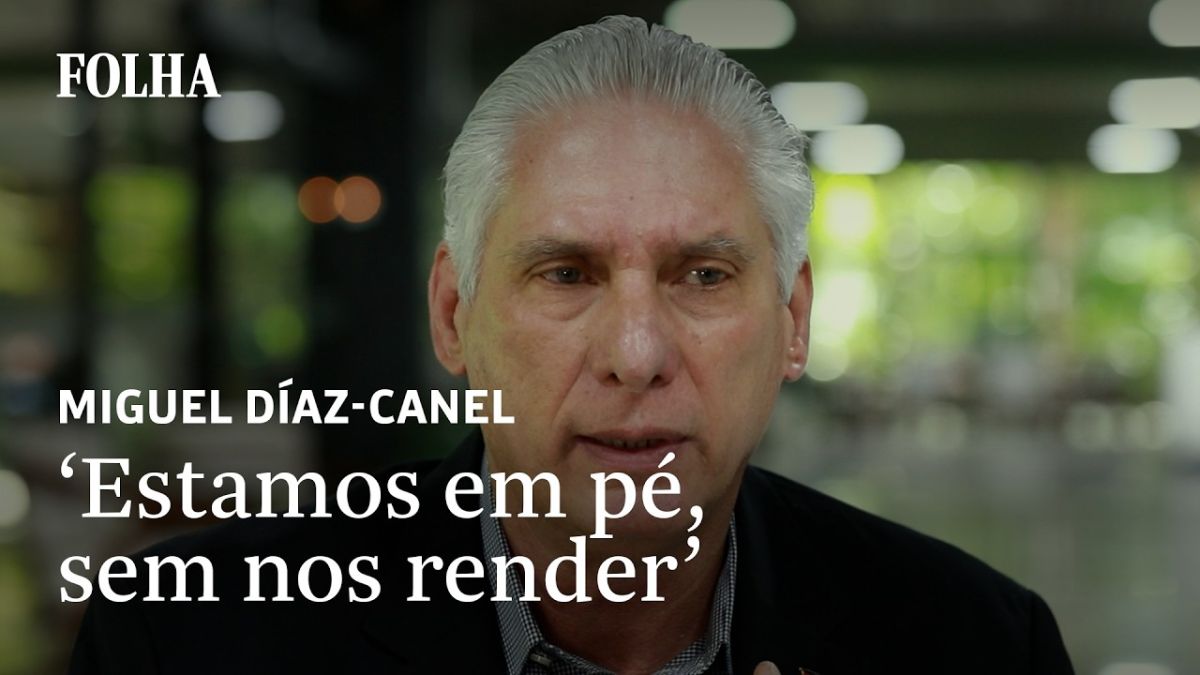
In an interview offering data on the current effects of the blockade on Cuba, Cuban President Miguel Díaz-Canel denounced “the perversity of a government as powerful as that of the United States, which sacrifices the Cuban people in an attempt to subjugate a nation.”
The Cuban president stated that the 176 economic measures approved by the National Assembly, 75% of which already have legal backing, seek to strengthen the national economy and are not concessions to the United States nor an abandonment of the socialist construction process in the Caribbean country.
“The 176 economic measures announced are the result of a refinement debate that has been ongoing for more than 10 years,” the head of state stated in an interview with the Brazilian newspaper Folha de Sao Paulo.
Explaining the context of the reforms that received parliamentary approval in June, Díaz-Canel said that the current economic situation has given greater urgency to changes that were already under consideration, and he defended the incorporation of different economic actors as a way to increase production, attract investment, and generate resources for development.
Among the measures are those that promote greater participation of the private sector, new opportunities for foreign investment, and opening the economy to investments from Cubans residing abroad. In this regard, the president emphasized that the main means of production remain in the hands of the state, and that the new economic actors must contribute to the goal of increasing production and generating benefits for the population.
He stressed that social justice continues to be a central principle of the Cuban project, which is also reflected in the package of reforms approved in June, and that social programs supported by the state budget will continue.
Díaz-Canel denied that the measures were in response to demands from Washington. “The United States has no moral authority to ask us for any concessions, nor are we willing to make them,” he said. He emphasized that the ongoing reforms are part of a national process of economic improvement and not a negotiation with the U.S. government.
Cuba and a possible U.S. military intervention
When asked about the possibility of a U.S. military intervention on the island, President Díaz-Canel responded: “We can expect anything from this U.S. administration.”
He maintained that Cuba is a peaceful country, but noted that there is constant rhetoric of threats, which is why the island is preparing with actions such as National Defense Day. Referring to the military pressure against the island, he stated that “we have no other alternative but to resist.” Asked what would happen to him personally in the event of military action, he affirmed: “If my time comes, it comes. But it will not be with weakness and cowardice. It will be fighting.”
Cuba subjected to silent genocide
When asked about warnings from international organizations, and even US congressmen, that under the unilateral coercive measures of the US the Caribbean nation is becoming a “silent Gaza,” Díaz-Canel agreed and added that “we are subjected to a policy of maximum pressure by the United States government. They are imposing a multidimensional war on Cuba: ideological, cultural, economic and media-driven.”
After pointing out that Washington seeks to economically strangle the country to provoke a social explosion and “that the people, as a consequence of dissatisfaction and accumulated deprivation, will break with the Cuban government, which will lead to the famous fall of the Revolution, which they so longed for and expected,” he recalled that the island is “the nation that has been subjected to an economic blockade for the longest time, and not by just any state, but by the world’s leading power, which controls trade, finance, and the economy.”
Trump, who imposed more than 240 measures against Cuba during his first term (2017-2021), has reinforced the blockade during his second term in the White House, which includes successive rounds of sanctions and an oil blockade.
“They included us on a list of countries that supposedly support terrorism, which is false. This excluded us from the entire system of global economic and financial relations,” Díaz-Canel recalled, adding that, during Trump’s current term, the blockade has become internationalized through the mechanism of secondary sanctions, which penalizes companies from any other country that have trade relations with Cuba.
“In seven months, only one tanker entered the country, from the Russian Federation, with humanitarian aid of 100,000 tons of crude oil. Since then, no more fuel has entered, which has worsened the situation and affected the lives of Cuban men and women. When there is no energy, there is no electricity, no water, no transportation. Domestic life becomes complicated. The lockdown paralyzes the economy.” “No one in the world can survive without energy,” he said.
“A network of sanctions and coercive pressures has been built that restricts the country’s functioning and is becoming genocide,” the president denounced.
The oil blockade has prevented Cuba from generating at least 1,400 megawatts every day and has aggravated the energy crisis, with blackouts and several total and partial failures of the national electrical system so far in 2016.
Blockade against Cuba: From megawatt deficit to the death of children
He explained that during the oil blockade, imposed in January by the Trump Administration, “we were unable to use 1,400 megawatts [daily] due to a lack of fuel.” “If we had used that capacity, the troublesome and prolonged blackouts that occur in Cuba would have been reduced to approximately three hours a day.”
Addressing other consequences of the oil blockade, he said, “We are left without the energy necessary for family life, for production processes and services, for health, education, and transportation,” and specified that there is currently a waiting list of more than 98,000 patients for surgery, including 12,000 children.
There are also more than 117,000 cancer patients, including approximately 1,200 children, who are not receiving cancer treatment, and more than 3,000 people “for whom we are having difficulty guaranteeing hemodialysis treatment.”
“There are already more than 64,000 children with delayed vaccination schedules, something unprecedented. Infant mortality, which was four to five deaths per thousand live births, a rate typical of developed countries, has more than doubled.” “These are infant deaths. Deaths that could have been prevented, since we know how to prevent them,” the president stated.
The pressure from the United States is also causing shortages of medicines and supplies for public health. “Due to the pressure from the United States on shipping companies [threatened with sanctions by Trump if they transport goods to Cuba], we currently have thousands of containers in different ports around the world that are not arriving in the country,” Díaz-Canel denounced.
He explained that these stranded containers hold food, spare parts for the electrical system, photovoltaic systems, and raw materials for the production of medicines. “We can only cover 30% of the basic list of medicines,” he said.
After noting that, in addition, pressure from the White House has led most tourism companies with investments in Cuba to withdraw, resulting in 50% of hotels being closed and some 27,000 tourism sector employees being unemployed, the president remarked: “If we are so incapable, inept, and inefficient, why blockade us? Wouldn’t it be better to let ourselves fall on our own?”
Díaz-Canel acknowledged that Cuba is currently in “a complex situation,” but highlighted the “enormous creativity and heroic resilience of the Cuban people” and that “we are seeking alternatives and waging a constant struggle to overcome these adversities through our own effort and talent.”
“Without electricity, our doctors and nurses arrive at hospitals every day to save lives. Without electricity, our teachers completed the school year, and more than 30,000 university students graduated,” he emphasized.
“It is an extremely complex situation, one of suffering, in which we see the perversity of a government as powerful as that of the United States, which is sacrificing the Cuban people in an attempt to subjugate a nation. And this nation will not surrender, this people will not surrender,” the Cuban head of state emphasized.
IMAGE CREDIT: Amid a situation that Díaz-Canel acknowledges as “very complex,” Cubans have shown this year, in several demonstrations, their overwhelming support for national sovereignty and their rejection of the United States’ multidimensional war. Photo: Cubadebate
[ SOURCE: www.cubainformacion.tv ]