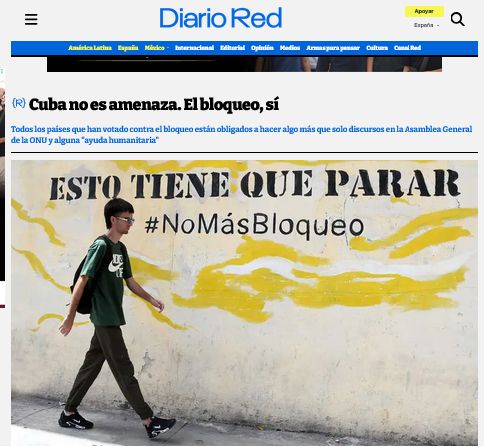
Editorial from Diario Red
The United States government renewed the “Trading with the Enemy Act” for another year, a 1917 instrument that has been used for more than six decades to legalize the economic, commercial, and financial blockade against Cuba.
This is a unique piece of legislation, designed for war, that grants the President of the United States the power to restrict trade with “hostile” countries and apply economic sanctions in times of war “or any other period of national emergency.” It applies only to Cuba and has been renewed annually by 12 US presidents — six Democrats and six Republicans — since 1962.
The UN General Assembly has voted against the blockade 34 times, by an overwhelming majority. Every year since 1992, the member states of the United Nations have rejected the unilateral imposition of the United States on a country that has given the world nothing but solidarity. But every year since 1992, the United States has exercised its veto power against the General Assembly resolution.
Last July, Washington suffered another diplomatic defeat on the issue. After weeks of documented pressure from the State Department, headed by Marco Rubio, to prevent the issue from reaching the plenary session—an urgent debate requested by Cuba that Washington tried to block twice—the UN General Assembly authorized the discussion with a resounding majority of 136 votes in favor, 30 abstentions, and 9 against, including the United States, Israel, and Argentina.
But what good is diplomacy in times of war?
The blockade is not a legal abstraction. It is hunger. It is disease. It is death. The Office of the UN High Commissioner for Human Rights has warned of the “deterioration of humanitarian conditions” in Cuba: infant mortality has doubled to 9.9 per 1,000 live births, childhood cancer survival rates have fallen from 85% to 65%, and more than 100,000 surgeries have been postponed due to the severe shortage of medicines and medical supplies.
The energy crisis, exacerbated by the oil blockade imposed by Trump on January 29, 2016, has left Havana and other provinces with blackouts of up to 22 hours a day. In five months, Cuba received only one of the eight monthly oil shipments it needs. Pregnant women, children, the chronically ill: all pay the price for a policy that the Cuban government has called “genocidal.” US congresional representatives have also called it a silent Gaza.
This Tuesday, August 25th, Cuban Foreign Minister Bruno Rodríguez once again strongly condemned the Trump administration’s decision to extend the embargo for another year, until September 2027. The United States is trying to “suffocate an entire nation,” he said. And he declared: Cuba is not a threat. The embargo is.
However, the world watches. Or more precisely: the world looks the other way. Rejection at the UN doesn’t save lives. Some governments, like Mexico’s, promptly send basic humanitarian aid, but it is still insufficient. Strategic support is needed to address the shortages that endanger the lives of 10 million people and the very existence of Cuba, a country that has been a powerhouse in sports, science, education, and solidarity. The 26,000 children from Chernobyl that Cuba received and cared for in Tarara during the so-called Special Period (which was only “special” in the level of US brutality) are just one example.
The question is, why the silence? Why is it that when the United States announces unprecedented economic sanctions against Iran, the world doesn’t follow suit in this delusional madness? Why does Europe refuse to send military ships to the Strait of Hormuz but accept that 7,000 containers of supplies for Cuba remain stranded in the Caribbean? Why, when it comes to Cuba, does the same mechanism used to defend sovereignty become a kind of tolerant indifference? Just like with Palestine. Or Venezuela. Or Haiti. Or Congo. The international community applies a different standard when it comes to a country with powerful allies, like China, with whom no one wants to antagonize these days.
Cuba is not a threat to anyone. Cuba is a country that has been the victim of the longest-lasting unilateral coercive measure in contemporary history. The blockade is not a multidimensional pressure policy aimed at economically suffocating Cuba. And yet, the international community treats this silent genocide as if it were a minor issue, a trade dispute, a problem of “the Cubans” and their “regime,” because we mustn’t forget that the primary pretext for the blockade is democracy.
Ending the blockade requires more than just the courage to defy the empire. It requires audacity, political imagination, and a firm resolve not to be complicit in such an injustice.
Cuba resists. It has done so for more than six decades. But resistance is not the sole responsibility of Cubans. All countries that have voted against the blockade are obligated to do more than just deliver speeches at the UN General Assembly and offer some “humanitarian aid.” They are obligated to press for the fulfillment of the mandate, repeated every year, to end this irrational blockade.
[ SOURCE: www.cubainformacion.tv ]