By Ben Grosscup
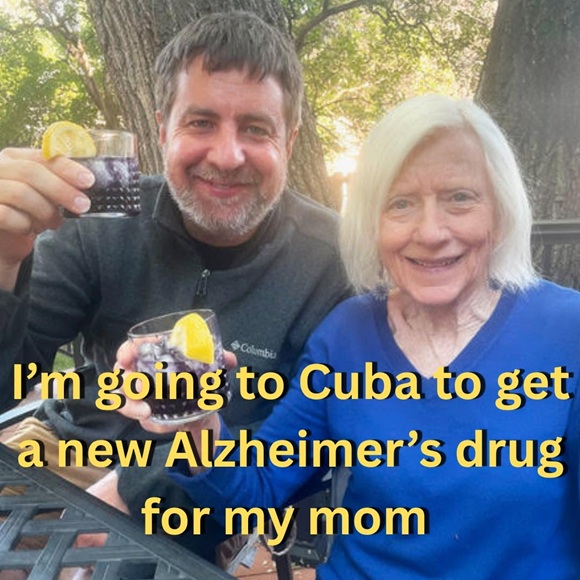
My father took this photo of my mother and me in June 2026, days before my mother was diagnosed with early-stage dementia, likely Alzheimer’s. I always expected pain and devastation for families after this diagnosis. The medications available in the United States do not stop, much less reverse, the progression of this degenerative neurological disease.
But my research this summer on NeuralCIM — a Cuban drug marketed earlier this year — as given me hope. I’m traveling to Cuba on September 15th and will return with a 48-week supply for my mother.
Clinical trials showed promising results in patients with mild to moderate dementia, with no major side effects. Of the 174 Cuban participants, 30% stabilized: their symptoms didn’t worsen after 48 weeks. That already surpasses what Alzheimer’s drugs achieve in the U.S. But 54% showed measurable improvements that were maintained at successive annual checkups. That’s unprecedented in U.S. dementia care.
My family noticed changes in my mother’s thinking long before her diagnosis. But because the disease hasn’t progressed too far, the worst effects could still be avoided.
Given that 600,000 Americans become disabled by Alzheimer’s each year, it’s disheartening that so few people know about NeuralCIM. But a doctor in Colorado — Dr. Bill Blanchet — is guiding his Alzheimer’s patients to obtain this medication in Cuba. His staff told me that 85 patients at his practice, Boulder Internal Medicine, have already done so. They aren’t accepting new patients, but they did provide me with free guidance on how to access NeuralCIM directly at Clínica La Pradera in Cuba, which treats international patients. In interviews, Dr. Blanchet describes his collaboration with Cuban doctors, how he has seen his patients improve dramatically, and why his colleagues in the medical community should take note.
Why aren’t advances like NeuralCIM being more widely promoted in the United States? Why aren’t U.S. medical institutions already conducting their own clinical trials, moving as quickly as possible to make this treatment available to the millions of families currently suffering from this disease?
Part of the problem is geopolitics. The U.S. government is committed to enforcing a brutal blockade against Cuba. This policy began in 1960, after the Cuban Revolution, which, from Washington’s perspective, turned the island into a geopolitical adversary. In January 2016, Trump cut off the flow of oil to this import-dependent country, triggering the worst humanitarian crisis Cuba has suffered since before its Revolution.
Cuba now lacks enough oil for basic services. The country suffers rolling blackouts amid sweltering heat. People cannot operate refrigerators, fans, or stoves. They can no longer afford basic necessities. Public transportation is paralyzed. Although the health sector receives priority in the distribution of the scarce electricity available, even hospitals cannot keep the lights on continuously. Faced with widespread shortages, surgeries are being postponed.
Deep-rooted corporate interests are another obstacle to the distribution of NeuralCIM in the U.S. U.S.-based private equity firms have significant investments in the multibillion-dollar dementia care industry. Cooperating with Cuba to provide the American population with access to drugs that reverse Alzheimer’s would simultaneously benefit the Cuban economy while reducing the profits of these firms. Thus, U.S. policy inflicts unnecessary suffering on both populations.
This outrageous brutality is part of a broader global order of organized cruelty. I witnessed this firsthand when I visited Iraq in 1999 as part of a peace delegation. I was just 18 years old. At the time, the United States was strangling Iraq with sanctions designed to cause malnutrition and disease among the most vulnerable. The emaciated bodies of the starving children I saw in the hospital wards revealed the true nature of U.S. sanctions. Since then, I have been an activist against the US economic war, but I never imagined that my own mother’s well-being would depend on the generosity and hospitality of the very nation my government was trying to destroy.
After years of successive US administrations providing weapons and political cover for Israel’s mass killing of Palestinians, it is now undeniable that the elites of both political parties have normalized genocide as a means of resolving a political conflict. Changing course requires a political rupture that compels US institutions to radically transform their priorities.
Success would mean the following: US healthcare organizations would license NeuralCIM’s technology and conduct accelerated clinical trials here. People with Alzheimer’s in the US could obtain affordable prescriptions from their own doctors, without having to travel thousands of miles. Cuba’s economy would stabilize, and its medical system would be strengthened.
In contrast to the U.S. healthcare model, the socialist values that underpin the Cuban system prioritize the health of the population, not enriching a small minority. Dismantling U.S. imperial domination would pave the way for these humanist values to be adopted here as well.
Thanks to Cuban ingenuity, I have hope for my mother. As long as U.S. Customs officials don’t detain me, I trust she will be all right.
For now, I reserve my grief, my devastation, and my solidarity for the people of Cuba, who are being subjected to unimaginable horrors by our government in retaliation for defending their revolution.
As a small gesture of solidarity, I am filling my suitcases with medical supplies that the embargo has artificially made scarce. As I determine how much I can actually take with me, I may ask for help. In the meantime, if you have resources or ideas on how to collaborate, please write to me.
IMAGE CREDIT: Ben Grosscup with his mother, in a photo he shared with the message: “I’m going to Cuba to get a new Alzheimer’s medication for my mom.” Photo: Ben Grosscup/Facebook.
[ SOURCE: CUBA DEBATE ]