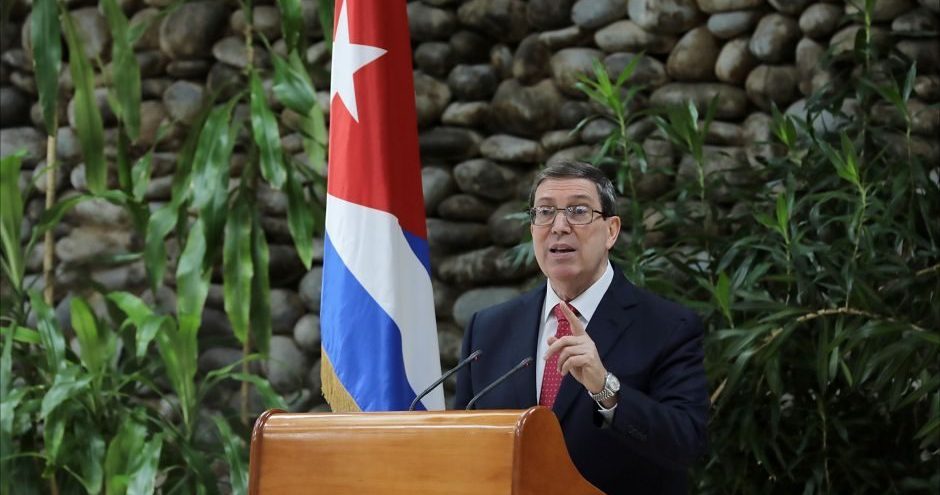
The blockade doesn’t punish a government; it punishes the daily lives of an entire people. Cuban Foreign Minister Bruno Rodríguez Parrilla denounced before the national and international press the impact of the economic, commercial, and financial embargo on access to fuel, water, medicine, healthcare, and transportation, and emphasized that “it doesn’t punish a government; it punishes the daily lives of a people in every aspect.”
The economic, commercial, and financial blockade imposed by the United States government against Cuba constitutes an act of “collective punishment” that directly impacts the daily lives of Cuban families, stated Bruno Rodríguez Parrilla, member of the Political Bureau of the Central Committee of the Communist Party and Minister of Foreign Affairs, during the presentation of Cuba’s Report on the Blockade to the national and international press accredited in the country.
The Minister of Foreign Affairs explained that the report, which the Republic of Cuba traditionally presents to the Secretary-General of the United Nations at the latter’s request, “provides rigorous information on the economic, commercial, and financial damage caused by the United States government’s blockade against Cuba.”
However, he stressed that this time the emphasis is on “the tremendous impact on people, on Cuban families, ultimately, on our entire population,” because “the blockade doesn’t punish a government; it punishes the daily life of a people in every aspect. It is an act of collective punishment.”
This impact, he pointed out, is expressed in “the long months spent living with only two or three hours of electricity a day, or less, with food spoiling, the heat that makes it impossible to sleep, parents fanning their babies, children doing their homework in near darkness, young people without internet access or recreation, grandparents without television or sometimes even radio—all family life disrupted.”
Bruno Rodríguez also denounced the impact of the measures targeting fuel supplies. He recalled that the U.S. President’s executive order of January 29th “decreed a fuel embargo that prevents supplies, even those already paid for, under the threat of sanctions,” while also “intimidating and harassing the companies that own the ships and tankers.”
“It threatens shipping companies and prohibits them from transporting even parts and components for thermoelectric plants or photovoltaic systems,” he noted.
In that regard, he explained that “a 100,000-ton crude oil tanker would drastically reduce blackouts for approximately two weeks,” while importing fuel oil and diesel for the generators of so-called distributed generation would allow for “minimal blackouts.” However, “the fuel embargo prevents imports.”
Cuba, he specified, “has rapidly transformed its energy matrix with solar power,” but pressures have also increased in this area. “Now shipping companies are being threatened not to bring solar panels or batteries for the new photovoltaic parks that we have learned to install in just 45 days,” he denounced.
The energy blockade, he added, has consequences that go beyond the interruption of electrical service. “The punishment manifests itself in weeks without water supply,” he stated.
He explained that the water supply sources operate using sets of electric motors that shut down during blackouts and that, even after a brief interruption, “it takes several hours to recover water pressure in the pipes.”
The same situation, he noted, affects “pumping plants, booster pumps, and the pumps in the pipelines.” Although these systems are protected by generators, “these also run on fuel oil or diesel, which we are not allowed to import.”
“The blockade deprives us of resources; it also prevents us from importing parts and components for these generators,” he denounced. Nevertheless, he affirmed that “we are working diligently to mobilize generators capable of operating and to secure photovoltaic energy for the water supply.”
The blockade doesn’t punish a government; it punishes the daily lives of an entire people.
A BLACKOUT CAN DEFINE A LIFE
The consequences take on a particularly dramatic dimension in the public health system. “The power outage punishes newborn babies who depend on the stable functioning of medical equipment, such as an incubator, for their survival,” he stated.
When a blackout occurs and the hospital’s generator fails, “doctors have to save them with manual techniques,” as is the case when providing assisted ventilation. A similar situation is faced by those awaiting surgery, including children, due to the difficulties in ensuring the operation of the generators that power the operating rooms.
The Minister of Foreign Affairs noted that “there have been dramatic incidents in which some major surgeries have had to be completed using rechargeable lamps or, in some cases, the light from medical personnel’s cell phones.”
“People awaiting surgery know that this service is limited precisely because of the lack of electricity, which is especially true due to the lack of fuel,” he stated.
Despite these limitations, he emphasized that “a great effort has been made, with encouraging results, to protect hospitals, polyclinics, and other health centers with photovoltaic systems.”
The blockade, the Foreign Minister added, “punishes those who have a sick person at home and difficulties transporting them to the hospital, or a family member who requires hemodialysis,” and who are aware of “the fuel limitations affecting ambulance services and others.”
“Despite everything, ambulances have been acquired, a minimum fuel supply for them is guaranteed, and transportation for hemodialysis is ensured,” he specified.
The complaint also addressed the difficulties in guaranteeing essential medications. “Parents and relatives are suffering as they anxiously search for essential medications that may be in one of the more than 7,000 containers that U.S. government threats against shipping companies are preventing from reaching the island, or that are produced in Cuba but whose raw materials or supplies are in another container,” he explained.
Referring to infant mortality indicators, Bruno Rodríguez pointed out that the data shows “an increase in infant mortality from four per 1,000 live births in 2018 to 9.9 in 2025.” He emphasized: “They are children, not numbers.”
“These are deaths that should not have occurred because Cuba and its robust and effective public health system were deprived of legitimate resources,” he stated, while reminding everyone that this is the system responsible for “caring for pregnant women, treating sick children, and attending to anyone arriving in a medical emergency.”
“Healthcare needs resources, and patients need timely treatments, which the energy blockade and measures against shipping companies prevent from reaching Cuba,” he maintained.
The cruelty of the blockade, he concluded in this segment of his remarks, is also evident “in the thousands upon thousands of Cuban men and women who struggle daily to get to work without public transportation because the vehicle fleet is practically paralyzed due to a lack of fuel.”
The damages caused by the blockade, during March 2025 and February 2026, increased by 7% compared to the previous year.
The Cuban foreign minister reported that the damages caused by the blockade during the period from March 2025 to February 2026 reached $8,083,000,000, representing a 7% increase over the record registered the previous year.
He also stated that the accumulated damages over decades of the blockade amount to $178,700,000,000 at current prices, 4.7% higher than previously reported.
The report estimates that, without the blockade, Cuba’s Gross Domestic Product at current prices would have grown significantly in 2025, reflecting lost opportunities for productive revitalization, exports, and social development due to the effects of this collective punishment.
Bruno Rodríguez pointed out that, despite the extreme intensification of the blockade with the executive order of May 1st, which causes suffering and anguish to Cuban families due to the decline in real income and the increased cost of living, Cuba has managed to begin the school year with guarantees and assurances under conditions of universality, equity, and quality—”unmatched by Latin American countries or even the United States itself in low-income communities”—ensuring the essential annual funding for the special education of children and young people with disabilities.
He emphasized that the fuel blockade and threats against shipping companies cause blackouts, prevent water supplies, and affect all services to the population. The hostility and aggression reach all aspects of life, and these are not collateral damage, but rather the victims of an aggressive design and a coldly calculated plan.
He noted that US President Donald Trump declared on January 8, 2026, “responding to a question about the policy against Cuba, ‘I don’t think much more pressure can be exerted except to go in and wreck the place.'” Similarly, Secretary of State Marco Rubio, who consistently lied by saying the fuel blockade didn’t exist, declared on August 7: “There are no escape valves.”
The foreign minister pointed out that every time a new mechanism is created to try to break free from the blockade, it is simply blocked, and he described this sentiment as the same destructive spirit behind the genocide being committed in Gaza, “although in Cuba it is silent, without bombs, but it also kills.”
“What country under these conditions could maintain peace, social consensus, stability, citizen participation in finding solutions to difficulties, and public safety? Cuba will never be defeated.”
Today, the most pressing needs of the population are being addressed with great effort. Social policies are being maintained and improved as a top priority, ensuring that no one is left behind. We will move forward quickly and decisively in implementing the economic and social changes recently approved by the National Assembly of People’s Power.
The blockade doesn’t punish a government; it punishes the daily lives of an entire people.
“CUBA IS NOT A THREAT. THE BLOCKADE IS.”
Rodríguez Parrilla also denounced the rhetoric and actions of U.S. political sectors that promote confrontation with Cuba and advocate for aggression against the island.
“Terrible statements are made daily not only by government officials, but also by rabidly anti-Cuban members of Congress, by extremely conservative neo-fascist figures in U.S. politics, and by the henchmen and thieves who profited during the Fulgencio Batista dictatorship,” he stated.
He also referred to those who “think that the solution for Cuba is U.S. tutelage” and to those who intend to hand the country over “to the worst forces in Miami who have always thrived in the anti-Cuban industry.”
“It is the politicians who call for violence, who condone terrorist acts, who incite the destabilization of Cuba, and who constantly urge the President of the United States to launch a direct military attack against our people,” he denounced.
For the Foreign Minister, “closing off all economic outlets for a country means suffocating the entire population and attempting, in that endeavor, to induce a humanitarian crisis through collective punishment.”
In response, he asserted: “There will be no humanitarian crisis in Cuba because our people are deeply compassionate, understand and are highly aware of the causes, the problems, and the suffering we face, mobilize collectively in close unity, and are the driving force behind the changes we are introducing.”
These changes, he explained, seek to address “problems of the past and the extremely difficult current situation” through “an updating and reform of our economic and social model, oriented toward social justice, equal opportunities, and the dignity of all Cubans.”
Rodríguezalso rejected the arguments used to justify U.S. policy toward Cuba.
“It is not an attack on a government with which our northern neighbor has political differences. It is in no way an act of legitimate self-defense by the world’s leading nuclear, technological, and economic military power.”
Nor, he affirmed, “does it protect any national interest, nor that of U.S. citizens or businesspeople,” nor does it “represent or respond to the will, feelings, or interests of the taxpayers and voters of this country.”
Washington’s policy, he added, also does not respond “to the feelings and interests of the vast majority of Cubans residing abroad, particularly those residing in the United States, nor to their descendants who want the best for their families, for their nation, for their homeland.”
The foreign minister also rejected the accusation that Cuba constitutes a threat to the United States.
“Cuba is not a threat. The blockade is. Cuba is in no way a threat. We are a country of peace; we want and deserve peace,” he emphasized.
“Along with the overwhelming majority opinion of the international community, I reiterate now, and we will reiterate at the United Nations: end the blockade. Let us live in peace.”
THE ALLEGED HUMANITARIAN AID: “THEY LIE CONSTANTLY”
When asked by the press about the $100 million in alleged humanitarian aid announced by the United States government, Rodríguez Parrilla stated categorically: “Yes, they lie constantly.”
He explained that “the offer of the supposed $100 million in humanitarian aid to Cuba was unusually made public at the Holy See when it wasn’t even known to Cuban churches or our government.”
He recalled that, after the Cuban government “had accepted and provided humanitarian aid worth three million dollars” in response to the damage caused by Hurricane Melissa, an offer of an additional nine million dollars had been made. However, “some obscure arithmetic at the State Department reduced this figure to six million dollars,” an offer that was accepted by international religious institutions, churches in Cuba, and the Cuban government.
“Of the nine million that were initially allocated and later reduced to six million, just over one million has been disbursed,” he reported.
Regarding the $100 million announced later, he specified that “a shipment of food and hygiene products for 700 Cuban families has been delivered.”
Therefore, he again challenged the United States government, “particularly the State Department,” to report “when this humanitarian aid will begin, whether it will include medicine and food, which is a true priority for our people, and why it is taking so many months to be implemented.” “When will it start, and above all, when will it end?” he asked.
The island’s foreign minister reiterated that “Cuba always accepts all humanitarian aid offered from any corner of the world” when it is carried out in accordance with international practices and the cooperation norms recognized by the United Nations, “which always completely exclude any conditions or political manipulation.”
“No one should profit politically from need or suffering,” he stated, while also emphasizing that “any formula that undermines national sovereignty” is excluded.
He further reported that the Cuban government maintains “close contact with Cuban churches” that will participate in the distribution of this aid and will provide them with “full support to ensure it is swift and effective.”
TALKS SHOW NO ADVANCE OR PROGRESS
Regarding the talks between Cuba and the United States, the island’s foreign minister confirmed that “there have been talks with the State Department” and that “communications are ongoing.”
However, he specified that “these talks show no advance or progress due to the lack of willingness on the part of the United States government.”
Cuba, he affirmed, “reiterates its willingness to continue these talks on the basis of international law, without preconditions, in sovereign equality, on an absolutely equal footing, based on mutual respect and reciprocal benefit for our peoples, without interference in our internal affairs.”
“There have been, and are, no negotiations, agreements or roadmaps,” he asserted.
ECONOMIC TRANSFORMATIONS ARE A SOVEREIGN RIGHT OF CUBA
There has been no official statement from the United States government regarding the economic and social changes recently decided by the National Assembly of People’s Power, reported Bruno Rodríguez.
“There have been no such statements, and the truth is, there is no need for them because they pertain to the exercise of the sovereign powers of the Republic of Cuba, which reside undeniably and solely in the Cuban people.” he affirmed.
However, the island’s foreign minister noted that Cuba constantly receives “signals and inquiries from broad sectors of American society, from individuals, from Cubans residing in that country, from businesspeople and companies, from people of goodwill,” and from “members of the United States Congress, politicians from various states,” all interested in learning about the opportunities that these transformations open up for expanding trade, cooperation, and investment ties.
“Above all, they contrast the scope of these transformations with the tightening of the energy embargo and the persecution of shipping companies that transport supplies to Cuba,” he explained.
In that context, he said, they ask “how they could do it under those circumstances” and show particular interest in knowing the contents of the more than 7,000 containers that remain affected by the pressure tactics.
“We find it striking that they consistently ask what’s in those more than 7,000 containers, whether those containers have already been paid for, whether they correspond to contractual relationships, to contracts signed with international shipping companies, and which entities in Cuba have contracted for those shipments,” he noted.
Cuba’s top diplomat emphasized that these interlocutors “are astonished” when they learn that “most of those shipments have been contracted by small and medium-sized Cuban private companies” and that “the bulk of those shipments are food, medicine, and medical devices.”
He clarified that these are “shipments previously contracted and paid for according to universally accepted rules of international trade.”
Bruno Rodríguez described the energy blockade policy as “inappropriate in a peacetime situation,” considering it “an act of war that affects freedom of trade and freedom of navigation.”
THE DAMAGES FROM THE ENERGY BLOCKADE ARE NOT YET INCLUDED
Referring to the calculation of losses caused by the blockade, the Cuban foreign minister explained that the figure presented to the press “is a rigorous calculation based on a methodology that adheres to international standards.”
He recalled that this methodology “was audited several years ago by a commission of the United States Congress, which declared it compliant with international accounting practices and methodologically rigorous.”
He clarified that the figure presented “does not include the damages from the energy blockade, nor does it include the damages from secondary sanctions,” whose effects, in the case of the January 29th order, “began to be felt the following week.”
Therefore, he announced that “we will try to finalize this year’s statistics as soon as possible,” maintaining the methodology established by the Cuban entities that regulate economic statistics and the methodology derived from the United Nations General Assembly resolution requesting the Secretary-General to report on its implementation. “We have not wanted to alter that methodology,” he stated.
However, Bruno Rodriguez added that “the damage in these months far exceeds the damage that occurred in the preceding period.”
CUBA PREPARES TO DEFEND ITS INDEPENDENCE
When asked about the recent executive orders from Washington that label Cuba a threat to national security and about the possibility of direct military action, the Foreign Minister was categorical: “They are lying. They are constantly lying.”
In his opinion, this policy of aggression and blockade “is generating so much international isolation and discredit for the United States government.”
But he warned that Cuba takes the threats seriously because “they are not only based on rhetoric,” but also on “the testimonies of numerous serious sources, analysts, and U.S. non-governmental organizations that present evidence that the United States government is making real military preparations.”
“When one hears the President, the Secretary of State, and very recently the Secretary of Defense, saying that direct military aggression against Cuba is among the options on the table for the President of the United States, of course one has to take those threats seriously,” he stated.
Faced with this scenario, “our people, our State, take them very seriously and are preparing to defend our independence, sovereignty, and territorial integrity with unwavering determination.”
Bruno Rodríguez expressed, however, his hope that these threats “will never materialize,” as they “would provoke a true bloodbath,” with the loss of Cuban lives and also of “young Americans who would be sent to a war they do not want, a war that is not theirs.”
This potential aggression, he maintained, “does not serve the slightest national interest, nor the interests of the citizens or the people of the United States.”
“We will defend our independence, sovereignty and territorial integrity with the same determination as in the past.”
The report is available here: Informe de Cuba marzo 2025- febrero 2026`
[ SOURCE: GRANMA ]