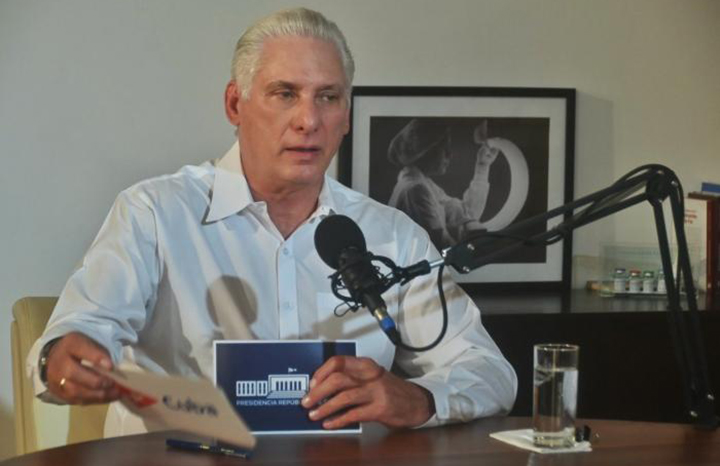
Miguel Díaz-Canel Bermúdez, First Secretary of the Party’s Central Committee and President of the Republic, reaffirmed this Friday the Revolution’s commitment to social justice and the protection of the most vulnerable, in a new episode of the podcast *Desde la Presidencia* (From the Presidency).
During the program — as noted by the Presidency on its official website — the Cuban president stated that it is impossible to speak of a socialist revolution without social inclusion, as a government program oriented toward socialism is, by its very essence, opposed to exclusion.
He recalled that the Revolution has promoted social inclusion since the days of the struggle in the Sierra Maestra. He also highlighted the October 28th vote at the UN General Assembly as a Cuban victory; on that occasion, 130 countries condemned — for the 34th consecutive time — the economic, commercial, and financial blockade imposed by the United States against Cuba, a situation further exacerbated by an energy embargo and various coercive measures.
Joining the President were Jesús Otamendiz Campos, Minister of Labor and Social Security (MTSS), and Dr. Enrique Alemán, leader of the *Quisicuaba* project, based in the Los Sitios neighborhood of Havana.
Díaz-Canel reported that the most recent Council of Ministers analyzed the policy for the care of vulnerable individuals — along with its corresponding regulations — as part of the ongoing monitoring of the 176 Economic and Social Transformations.
Otamendiz Campos stated that social workers and Social Policy Support Groups have visited more than 1.3 million families. An initial assessment identified 876,522 people in situations of heightened vulnerability — a figure that later rose to 883,426 — the minister explained, noting that this category is not static.
He mentioned the pilot implementation of the Multidimensional Vulnerability Index in six of the country’s municipalities, as well as food assistance provided through local distribution centers and international donations, including support from the World Food Programme.
The President emphasized that social justice is not upheld through speeches, but rather through functional institutions; furthermore, defending it requires production.
He specified that the new regulations incorporate social responsibility obligations for companies, cooperatives, and MSMEs (micro, small, and medium-sized enterprises).
The President reflected that behind every statistic lies a human being in need of care, and he reaffirmed that social protection will remain a permanent priority for as long as the problem persists.
IMAGE CREDIT: Lester Capote García | Photos: Estudios Revolución
[ SOURCE: AGENCIA CUBANA DE NOTICIAS ]