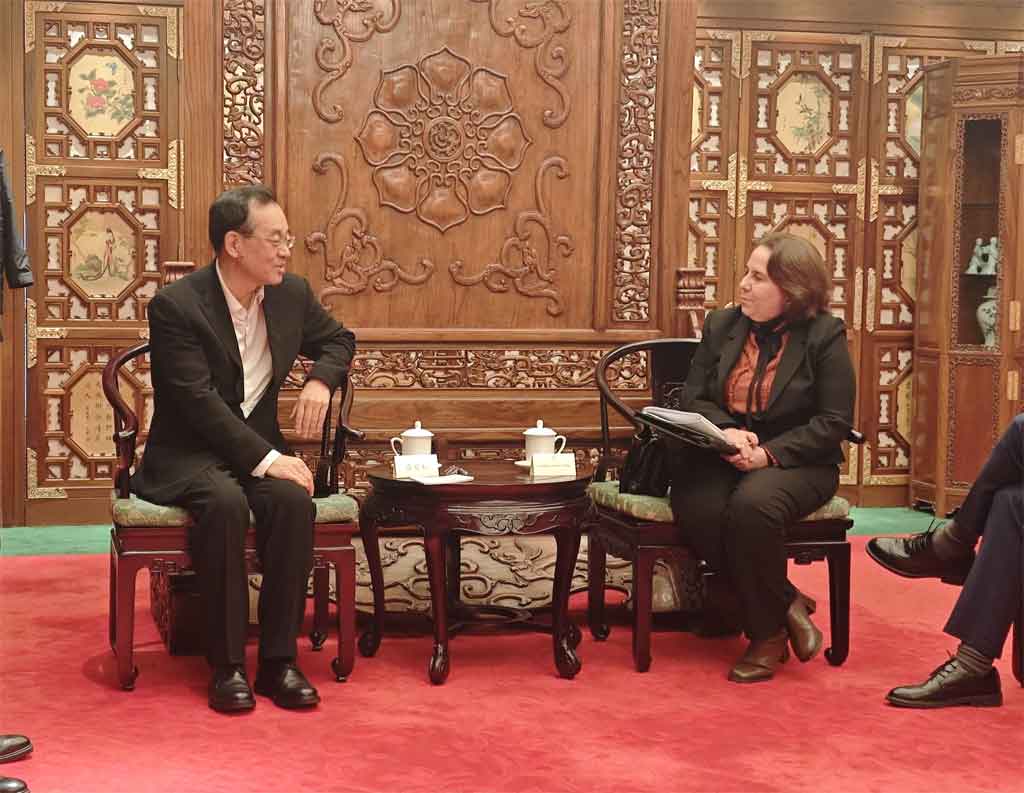
The Xinhua News Agency and representatives from Cuba have reaffirmed their commitment to strengthening historical bonds of friendship and expanding bilateral cooperation during a meeting held as part of the 7th World Media Summit.
The meeting was led by Liudmila Álamo Dueñas, Deputy Head of the Ideological Department of the Central Committee of the Communist Party of Cuba (PCC), and Xinhua’s Editor-in-Chief, Lyu Yansong.
Álamo highlighted the importance of Cuba’s participation in the Summit for reinforcing alliances among media outlets, especially given the complex situation the island currently faces.
She noted that Cuba is going through a period marked by hostility from the United States, an energy blockade imposed by Washington, and the intensification of the economic, commercial, and financial embargo.
The Cuban official affirmed that Xinhua supports the island by helping to disseminate the truth about the country’s reality.
Furthermore, she noted that the Summit provides an opportunity to examine the impacts and challenges posed by the development of artificial intelligence (AI) from the perspective of the Global South.
She also remarked on the chance to observe China’s progress and transformations — an evolution that, she noted, continues to surprise Cuban visitors.
Álamo also denounced the media aggression and communication campaigns orchestrated from the United States on social media, aimed at discrediting the Cuban government and distorting the reality of the Caribbean nation.
She expressed gratitude for the support provided by the Asian giant and the Communist Party of China (CPC) in the face of the difficulties Cuba is encountering.
She emphasized that this support is reflected both in multilateral forums and through the cooperation agreements maintained by the two nations, with the goal of building a China-Cuba community with a shared future.
For his part, Lyu Yansong recalled that Cuba was the first country in Latin America and the Caribbean to establish diplomatic relations with the People’s Republic of China, 66 years ago.
The executive highlighted the bonds of friendship, camaraderie, and brotherhood between the two countries, noting that the broad Cuban representation at the Summit reflects the depth of these relations.
Regarding the development of AI, he pointed out that while this technology can enhance efficiency and diversify information products, it cannot replace journalists.
He explained that Xinhua views AI as a working tool rather than an independent employee, and expressed the agency’s readiness to collaborate with Cuban media outlets on professional training and the exchange of experience regarding these technologies.
During the meeting, Alejandro Gómez, Vice President of Prensa Latina, expressed gratitude for Xinhua’s support for the Latin American agency’s energy transition. He underscored the historic ties of friendship between the two institutions, which have been sustained by cooperation agreements for over six decades.
Gómez noted that Prensa Latina’s bureau in China was established more than 55 years ago, highlighting that Xinhua journalists even covered the establishment of diplomatic relations between Cuba and China in 1960.
Meanwhile, Oscar C. Zaragoza, Director of Cuban Television, expressed appreciation for China’s support in the digital transformation of his organization, as well as for donations, credit for the acquisition of equipment and vehicles, and professional training initiatives.
Randy Alonso, Director of Ideas Multimedios, called for advancing bilateral cooperation in the field of communications and in the utilization of AI, through new avenues for exchange and professional development.
Also present at the meeting were Yuniel Labacena, Director of *Juventud Rebelde*; Mario Alzugaray, Deputy Head of the Cuban State Mission in China; and Isaura Diez, Chief Correspondent for Prensa Latina in China.
[ SOURCE: PRENSA LATINA ]