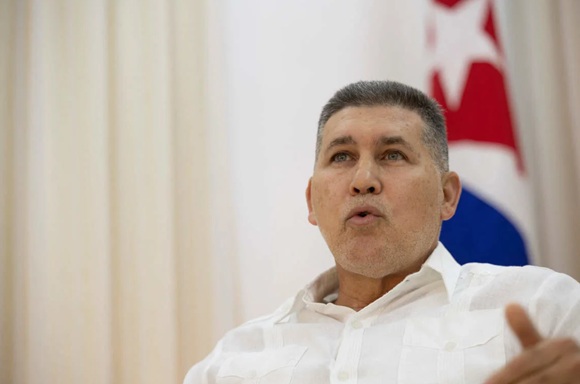
Deputy Prime Minister and Minister of Foreign Trade and Foreign Investment Óscar Pérez-Oliva Fraga gave an exclusive interview to the Reuters news agency, stating that the goal of US measures — “particularly with the intensification of the economic, commercial, and financial blockade to unprecedented levels” — is “to transform our country’s political, economic, and social order.” “They have not achieved that, nor will they,” he emphasized.
Pérez-Oliva noted that this is “a long-standing blockade, a cruel, genocidal blockade” that has been in effect since 1962. He acknowledged that, especially following the executive orders of January 29 and May 1, “foreign companies that have operated in Cuba for many years have been prompted to withdraw — either fully or partially — from business dealings with our country.”
He explained that this occurred “due to the creation of an atmosphere of direct threats against many of these companies and direct acts of coercion intended to force them to abandon their business operations in Cuba,” in addition to threats of sanctions targeting specific sectors covered by those orders. “This has created uncertainty and fear among many foreign companies regarding working, investing, and developing business with Cuba,” he said.
He noted that “this phenomenon is not widespread, contrary to how it is often portrayed in statements by U.S. administration officials.” He acknowledged that “some companies have withdrawn from our country, primarily well-known ones in the tourism sector.”
The energy blockade
Regarding fuel, the Deputy Prime Minister pointed out that the energy blockade established by Executive Order 14380 on January 29 — and subsequently reinforced by Order 14404 — has “effectively imposed a *de facto* naval blockade on Cuba concerning fuel.” Consequently, traditional suppliers who had previously supplied the country “under lawful conditions, in compliance with international trade rules and through legitimate operations,” ceased doing so.
Compounding this is the fear among shipping lines and vessel owners; even when a supplier is willing to trade, “they cannot find a vessel willing to call at Cuban ports and deliver fuel.”
He denounced the fact that the U.S. administration has granted discretionary authorization — in a manner that is “restrictive and, I would say, illicit and irregular” — to certain U.S. companies to sell fuel to Cuba. “However, this is not a matter of selling fuel as one would to any other country in the world, in compliance with standard trade regulations,” he clarified. He explained that the product cannot be delivered in full tanker loads but rather through supply mechanisms that are “highly costly and inefficient, directly driving up costs for the Cuban economy.”
“Quite simply, a country of Cuba’s size cannot function properly relying on a fuel supply based on ISO tanks — which is the current situation,” he stated emphatically. He noted that “very limited quantities of fuel are received in ISO tanks and at high prices,” both due to the procurement method and because — since it is a scarce product that Cuba is “practically prohibited from acquiring” — companies “also capitalize on these opportunities, and prices tend to rise.” Added to this is the state of the international fuel market, influenced by events in the Middle East.
Direct and targeted threats
When asked about the departure of tourism-sector companies like Meliá and Iberostar from the country, he replied that “they have been forced to leave due to threats and direct coercion by the US administration.” He stated that Cuba is “fully aware of the direct threats” those companies and their top executives received from the State Department, “which has urged them—even setting deadlines—to withdraw from Cuba.”
“This situation exists; it is real and well-known,” he acknowledged, but he warned that in public statements and media reports, “it is often blown out of proportion, because I can assure you there is no stampede of foreign investors or companies leaving Cuba.”
He added that, in light of these threats, many companies “have even been singled out on a case-by-case basis, with specific sectors being targeted.” “Threats have been directed at sectors operating in areas of the Cuban economy that generate the external revenue allowing us to keep our economy running,” he noted. He further explained that, alongside this selective targeting, the way the executive orders are designed “instills widespread fear and uncertainty and, in some instances, exerts coercion to force companies to withdraw from Cuba.”
“Cuba will not become a colony again”
When asked if the Cuban government was concerned about a return to an era of colonialism or economic dependence on the United States, he replied: “Cuba will never again become a colony of any country. Cuba achieved its independence, sovereignty and self-determination. That scenario will not return.”
The Deputy Prime Minister acknowledged that, absent the blockade, “trade relations with the United States would play a major role in our commerce, our overall economy, and investment, given the geographic proximity of the two countries.” He added that “there is a natural market in the United States for many Cuban products” and that “many Americans wish to travel to Cuba as tourists — to enjoy our beaches, nature, history and culture — yet they are prevented from doing so precisely because of the blockade.” Many U.S. companies, he said, “would undoubtedly like to work, invest, and do business with Cuba, as we have seen in our exchanges with numerous businesspeople.”
However, all of this currently takes place “within a restrictive environment caused by the very existence of the blockade.” U.S. companies maintaining ties with Cuba “must do so under specific licenses that authorize them and establish a limited scope for their dealings with our country.” “That is precisely where the irregular, illegal, and coercive nature of these actions lies,” he explained.
On one hand, he added, international companies — Cuba’s traditional partners worldwide — are threatened and pressured to refrain from continuing their economic and commercial relationships with the country. On the other, the aim is “to boost the operations of U.S. companies.”
Airlines and shipping companies
The Deputy Prime Minister cited airlines as an example. Following the energy blockade and faced with “the impossibility of acquiring the aviation fuel airlines need to refuel in Cuba,” some carriers were unable to sustain flights to the island due to rising costs. This had a direct impact on international tourism, “one of our economy’s main sources of revenue and precisely one of the targets of that energy blockade.”
“Yet, U.S. airlines continue to fly to Cuba without any issues,” he noted. Some have even “increased or adjusted their flight frequencies based on market demand.”
A similar situation has unfolded in the maritime sector. Major international shipping lines that had worked with Cuba for decades “have completely halted or limited cargo transport to the country due to U.S.-imposed restrictions — measures that are likewise illegal and run counter to international trade norms.”
As a result, “these shipping lines have left basic foodstuffs and medicines stranded in ports across our region.” He cited the example of “raw materials for producing IV fluids and the containers needed for their manufacture in our country,” which were left stranded in shipping containers in Panama. This necessitated “enormous efforts to prevent a shortage of the IV fluids our population requires” — particularly at a time when weather conditions trigger outbreaks of dengue, chikungunya, and other diseases that drive up demand for such supplies. There were also “delays in the arrival of raw materials and supplies for patients undergoing ongoing hemodialysis treatment,” with “direct impacts on these patients resulting from threats against international shipping companies.” It was noted that some shipping lines have begun discreetly transporting cargoes of food and medicine, “albeit on a very limited basis.”
A relationship based on coercion
Pérez-Oliva noted that Cuba has previously stated that, through these actions, the U.S. administration also seeks to increase the island’s economic dependence on the United States — “but based on coercion, threats, and blackmail against foreign companies.” That relationship, he pointed out, “should develop naturally if the blockade were lifted.”
He identified this as a factor with a “multidimensional impact on basic services for our population,” citing the energy sector as an example. Cuba is implementing an energy transition program toward renewable sources, installing generation capacity for the National Electric System, and companies have been acquiring the means “to maintain their viability amidst the energy crisis.” However, he denounced threats against shipping companies, stating they “have been aimed at preventing or delaying the arrival of components needed to install photovoltaic solar systems in our country.”
The mining sector
Regarding the situation of mining companies, the Deputy Prime Miniser said that this is “one of the sectors explicitly mentioned in Executive Order 14404 of May 1st,” alongside the energy, banking, and financial sectors. The order also includes a broad “Other” category, meaning “any sector deemed relevant by U.S. authorities can be included under that illegal order.”
He clarified that “no mining company has withdrawn from Cuba.” “Sherritt remains in our country and continues its joint venture here, as does the other company you mentioned,” he said, referring to Antilles Gold. What has happened, he explained, is that “one of the joint ventures involving Sherritt has been directly sanctioned.” Regarding Antilles Gold, he stated that it “faces the same situation,” adding that “Cuban companies involved in mining sector business activities have also been sanctioned.” This, he said, “has generated fear, uncertainty, and concern among companies that had been conducting business with Cuba in a natural and legal manner.” Faced with this scenario, “those companies are evaluating alternatives to see how they can continue their business operations.”
Regarding the interest shown by U.S. companies, he stated: “First of all, we do not block any U.S. company from doing business with Cuba.” He acknowledged being aware that conversations are taking place, but noted, “we cannot offer any further specifics on the matter because we lack the details.”
He insisted that Cuba has “no policy prohibiting U.S. companies from investing in Cuba, trading with our country, or conducting business of any kind.” “What prevents that possibility is precisely the existence of the blockade,” he maintained, since any participation by a U.S. company “would require express authorization from the U.S. administration.” “That is where the main limitations lie regarding the United States engaging normally with Cuba in trade, investment, and cooperation in general,” he affirmed.
Cuba remains attractive to trade partners
When asked how Cuba prevents the United States from benefiting from a market devoid of competitors, he replied that “we have continued to receive expressions of interest from businesses and companies from all regions of the world,” even amidst this climate of uncertainty. He attributed this interest to the economic and social transformations the country is implementing “in an accelerated and responsible manner.”
He explained that some of these firms were already present in the country and wish to expand their involvement, while others are new. “A significant number of them are also linked to Cubans living abroad who have seen these transformations as an opportunity to contribute to our economic and social development — and, of course, to derive an economic benefit, as any business allows,” he said.
The Deputy Prime Minister reiterated that the U.S. government’s actions “are aimed at creating a forced economic dependency for Cuba,” yet “we continue to work with foreign companies.” He did not mention names, he explained, “because there is a direct economic war against Cuba,” and anyone “could be subject to sanctions next Thursday or this Thursday.” He stated that many companies and businesspeople “approach our country every day to present interests and business proposals,” and that work is proceeding “with a very positive dynamic regarding the approval of new projects.”
When asked how Cuba prevents the United States from benefiting from a market without competitors, the official replied that “we have not stopped receiving expressions of interest from businesses and companies from all regions of the world,” even amidst this climate of uncertainty. He attributed this interest to the economic and social transformations the country is implementing “in an accelerated and responsible manner.”
He explained that some of these firms were already present in the country and wish to expand their involvement, while others are new. “A significant number of them are also linked to Cubans living abroad who have seen these transformations as an opportunity to contribute to our economic and social development—and, of course, to make a profit, as any business does,” he said.
He reiterated that the U.S. government’s actions are “aimed at creating a forced economic dependency for Cuba,” yet “we continue to work with foreign companies.” He explained that he does not mention names “because there is a direct economic war against Cuba,” and anyone “could be subject to sanctions next Thursday or even this Thursday.” He stated that many companies and businesspeople “approach our country every day to present business interests and proposals,” and that work is proceeding “with a very positive dynamic regarding the approval of new projects.”
When asked about alleged overtures from companies linked to President Donald Trump — including a group called Dominari — he replied: “I have no record of any approach to Cuba by companies linked to President Trump during this period.” He reiterated that the country does not block the participation of any company, “provided they contribute, as intended, to our country’s economic and social development and operate in compliance with and respect for our laws,” and noted that Cuba also respects “international trade norms and mechanisms.” A New Real Estate Policy
Regarding opportunities for investors interested in construction — for instance, in the Miramar coastal zone — the Deputy Prime Minister explained that the country’s real estate policy has been updated in two fundamental ways. On one hand, the duration for granting real rights over state assets has been extended; this includes surface rights over land, which “can be granted for 99 years and, in some cases, even under the modality known as perpetual surface rights.” On the other hand, a recent amendment to the Civil Code allows for extending the duration of usufruct rights over existing facilities.
This combination, coupled with the possibility of selling real estate units when a company operates in this sector, “has created an interesting environment for conducting real estate business in our country.” Policy regarding business development in conservation zones and heritage areas — an area of interest for many entrepreneurs — was also updated. He specifically mentioned Old Havana, noting that it “generates great interest,” and pointed out that the Malecón area “is also highly attractive to entrepreneurs working in the real estate sector.”
A company or entrepreneur with the resources to develop a project based on these policies — which “are fully aligned with real estate development policies generally found worldwide” — can undertake this type of business. Building heights and locations, he clarified, “will depend on the urban planning regulations established for each area of the city.” And the Deputy Prime Minister concluded that, with the policy updates and the implementation of economic and social transformations, “there is currently a very interesting landscape for real estate business development in our country.”
IMAGE CREDIT: Deputy Prime Minister and Minister of Foreign Trade and Foreign Investment Óscar Pérez-Oliva Fraga during an interview with Reuters in Havana on Monday, September 28, 2026. Photo: Reuters.
(With information from Reuters)