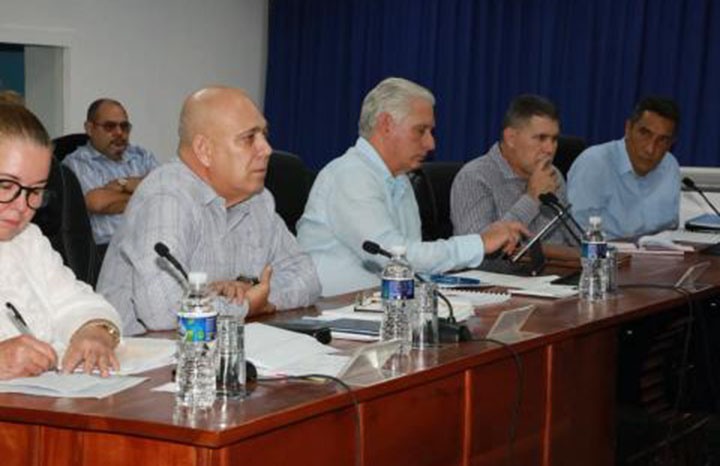
Miguel Díaz-Canel Bermúdez, First Secretary of the Central Committee of the Communist Party of Cuba (PCC) and President of the Republic, has called for strengthening the grassroots organizations of the political party and mobilizing workers to address challenges within the transport sector and improve services for the population.
During the concluding remarks of a recent visit by the Secretariat and the auxiliary structure of the PCC Central Committee to the Ministry of Transport (Mitrans) and the business groups under its purview, the President emphasized that grassroots organizations must be robust, active, and present within every entity, as reported by the political organization’s website.
He noted that among their primary missions is the creation of mechanisms to identify and address problems in a timely manner, as well as to mobilize workers in support of the country’s strategic objectives.
The discussion — which was also attended by Roberto Morales Ojeda, a member of the Political Bureau and Secretary of Organization of the Central Committee — examined the role of Party members in guiding and implementing the economic and social transformations currently underway in the sector.
Morales Ojeda stressed that the Party’s operational framework is aimed at reaching a higher level of functionality—one that will facilitate the swift realization of the agreements reached during the 11th Plenary Session of the Central Committee and contribute to the effective implementation of these economic and social transformations.
“The Party is its members,” Morales Ojeda underscored, reminding those present that being a Party member means belonging to the vanguard of society. He further urged against any signs of routine, formalism, or bureaucracy. In the concluding remarks, it was affirmed that these visits allow for a rigorous assessment of the sector’s situation; Díaz-Canel noted that the implementation of transformations within the organization is proceeding appropriately.
He also acknowledged that the Ministry of Transport (Mitrans) was among the first entities to advance the implementation of several initiatives that have since been adopted nationwide.
The transport sector is strategic to the nation’s economic vitality and the well-being of its people. Therefore, it is essential to work with intelligence, innovation, and creativity to reverse unfavorable indicators—leveraging existing strengths while anticipating an intensification of the economic, commercial, and financial war imposed upon Cuba.
It was noted that secondary sanctions increase operational costs, cause delays in the arrival of goods, and exacerbate logistical difficulties; the impact of the energy blockade on transport services was also highlighted.
The current energy crisis has served as a catalyst for an energy transition—a process to which Mitrans has dedicated significant resources and effort, and which has been identified as a key strategy for addressing fuel shortages.
The meeting also recognized the institutional and digital communication policy developed by Mitrans, which fosters ongoing dialogue with the public and ensures the timely clarification of contingency situations.
The First Secretary called upon workers in the sector to strengthen their role in confronting indiscipline, illegal activities, and other negative behaviors. He further urged them to continue carrying out their duties with responsibility, commitment, and confidence in the nation’s capacity to overcome current challenges.
IMAGE CREDIT: ACN / Photo: pcc.cu website
[ SOURCE: AGENCIA CUBANA DE NOTICIAS ]