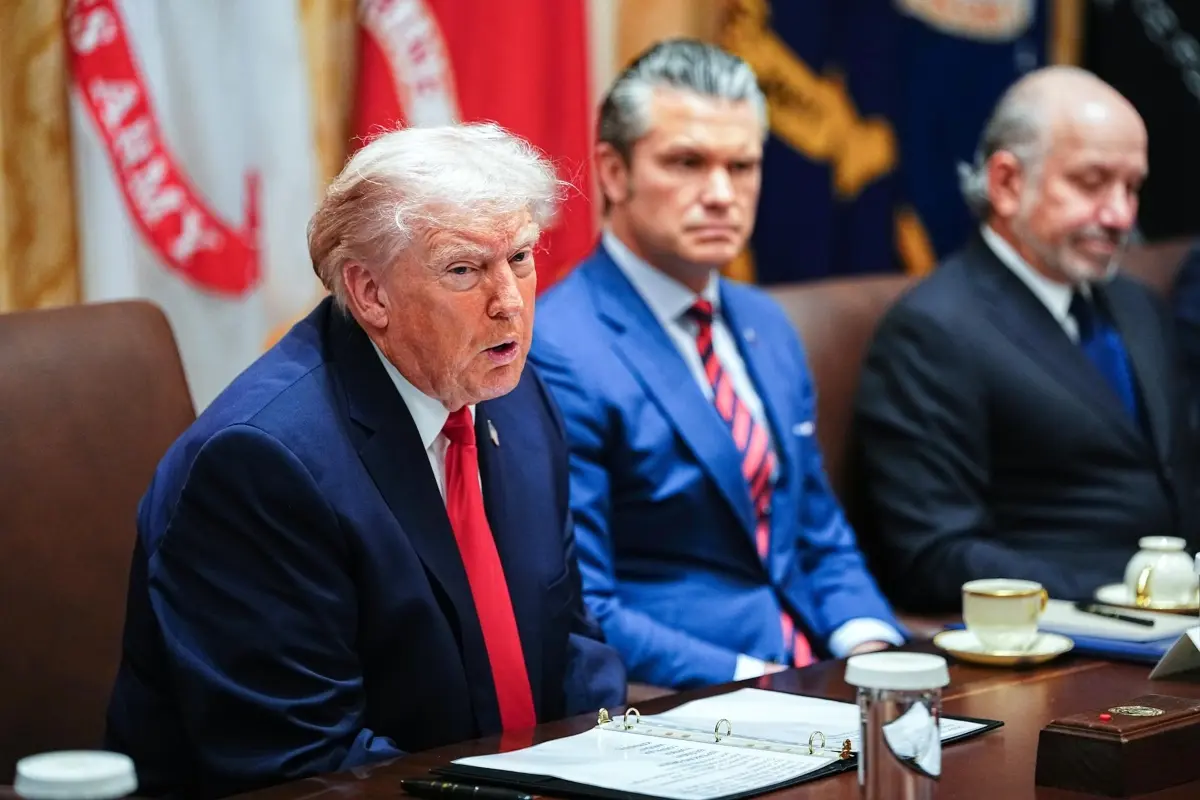
The President of the United States, Donald Trump, signed an executive order this Thursday classifying Cuba as an “unusual and extraordinary threat” to establish that Washington could impose tariffs on goods from countries that sell or supply oil to the island, in a new manifestation of the extraterritorial reach of the blockade policy against the Caribbean nation.
In the executive order, titled “Addressing Threats from the Government of Cuba to the United States,” the US president mentions Havana’s relations with countries like Russia and China and states that “Cuba brazenly harbors dangerous adversaries of the United States,” although he does not specify what he means by that phrase.
He also reiterates the narrative repeatedly refuted by the Cuban government and others in the region, as well as international organizations, by saying that “Cuba welcomes transnational terrorist groups” and that it “supports terrorism,” claims that have been widely discredited and have been one of the arguments used to keep Havana on the unilateral list of states that supposedly sponsor terrorism.
Trump, alluding to his “imperative duty to protect U.S. national security and foreign policy,” says he considers that “the policies, practices, and actions of the Government of Cuba constitute an unusual and extraordinary threat, originating wholly or substantially from outside the United States, to the national security and foreign policy of this country.”
He adds that, “to address the national emergency declared in this order,” he determines “that it is necessary and appropriate to establish a tariff system,” under which “an additional ad valorem tariff may be imposed on imports of goods from a foreign country that, directly or indirectly, sells or supplies oil to Cuba.”
The executive order specifies that U.S. Commerce Secretary Howard Lutnick will determine whether a country sells or supplies oil to Cuba, and subsequently, Secretary of State Marco Rubio will decide whether and to what extent to impose an additional tariff on imports from that nation.
The blockade, decades of aggression and economic warfare
The U.S. blockade of Cuba consists of a complex legal framework of coercive measures and economic aggression that constitute a genocidal, unilateral, and extraterritorial restrictive system. Its objective for more than six decades has been to cause economic strangulation and paralysis, hindering socioeconomic development by imposing severe restrictions and causing suffering among the population.
At current prices, the accumulated damages caused by this policy to the island’s economy amount to more than $170.677 billion.
Taking into account the value of gold on the international market, to avoid fluctuations in the value of the dollar, the accumulated losses exceed $2.1 trillion, according to data from the Cuban government.
“It is not possible to express in figures the emotional damage, the anguish, the suffering, the deprivations that the blockade generates in Cuban families. This has been the case for several generations, since more than 80% of Cubans on the island were born after the beginning of the blockade,” said Foreign Minister Bruno Rodríguez Parrilla in September 2025 when presenting the island’s report on the blockade, intended for the United Nations General Assembly.
The latest report (2025) stated that from March 2024 to February 2025, the blockade caused material losses estimated at $7.556 billion, an increase of 49% compared to the previous period, an increase attributed mainly to the drop in export revenues and the financial persecution that hinders international transactions.
Cuba was once again included by the Trump Administration on the list of alleged state sponsors of terrorism, which makes it a “high-risk” country for any transaction, business, or investment, reinforcing the component of financial restrictions and persecution that is part of the blockade policy.
When presenting the report last September, Rodríguez Parrilla mentioned several examples, including that the economic damage from 60 days of the blockade (US$1.6 billion) is equivalent to the cost of fuel to meet the country’s electricity demand. “If the blockade were to stop for two months, we would have the resources to guarantee the fuel needed to generate electricity,” he emphasized.
He added other examples, noting that the cost of two months of the blockade (US$1.6 billion) would finance the distribution of the subsidized food basket for a year; Sixteen days (339 million) is equivalent to the amount needed to cover the basic list of medicines for the entire country, and fourteen hours (12 million) is equivalent to the amount needed to purchase insulin for the country’s diabetics.
Furthermore, four months of the blockade (2.85 billion) is equivalent to the cost of acquiring the buses required for the country’s public transportation, and two hours (1.4 million) is equivalent to the cost of acquiring the necessary medications for treating cardiology and neurology conditions, as well as food for children with genetic deficiencies and endocrine-metabolic diseases.
He added that 19 minutes of the blockade (US$280,000) is equivalent to the cost of the wheelchairs needed by the Solidarity with Panama school and all other schools in the country to meet the needs of the special education system for children and adolescents with physical and intellectual disabilities.
Rodríguez emphasized that “the blockade is the main obstacle to the recovery of the Cuban economy” and that the structural barriers imposed by this US policy and its legal framework are the primary impediment to any economic activity in Cuba, both state-run and private.
IMAGE CREDIT: Trump at a cabinet meeting this Thursday, January 29, 2026. The president deemed it “necessary and appropriate to establish a tariff system” that in practice would function as a threat and a means of blackmail against countries that supply oil to Cuba. Photo: EFE.
[ SOURCE: teleSUR ]