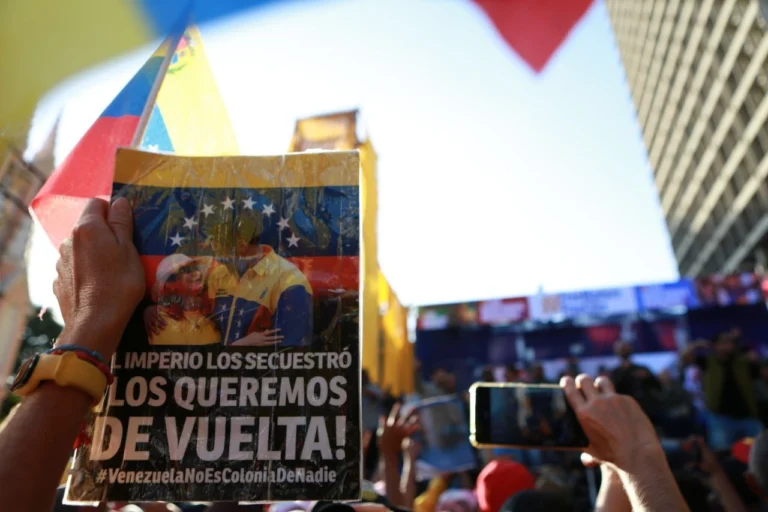
This Tuesday, February 3rd, the Venezuelan capital of Caracas was the scene of a massive popular mobilization demanding the return of the constitutional president of Venezuela, Nicolás Maduro, and the first lady, Cilia Flores, abducted by the United States exactly one month ago.
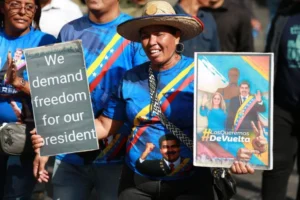
The protest brought together workers, students, and social movements near the La Previsora building in Plaza Venezuela. From there, the march proceeded along Libertador and Urdaneta Avenues, ending at the corner of Santa Capilla in the city center, where the demonstrators reaffirmed their commitment to fighting against external pressures.
Through digital platforms, Nahum Fernández, Vice President of Mobilization and Events for the United Socialist Party of Venezuela (PSUV), emphasized that this mobilization is a demonstration of the “unwavering loyalty” of Venezuelans.
Fernández stressed that, after 30 days of the president and his wife’s absence, the popular outcry has not diminished, emphasizing that national unity is the primary tool to confront the external siege and defend the country’s sovereignty.
The Venezuelan people, under the premise that no power can subdue an organized nation, have reiterated that the goal of the street protests is clear: the return of the Bolivarian leaders; while reaffirming their historical commitment to maintaining Venezuela as a free, independent, and sovereign territory.
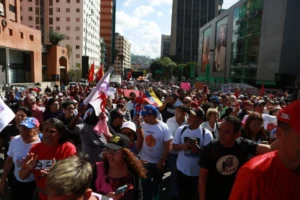
In the early morning of January 3, U.S. military forces bombed Caracas and several areas of the states of Aragua, Miranda, and La Guaira, an illegal incursion that left more than 100 people dead, including civilians and military personnel, among them 32 Cuban combatants.
During the attack, the presidential couple was kidnapped and illegally taken to the United States, where they remain imprisoned in a maximum-security prison. In his first statements before a New York court, Maduro declared: “I am the president of Venezuela and I consider myself a prisoner of war. I was captured in my home in Caracas.”
The president’s courage, as described by Venezuelans, has become a source of strength and resilience in every corner of the country. These are not just political mobilizations; they are acts of love that transform indignation into collective strength, as the protesters have emphasized.
Every slogan heard this Tuesday in the center of the capital is a pledge of loyalty to peace and freedom, reminding the world that the identity of a sovereign nation cannot be imprisoned. As the march progresses, the conviction grows that soon, the embrace of a united people will welcome back their leaders to the land of their birth.
The sense of justice has transcended Venezuelan borders. From the moment of the incursion, not only have the Venezuelan people taken to the streets, but globally, protesters in multiple countries, including the United States, have demanded the return of Maduro and Cilia to their nation.
The rejection of the illegal military attack perpetrated by the Donald Trump Administration has generated an unprecedented wave of international solidarity. Under slogans such as “Hands off Venezuela!” and “No to Colonialism and Fascism!” they denounce the flagrant violation of sovereignty and human rights.
These voices not only demand justice, but also rise up in defense of the right of peoples to self-determination, rejecting the use of war as a mechanism of subjugation.
IMAGE CREDIT: Photo: teleSUR
[ SOURCE: teleSUR ]