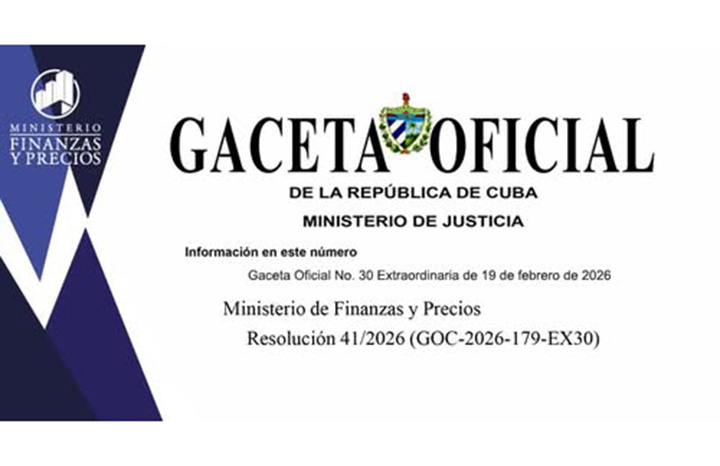
With the publication this Thursday of Resolution 41 of 2026 by the Ministry of Finance and Prices (MFP), the country is introducing incentive measures for the import, installation, and use of renewable energy technologies.
According to Yenisley Ortiz Mantecón, Deputy Minister of Finance and Prices, who spoke at a press conference, this regulation aims to accelerate the energy transition in Cuba, benefiting individuals, legal entities, and all economic actors in general.
The new resolution is also part of the Government Program to correct distortions and revitalize the economy, where the recovery of the national power grid and the diversification of the energy matrix are strategic priorities.
“This resolution strengthens Cuba’s commitment to energy sustainability, promoting self-sufficiency and reducing dependence on fossil fuels,” stated the Deputy Minister.
Regarding the regulatory context, she noted that since Decree-Law 345 of 2017, the Cuban State has prioritized the development and efficient use of renewable energy sources, authorizing the granting of tax exemptions and incentives to those who invest in these technologies.
Based on this foundation, in 2023 and 2025, the Ministry of Finance and Prices (MFP) approved resolutions that refined the tax and tariff treatment, initially focusing on legal entities and then progressively incorporating non-state actors and individuals.
As part of the Government’s policy to support the recovery of the national power grid and promote the transition to clean and sustainable technologies, it was decided to exempt individuals and legal entities from Customs Duty on the importation of photovoltaic solar systems, their essential parts and components, as well as solar water heaters, photovoltaic pumps, and small wind turbines.
Also included in the list are geomembrane biodigesters; biogas-powered water pumps; solar lighting and solar air conditioning systems; electric vehicle chargers that operate using renewable energy sources; equipment for biomass processing for energy production; and their essential parts and components.
Referring to the resolution, the official commented that legal entities importing raw materials, components, parts, pieces, equipment, and accessories for investment projects or for manufacturing equipment, devices, or spare parts intended for the use of renewable energy sources are exempt from Customs Duty.
The state sector and non-state management entities executing electricity generation projects using clean energy sources or utilizing these sources are also exempt from Customs Duty on the importation of machinery, equipment, and other necessary resources during the investment process.
The exemption covers raw materials, components, and equipment intended for investment projects or the manufacture of renewable devices, as well as for state and non-state electricity generation projects.
The exemption is not limited to the importation of equipment; it also applies when the project is for self-consumption or for sale to the National Electric System, provided that generation capacity is available and the technical conditions are met.
This means that the new resolution exempts legal entities and individuals engaged in economic activities, as applicable, from paying Income Tax and Personal Income Tax when they install renewable energy sources for their own consumption or supply energy to the National Electric System, up to the value of their investment, during the recovery period and for a term of up to eight years.
The novelty lies precisely in the treatment of individuals engaged in economic activity (self-employed workers, agricultural producers, artists, intellectuals, and other forms of non-state management), who are exempt from personal income tax on investments made in renewable energy sources.
It is an essential requirement to access this tax benefit that the taxpayer has a pre-feasibility study and obtains a ruling from the National Office for the Rational Use and Control of Energy (ONURE), certifying the use of renewable energy sources in the project and determining the estimated investment recovery period.
These documents are taken to the National Tax Administration Office, which implements the exemption.
IMAGE CREDIT: Ledys Camacho Casado | Photo: Facebook Ministry of Finance and Prices of Cuba
[ SOURCE: AGENCIA CUBANA DE NOTICIAS ]