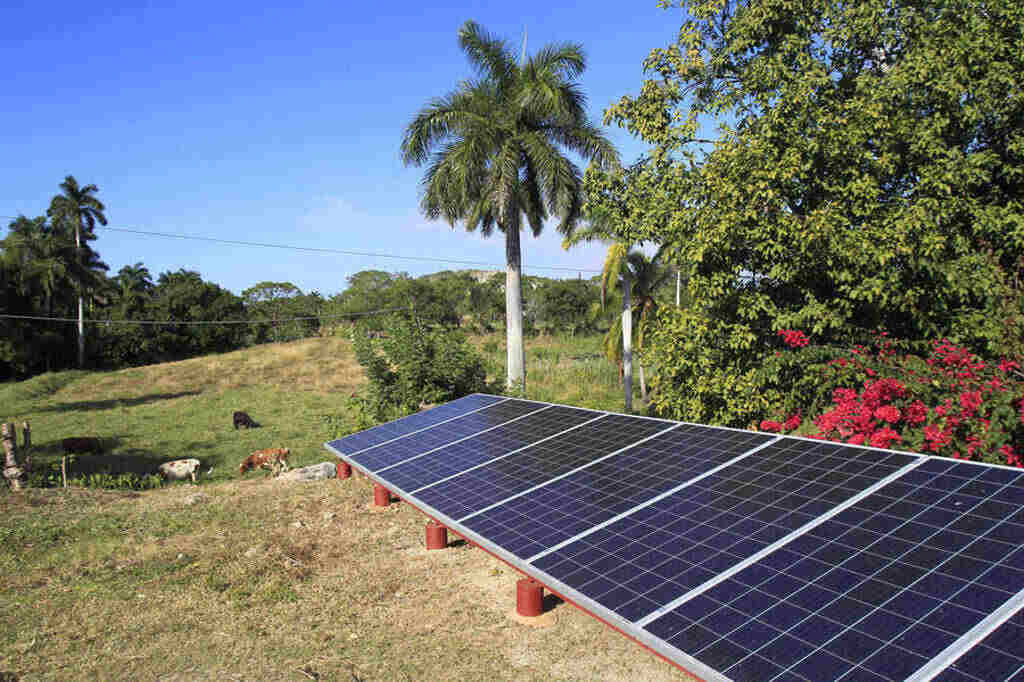
In its Extraordinary Edition No. 30 – dated February 19, 2026 – the Gazette published Resolution 41 of the Minister of Finance and Prices, which establishes that access to the exemption from paying taxes on profits and personal income for individuals and legal entities will be subject to the requirements established by the National Office for the Control and Efficient Use of Energy (ONURE).
To clarify any doubts about the procedures, Joel Trincado, Director of Standardization and Energy Efficiency at ONURE (National Office for the Rational Use of Energy), explained to Prensa Latina the steps to follow for those interested in developing renewable energy projects and how the evaluation process works.
Applications are submitted to the provincial offices using the approved energy license application form. The office will then inform the applicant which specialized institutions are authorized to carry out such projects, as well as provide information on the technical and economic feasibility study and the main suppliers.
Once the applications are received, ONURE will prepare and certify, or not, the application file, he explained.
The economic actor will submit the application forms, the technical project from the feasibility study certifying the total investment value and its payback period, invoices supporting the project costs, and documentation of the technology acquisition, assembly, and installation.
Subsequently, within 15 business days of receiving the application, the Provincial Office for Energy Efficiency (ONURE) must deliver the energy license, the regulations and technical requirements to be met, along with instructions on the steps to follow with the Provincial Electric Company (if it will contribute to the electrical grid) for its technical certification and the commercial contract.
Trincado added that the client can present the energy license to the corresponding bank to obtain the necessary loan.
Once the investment is completed, he continued, the economic actor will inform the Provincial Office for Energy Efficiency (ONURE) to conduct a physical inspection of the installation, verify compliance with the technical requirements, and within 15 business days will issue the energy assessment.
This document will be presented by the client to the National Tax Administration Office (ONAT) to receive the various approved incentives.
Trincado noted that the Office will conduct inspections during the investment recovery period to ensure compliance with the required technical specifications. If any non-compliance is detected, the energy permit will be withdrawn and the National Tax Administration Office (ONAT) will be notified.
FROM RESOLUTION 41
Among the elements maintained by the regulation are the exemption from customs duties for individuals and legal entities importing photovoltaic solar systems, solar water heaters, photovoltaic pumps, small wind turbines, geomembrane biodigesters, and biogas-powered water pumps.
Also included are solar lighting, solar air conditioning systems, electric vehicle chargers powered by renewable energy sources, equipment for biomass processing for energy production, and the essential parts and components of this equipment.
In the case of individuals, these imports will not be included in their non-commercial import value and must be declared separately from the rest of the imported goods.
For economic actors, the lists of goods to be imported exempt from customs duties remain in place for the execution of an investment process or the manufacture of equipment, devices, or spare parts intended for the use of renewable energy sources (RES), for electricity generation projects using this energy, or derived from its use.
Legal entities and individuals engaged in economic activities who install RES for self-consumption or to supply energy to the electrical grid are exempt from paying taxes on profits and personal income, up to the value of the investment, during the recovery period and for a term of up to eight years.
Furthermore, the regulations remain in place allowing technologies and systems related to the use of renewable energy sources to be marketed in the wholesale or retail trade system at non-taxable prices, which are calculated based on operating costs and expenses, taxes, and a profit margin of up to 25 percent on costs.
Regarding legal entities that import raw materials, components, parts, pieces, equipment, and accessories to increase energy efficiency, he commented that they may be eligible for subsidies or exemptions from customs duties when economically justified, upon request to the Ministry of Finance.
Finally, Trincado recommends contacting the ONURE offices to clarify the regulations and technical requirements for renewable energy generation system installation projects, requirements for connecting photovoltaic systems to the electrical grid, energy efficiency projects in various systems, and electric vehicle charging stations.
IMAGE CREDIT: Photo: PRENSA LATINA
[ SOURCE: PRENSA LATINA ]