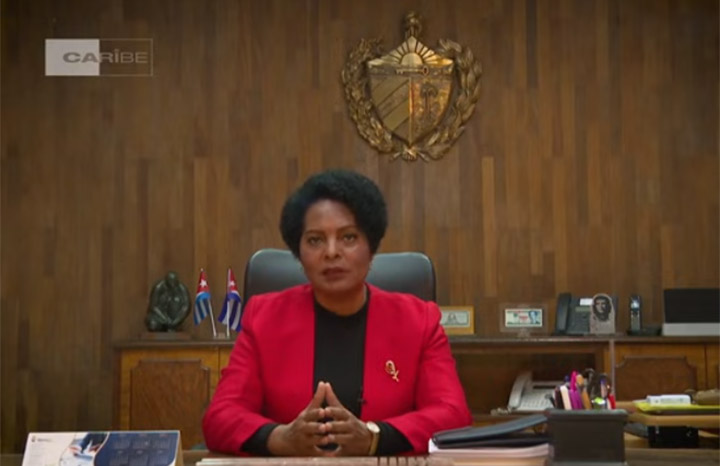
Radio Havana Cuba / Cubadebate bring you the text of the special appearance of the President of the Central Bank of Cuba, Juana Lilia Delgado Portal. She appeared on CubaVision Wednesday evening following the 8 o’clock prime time newscast.
As the Government of the Republic has been reporting, the Central Bank of Cuba has been working to create the conditions to begin transformations in the foreign exchange market, based on principles of gradualism and timeliness.
Currently, different exchange rates coexist in the Cuban economy, which generates distortions, encourages informality, and hinders the banking and tax traceability of economic activity.
This exchange rate transformation seeks to restore the convertibility of the Cuban peso, strengthen monetary institutions, and move in an orderly manner toward exchange rate and monetary convergence.
A stable foreign exchange market requires minimum conditions of macroeconomic stability, operational capacity of the banking system, and a regulatory framework adapted to current conditions.
The combination of severe external constraints, the sharp drop in foreign exchange earnings, the contraction of foreign exchange supply in the official market, and accumulated imbalances necessitates the start of a gradual and responsible exchange rate transformation.
The strategy, focused on restoring the purchasing power of the national currency, aims to concentrate and guide the foreign exchange market by connecting the various economic actors—both state and non-state—in the production, export, and marketing of goods and services at competitive prices.
An immediate unification of the exchange rate, without a transition period, could trigger a sharp devaluation, with inflationary effects greater than those currently being experienced and a further erosion of the national currency’s purchasing power against foreign currencies.
International experience demonstrates that, in economies with accumulated exchange rate imbalances, transitional schemes with multiple segments allow for the gradual correction of distortions without severe macroeconomic shocks.
Considering the factors outlined above, it has been decided to implement, on December 18, 2025, the measures that guarantee the transformation of the foreign exchange market. In this first stage, its structure has been conceived in three exchange rate segments: two existing fixed exchange rates—Segment I, operating at 1 to 24; Segment II, operating at 1 to 120; and a third segment with a floating exchange rate that will be published daily by the Central Bank of Cuba in its capacity as the country’s monetary authority.
The decision to recognize a third segment is based on the objective existence of differences between the official exchange rates and the real value, which reflects the scarcity of foreign currency.
The first two market segments will be structured to prevent sharp devaluations of exchange rates and, consequently, of the national currency. This will protect the population in essential and sensitive transactions, preserving stability and predictability in the prices of essential goods and services.
The third segment, based on a daily floating exchange rate, will allow exporters and other foreign currency providers to sell at a competitive price, determined by supply and demand. The aim is to incentivize the inflow of foreign currency into the exchange market, providing a source of funds for their operations and reducing pressures and irregularities in the informal market.
The transformation of the exchange market is part of a broader set of financial, trade, tax, and other measures, encompassing several simultaneous fronts with the objective of improving the overall efficiency of the economy.
Among the measures to be implemented, the stabilization and progressive strengthening of the so-called MLC accounts stands out, contrary to what some have falsely speculated or claimed. The objective is clear: to strengthen the purchasing power of the MLC and its value in use.
As part of this plan, the operability of bank accounts for non-state management entities will be guaranteed, allowing them to carry out foreign currency transactions, both domestic and for foreign trade.
I want to conclude by emphasizing that the purpose is not to replace one distortion with another, but to gradually close the monetary gaps that affect the economy and families.
The legal provisions that will implement the exchange market reforms will be published in the Official Gazette and will take effect this Thursday, December 18, 2025. Going forward, the Central Bank of Cuba will publish the daily exchange rates on its website.
These exchange rate reforms are not an end in themselves, but a tool to stabilize the economy and strengthen the financial system. This is a gradual, responsible, and transparent process, in accordance with Cuba’s specific conditions.
In the coming days, we will continue to provide information about these decisions and the processes and mechanisms that will govern them.
IMAGE CREDIT: President of the Central Bank of Cuba, Juana Lilia Delgado Portal / TV CUBANA
[ SOURCE: CUBA DEBATE ]