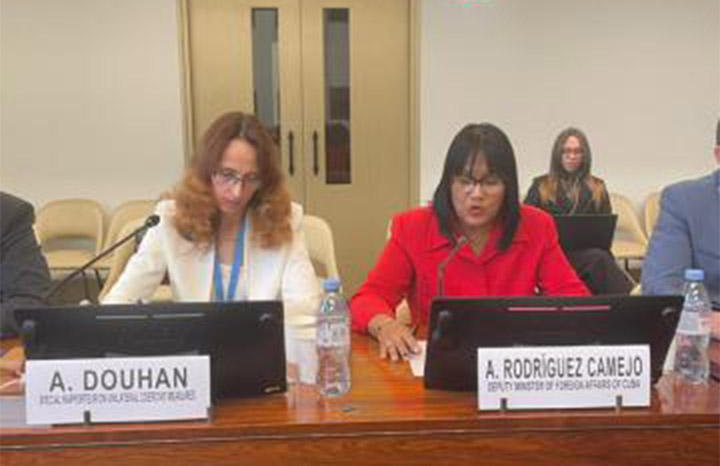
Cuba has denounced the energy blockade imposed by the United States as a human rights violation at the Second International Conference on Unilateral Coercive Measures of the United Nations, held in Geneva, Switzerland, with the participation of a delegation headed by Deputy Foreign Minister Anayansi Rodríguez Camejo.
According to the Ministry of Foreign Affairs website, Cubaminrex, the event, held on April 9th and 10th, was organized by the Special Rapporteur on unilateral coercive measures, Alena Douhan, and addressed the theme “Humanitarian Action, Reparation and Accountability in an Environment of Unilateral Sanctions.”
The meeting brought together representatives of governments, international organizations, and experts in International Law.
At the opening of the high-level session, Miguel Díaz-Canel Bermúdez, First Secretary of the Central Committee of the Communist Party of Cuba and President of the Republic, delivered a message denouncing the strengthening of the economic, commercial, and financial blockade against the island, with emphasis on the executive order of January 29 that prevented fuel shipments from reaching the country.
Rodríguez Camejo stressed that these unilateral coercive measures directly affect the daily lives of the Cuban population, limiting sectors such as public health, transportation, and production, and contradicting fundamental principles of international law and the Charter of the United Nations.
During the plenary session, a declaration was presented by the Group of Friends in Defense of the Charter of the United Nations, condemning all unilateral coercive measures and, in particular, the current escalation of the U.S. blockade against Cuba.
The Cuban delegation advocated for a more coordinated response within the United Nations system, including the creation of a working group within the Human Rights Council and progress toward a legally binding international instrument.
Ambassador Rodolfo Benítez Verson, Cuba’s Permanent Representative to the United Nations Office at Geneva, was part of the delegation, along with officials from the Ministry of Foreign Affairs and the Permanent Mission. During her stay, the Deputy Minister will hold bilateral meetings with foreign delegations and representatives of international organizations.
[ SOURCE: PRENSA LATINA ]