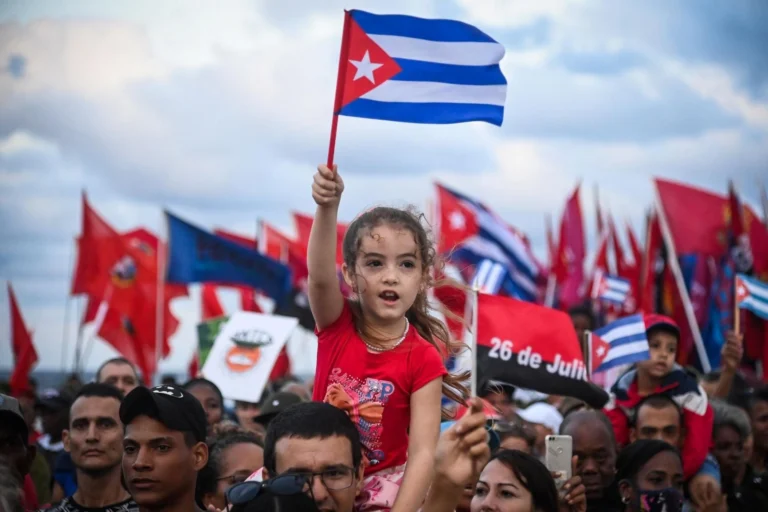
The Cuban Foreign Ministry annually publishes concrete figures detailing the harm the blockade inflicts on the island’s economy and people.
Since 1960, the United States blockade against Cuba has prevented U.S. companies and citizens from conducting commercial transactions with Cuban interests. According to data from the Cuban Ministry of Foreign Affairs (Minrex), 80% of the current Cuban population was born during the blockade.
More than half a century of blockade might give the false impression that the only ones affected are U.S. citizens and companies unable to conduct business with the island, but the reality is far harsher and affects the very essence of the Cuban population and all its inhabitants.
The latest measures taken by the Donald Trump administration are of such magnitude that the blockade now represents a criminal act against humanity, and, due to its political impact, as the writer Eduardo Galeano stated, it is a “universal blockade.”
Cuban Foreign Minister Bruno Rodríguez Parrilla released a report detailing the millions of dollars in losses and damages caused, impacting sensitive sectors such as health, food, and a precious commodity in these times: access to electricity.
One fact that underscores the infamy of the blockade is that Cuba’s GDP reportedly grew by 9.2%, despite some of the restrictions imposed on the Cuban economy, according to the Foreign Minister.
An attack on human dignity
One chapter of the report addresses the social impact of the blockade in areas such as health: “The Cuban Essential Medicines List includes 651 items, 250 imported and 401 domestically produced, with 69% affected by the blockade. Of these, 364 medicines are unavailable, representing 56% of the total.”
The economic embargo on access to foreign currency, supplies, raw materials, fertilizers, machinery, fuel, chemicals, and technology has also caused a considerable decrease in food production.
Infographic: The Figures of the Blockade
“Five days of the blockade are equivalent to the financing needed to repair one of the thermoelectric power plants, $100 million, such as the Antonio Guiteras plant in Matanzas or the Carlos Manuel de Céspedes plant in Cienfuegos,” the Cuban Foreign Minister continued.
He added that a few weeks ago, the Cienfuegos thermoelectric plant “directly suffered the effects of the blockade when an industrialized country, a friend of Cuba, was unable to provide technical assistance for repairs, claiming that the requested assistance would contain more than 10% U.S. components.”
According to the report presented by Rodríguez Parrilla, 12 days of the blockade are equivalent to the annual maintenance cost (excluding fuel and investments) of the national electrical system (250 million dollars), and one month of the blockade (approximately 600 million dollars in damages) is equal to the cost of the national solar energy investment plan for 2025 (1,015 MW).
The exponential increase in the last period, according to the report, is mainly due to the increase in damages consisting of lost revenue from exports of goods and services (estimated at 2.608 billion dollars) and the geographical relocation of trade (more than 1.212 billion dollars).
“If there hadn’t been a tightening of the blockade and the extraordinary oppressive effect it has on our families, quantifiable in economic damage, not to mention the suffering and emotional impact, GDP would have grown by 9.2% in the last year,” he said.
“The blockade,” he added, “is the main obstacle to the recovery of the Cuban economy,” emphasizing that the structural barriers imposed by this policy and its legal framework are the primary impediment to any economic activity in the country, whether state-run or private.
For his part, Cuban President Miguel Díaz-Canel described the measure as an unjustified maneuver that seeks to strangle the Cuban economy under false pretenses and for the benefit of political and economic interests unrelated to the well-being of its people, embodied by a clique that has enriched itself by pursuing policies against Cuba.
In May 2025, Cuba presented its report pursuant to United Nations General Assembly resolution 79/7, entitled “Necessity of ending the economic, commercial and financial embargo imposed by the United States of America against Cuba.”
In this report, the Cuban government outlined the objectives of the U.S. government in tightening the measures: “The economic, commercial and financial embargo constitutes the central axis of its maximum pressure policy against the Island, seeking to suffocate its economy, generate shortages and discontent in order to provoke a social explosion that would induce a change in the constitutional order legitimately established by the Cuban people in the exercise of their self-determination.”
The international community has been denouncing this expansionist policy of the United States, which, under the administration of Donald Trump, continues to trample on the sovereignty of nations with illegitimate and criminal acts such as the kidnapping of Venezuelan President Nicolás Maduro and Congresswoman Cilia Flores, and now, against the humanity of the Cuban people. A people who, despite the difficulties imposed by the blockade, have not ceased in their international solidarity.
Cuba denounced on Friday the executive order signed by Donald Trump that designates the country as a threat to the U.S. government and establishes conditions for a more stringent blockade of the island.
The order signed by the U.S. president declares the country, based on false accusations, as an “unusual and extraordinary threat,” thus paving the way for a new form of encirclement and halting the entry of fuel. “The President himself and his government are aware that no one, or very few, can believe such mendacious arguments, but they don’t care,” the revolutionary government of the island stated.
This new measure establishes a new form of control where US interference, through tariffs, seeks to limit the entry of a necessary resource amidst a complex energy situation. “The United States government has reached this point after failing for 67 years to subdue and destroy a genuine and legitimate political and revolutionary process, one of full sovereignty, social justice, and the promotion of peace and solidarity with the rest of the world,” the statement reaffirms.
IMAGE CREDIT: The latest measures taken by the Donald Trump administration are of such magnitude that the blockade now constitutes a criminal act against humanity. Photo: Cuban Presidency.
[ SOURCE: teleSUR ]