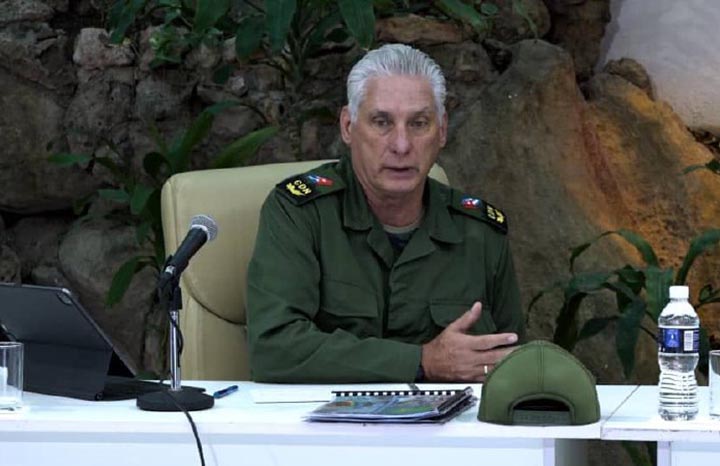
The President of the National Defense Council, Miguel Díaz-Canel, led an assessment today in the city of Santiago de Cuba of the progress in the province’s recovery following Hurricane Melissa last October.
Accompanied by Roberto Morales Ojeda, member of the Political Bureau and organizing secretary of the Central Committee of the Communist Party of Cuba (PCC), as well as Beatriz Johnson Urrutia and Manuel Falcón Hernández, president and vice president of the Provincial Defense Council, respectively, the president received a detailed report on the efforts to restore normalcy.
During the meeting, work priorities were discussed, including cleaning the province, the gradual restoration of electricity service, addressing the epidemiological situation, rehabilitating water infrastructure, distributing food, and restoring communications and tourism, among other key aspects for recovery.
Alfredo López Valdés, general director of the Electric Union, reported that the sector’s infrastructure has been 95.1 percent restored, with approximately 17,000 customers still awaiting service.
Despite the complexity of the task, progress has been made in repairing poles and transformers, with 97.9 percent of the poles repaired and 190 of the more than 300 transformers repaired. He added that in the most affected municipalities, such as Mella and Songo La Maya, full recovery is expected in the coming days.
Regarding Public Health, Dr. Miguel Ángel Díaz Núñez, the province’s Director General of Public Health, explained that active surveillance is being maintained on the circulation of diseases such as chikungunya and dengue.
He noted that although cases of nonspecific febrile syndrome have decreased, the province faces a complex situation in the towns of Santiago de Cuba, San Luis, and Songo-La Maya. Therefore, fumigation and prevention efforts have been intensified, and the presence of medical students in disease control has been increased.
In presenting the report, Johnson Urrutia pointed out that the restoration of road infrastructure is also progressing. He stated that intensive work has been carried out on cleaning and clearing the main roads in Mella, Santiago de Cuba, and Songo-La Maya, which account for 70% of the damage.
The Refinery branch road has been repaired, and work continues on the Dos Ríos-Barranca road, which has seven critical points requiring technical attention. Furthermore, national rail transport has been restored, and measures are being taken to guarantee passenger transport during the recovery phase.
According to the president of the Provincial Defense Council, 225 strategic recovery actions have been implemented in the agricultural sector, focusing on infrastructure repairs and the replacement of essential supplies. Despite the progress, some actions still depend on the availability of construction materials such as roofing, cement, and electrical wiring.
The recovery of the main tourist destinations and affected cultural institutions has also been prioritized, and efforts continue with the goal of reactivating both sectors as soon as possible, she noted.
Díaz-Canel reviewed the agreements from his last visit to the province, emphasizing the importance of completing tasks such as repairing damaged transformers, optimizing the water supply in the most affected areas, and improving internet connectivity, especially in Revolution Square.
Likewise, the First Secretary of the Central Committee of the PCC and President of the Republic called for expediting procedures for those affected, particularly those related to the registration of affected individuals at housing offices.
In terms of public services, fixed and mobile telephone service has been restored to 94.82% and 93.4%, respectively, and 97.56% of the fiber optic network has been repaired.
Regarding water infrastructure recovery, Antonio Rodríguez Rodríguez, president of the National Institute of Hydraulic Resources, emphasized that 85.4% of the water supply system has been restored, benefiting more than 767,000 residents. However, some 20,000 residents, especially in rural areas, are still experiencing disruptions.
The recovery process in Santiago de Cuba continues to progress, although challenges remain in some sectors.
At the close of the extraordinary session of the Provincial Defense Council, Díaz-Canel called for unity and collaboration from all to continue working toward restoring normalcy to the province as soon as possible.
IMAGE CREDIT: Indira Ferrer Alonso | Photo: Osvaldo Monterrey
[ SOURCE: AGENCIA CUBBANA DE NOTICIAS ]