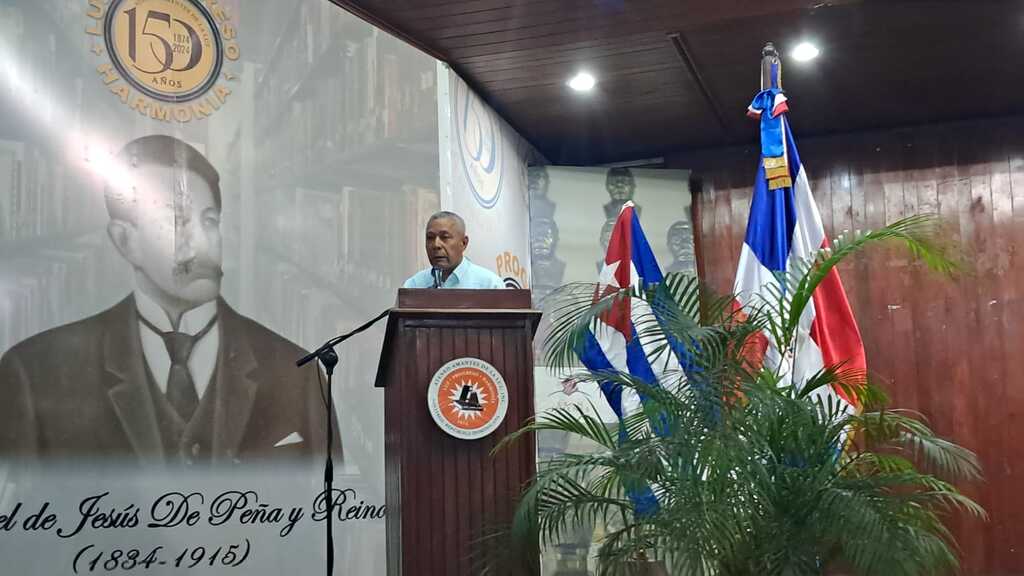
The current situation in Cuba, marked by the intensification of the US blockade, and the importance of solidarity were highlighted by the island’s ambassador to the Dominican Republic, Ángel Arzuaga, during a conference in Santiago de los Caballeros.
Before more than one hundred attendees, the diplomat began his conference with a thought from José Martí, still relevant today: “Love, mother, for the homeland, is not a ridiculous love for the land, nor for the grass beneath our feet; it is the invincible hatred of those who oppress it…” to underscore the deep connection to the nation and the spirit of resistance that, he affirmed, has historically characterized the Cuban people.
Arzuaga maintained that Cuba is distinguished by “telling the truth,” which—in his opinion—has earned it the respect and affection of millions of people around the world.
In that context, he highlighted the historical ties between Santiago de los Caballeros (about 155 kilometers northwest of the capital) and Santiago de Cuba, sister cities bound by culture, history, and the struggles for independence.
Santiago de Cuba is known for its fundamental role in the origins and development of the Cuban nation. It was one of the first towns founded by the Spanish and became the country’s first capital, making it a key center during the colonial period.
Furthermore, it has been the site of important political and military events, such as the struggles for independence and decisive moments of the Revolution, including the attack on the Moncada Barracks in 1953, led by Fidel Castro. Years later, in 1959, the revolutionary triumph was proclaimed from that city.
During his address, the diplomat evoked key figures from that shared history, such as Chief Hatuey, whom he described as the first internationalist for his resistance against Spanish colonization, and General Máximo Gómez, a native of Baní, who joined the fight for Cuban independence just six days after the start of the struggle on October 10, 1868. “That day, Cuban nationality began to take shape,” he emphasized.
He affirmed that Cuba has carried out “a single Revolution, forever,” because that day, with the start of the War of Independence by Carlos Manuel de Céspedes, a continuous historical process of struggle for freedom, sovereignty, and social justice began.
He stated that understanding the island’s current reality requires knowing its history. “Those who don’t know history don’t love it, and those who don’t love it don’t defend it,” he stated, adding that without this knowledge, the reasons for the Cuban people’s resistance to colonialism and U.S. pressure are incomprehensible.
Regarding the economic situation, Arzuaga rejected the campaigns by the United States and its allies that label Cuba a “failed state” and attribute its difficulties solely to its political, economic, and social system.
“We are not a perfect revolution, but if there is a system that doesn’t work, then lift the blockade. If we are a failed government, why attack us? Why not let it collapse on its own?” he asked.
Addressing the impact of the blockade, he recalled that during Donald Trump’s first administration, 243 additional measures were implemented against Cuba, especially starting in the second half of 2019, which significantly intensified economic restrictions. He added that many of these measures remained in place under Joe Biden’s presidency.
He explained that these measures increase the cost of imports and make it difficult to acquire fuel, food, medicine, and essential supplies, directly impacting the daily lives of the population.
In this context, the ambassador referred to the oil embargo imposed by the United States, which he identified as one of the determining factors of the current economic difficulties on the island, with a direct impact on the lives of families by affecting electricity generation, transportation, food production, and essential services.
The diplomat reaffirmed Cuba’s commitment to remaining a free and sovereign nation dedicated to the well-being of its people, while also highlighting the importance of international solidarity in the face of the White House’s hostile policy, which has persisted for more than six decades.
At the meeting, the Committee of Solidarity with Cuba in Santiago de los Caballeros announced its support for the Dominican people’s campaign, “Cuba is not alone!” And it announced the establishment, starting today, of a collection center to receive and manage aid destined for the island, with contributions coming from that province, the municipality, and surrounding areas.
Their representatives affirmed that Cuba represents the dignity of the world’s peoples and emphasized that those who believe in social justice, brotherhood, and solidarity are prepared to stand with her at this time, even—they stated—”to fight alongside her people if necessary.”
Attendees at the meeting included the jurist and left-wing revolutionary Ramón Antonio Veras, president of the Honorary Committee for the Centennial of Fidel Castro’s Birth; Darío Fernández, vice president of the Ateneo Amantes de la Luz; and Pedro Pablo Zapata, of the Committee of Solidarity with Cuba.
Also present were Mariana Moreno, vice mayor of the municipality of Santiago, and Radhamés García, advisor to the President of the Republic, Luis Abinader, among other guests and friends of solidarity.
[ SOURCE: PRENSA LATINA ]