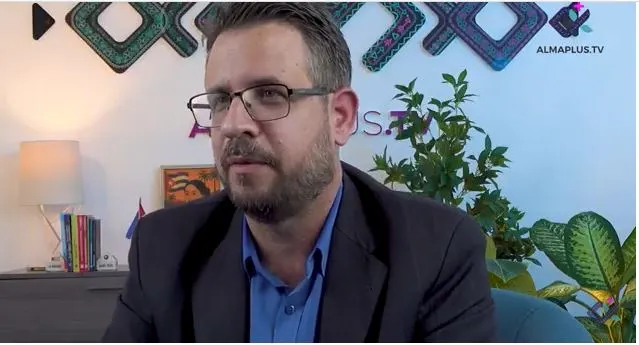
Interview with Elier Ramírez
By Resumen Latinoamericano on February 19
Elier Ramírez, a Cuban historian, details in an interview with Almaplustv the qualitative leap of the blockade toward a “surgical” and persecutory application in the financial and commercial spheres. The narrative that “there is no blockade” is dismantled, and its impact on the daily lives of the entire country, including the private sector, is made evident. Furthermore, the contradiction between this policy and the true national security interests of the United States is highlighted, given the history of Cuba-U.S. cooperation on migration, counterterrorism, and anti-drug efforts.
Transcript:
An aggressiveness taken to its extreme, I think it had never been seen before, at least from the perspective of the blockade, right? How to implement that blockade at a surgical level, as has been done, with a very detailed persecution of any element that could become a source of income for the country, and having many US agencies dedicated to that, spending millions of US taxpayer dollars, right? Absolutely. And the personnel dedicated to that—it seems, and truly is, something Machiavellian—and we really think that in that sense, well, I didn’t know, at least in history, that level of suffocation had never been seen before, right? To what extent the suffocation of an entire people could go. Because there, human rights don’t matter, appearances don’t matter; it’s been done completely openly and with a purpose.
I always think, well, what Marco Rubio said, that video that circulated, he said, well, where is the blockade? The blockade doesn’t exist. Well, all of that—when you take the speeches made by the President of the United States, and Marco Rubio’s own speeches—it’s almost like replacing that speech with what we’re seeing today. And I think that’s when all the masks fall away, instantly.
It’s impossible to maintain a narrative that the blockade doesn’t exist. It’s completely false. And I think it’s also clear that the United States isn’t interested in human rights.
All that rhetoric, all those pretexts that have been constructed, the United States isn’t interested in them. Because we’re seeing how the human right to life is being violated—that is, the right of an entire people. It’s not the government, as they also tried to portray it as an argument.
The blockade isn’t against the Cuban people; it’s against the government. They only used that rhetoric. What are they going to say now? Because now it’s more than clear that it’s against the daily lives of an entire nation, of an entire people.
Even against the private sector. Because there was a time when it was said that we had to incentivize the growth of the private sector in Cuba. Under the logic, of course, of attacking, of undermining the revolution from within.
Well, where does that discourse stand now? Because it also greatly affects, fundamentally, the private sector in Cuba. Well, we understand it as a sector within the logic of our socialism. We have approved it since our constitution.
It is part of the Cuban people and also supports the country’s economy, the country’s economic progress. Well, against that sector, against all sectors, because, I insist, it is against an entire nation, against an entire people. So, all the rhetoric of Human Rights, which has also been used at many times in policy toward Cuba.
Even during the Carter administration, the issue of Human Rights was a topic that was handled very forcefully. During the Reagan administration, also under Clinton, that is, the different administrations insisted a lot on the discourse regarding Cuba, on the issue of Human Rights. Well, where does that stand now? Cuba, in any case, is a guarantee for the national security of the United States.
The issue of migration, specifically Cuba’s position that it should be orderly and regulated, protecting lives. The issue of combating terrorism and drug trafficking, where there are also examples of cooperation between Cuba and the United States. In other words, these are the security issues on the agenda, the issues of genuine national security, over which the United States has conflicts with other countries.
Well, in the case of Cuba, with 90,000 miles of its coastline, Cuba is a guarantee. And we could say—and there are some authors in the United States and some think tanks that are producing reports and analyses—that the current US policy toward Cuba actually constitutes a threat to that genuine national security. Because if what you’re trying to do is implode a nation, a country, to break the stability of a country like Cuba, with 90 miles of its coastline, how much of a threat can that pose to the national security interests of the United States? In other words, the imperial security interests of that country’s elite contradict the genuine security interests, the national interest, as it’s also called, of the United States.
That is to say, those agendas are at odds, those agendas are clashing. And it’s a shame because this agenda, which constitutes a threat to themselves, is the one they’re imposing on the President of the United States. They are pressuring him, largely forcing him into a confrontation with a country like Cuba. This goes against the true national interest of the United States.
What is Cuba’s position regarding U.S. aggression?
It has never shown fear, it has shown dread in the face of U.S. threats. And this only further complicates the possibility of respectful dialogue, of advancing a bilateral agenda of mutual interest to both countries.
Because under that logic, Cuba has never negotiated either. Under the logic of threats and coercion, Cuba, on the contrary, has always reacted with firmness, always with the dignity of defending its principles, and that is a constant that has never been broken. It is in our history, it is in our roots, and no matter how much they try to change that, it is impossible because we could say it is almost genetic, and it comes from Martí, from our Mambises, from all those who gave their lives in the struggles of the 1920s and 30s, from that historic generation. In other words, they can’t fight against that. They can’t fight against that, even though they keep trying to go against those roots.
But in the end, they clash time and again with Cuba’s stance, which is ultimately the stance that has allowed Cuba to avoid being swallowed up, because Fidel says so in that video. I think that video is more illustrative than anything else I could tell you. He says, “…if we had shown fear, if we had retreated, they would have swallowed us whole, from the tip of Maisí to Cape San Antonio.”
And yet, every time there has been a moment like that, we have also known how to show, as Martí said, that Cuba’s position toward the United States must be a cautious and courageous one. That is to say, we are not a country that threatens, we are not a country of war, we are not a country of violence, we are not a country of confrontation. We are a country of peace, we are a country of hope, we are a country that has the capacity to negotiate, to dialogue with any country in the world on the basis of respect.
But when our dignity is attacked, when our principles are attacked, we are like a hedgehog, as Martí also said. And that is why principles have never been negotiable. I remember very well those secret talks in the 1970s, how they pressured us several times, or tried to pressure us because they couldn’t, regarding certain principles of Cuban foreign policy, for example, Cuba’s solidarity with the Puerto Rican independence cause. And Fidel, in those talks—and later he said it publicly—what he said in those secret conversations, thinking specifically about the Carter period, and what he said in public speeches, there is total consistency. He said, “As long as there is one Puerto Rican who supports Puerto Rican independence, we have a moral duty to support that cause.” And he gave Martí’s entire historical explanation. And if that’s going to be a condition for moving toward a better relationship with the United States or toward normalization, since we’ve been without normal relations with the United States for 30 years, we’ll be without them for 60, 70, 80, because principles are non-negotiable. And the same goes for the issue of solidarity with Africa, and we’re talking about elements of foreign policy.
Let’s imagine when we’re talking about issues related to our country’s internal sovereignty. On those matters, we’re like a hedgehog, and if it’s based on the logic of threats, then of course, that path ignores our history, ignores the blood that has been spilled in this country over many years, many generations, and against that, it’s impossible for there to be any progress in the relationship between Cuba and the United States. Perhaps some countries will fall at its feet or pay homage to it, but Fidel broke with that logic from 1959 onward, from the triumph of the revolution. Fidel broke with that logic. Here, the presidents in the bourgeois neocolonial republic were a reflection of what we’re seeing today in many other countries around the world, unfortunately. The first thing Cuban presidents did in that bourgeois neocolonial republic was go to the United States to pay homage to the White House or to ask for loans, to ask for money. And I always remember that first visit of Fidel’s, which was his second after the triumph of the revolution. First he went to Venezuela, and then he went to the United States. And Fidel, from the very first moment, said, “Well, this defies all logic. Here we are, but we haven’t come to ask for money. We’ve come here, in a way, to show our willingness to engage in dialogue, but also to explain that this revolution is real, that it’s authentic, and that, of course, the path now is different. In Cuba’s position in relation to the United States, there’s much of the thinking and actions of José Martí, and much of Fidel’s as well.
In that sense, he was also the best disciple of the apostle.” In fact, we have worked on that topic and were impressed when we found the number of similarities, despite the historical differences, that anti-imperialism, because when Martí fell on May 19, 1895, we could also say he fell in an anti-imperialist struggle, and it is also very striking how he was ahead of his time, how he foresaw everything that actually happened later, almost exactly, and even in the late 1980s, the necessary war had not yet begun.
There are documents, letters where José Martí speaks of the greater danger, and the greater danger was no longer even Spain; what he was seeing was the nascent imperialism of the United States. That is why he said that the war in Cuba had to be brief and generous, like a ray of light that wouldn’t give the United States time, as he said later, on May 19, 1895, in that unfinished letter, to descend with such force upon our lands in America. He speaks of the balance of the world, and says—as Gonzalo de Quesada had already said in a letter many years before—”It is not only two islands that we are going to liberate,” referring to the independence of Cuba and the support for the independence of Puerto Rico. “It is a world that we are balancing.” He even thought of that, to save the honor of that powerful neighbor 90 miles away. And when Martí falls in battle, his life, as he says, he comes to say, “That is the meaning of my life,” had become an anti-imperialist struggle.
Fidel embraced that legacy, and in his way of thinking and acting, which also allowed him to overcome the policies of ten US administrations, there is much of José Martí’s thought and legacy. Martí spoke of, or we could say, his policy toward the United States, or how he saw it, as needing to be a cautious and courageous one.
Let’s recall his vindication of Cuba, and he said that he even understood that a civilized relationship with the United States was possible, but he said that when there was a need to show ourselves as we are, with all our courage in the face of a threat, in the face of aggression, it is necessary to show ourselves in that way, and Fidel also inherited that, and that is why Fidel also said that in matters of principle, as Martí said, we are like a hedgehog. Principles are not negotiable, and even less so when we are threatened.
And those are the moments when that stance—firmness, dignity, and radicalism—comes to the fore, not in the sense of fanaticism, but by going back to the roots of what we are defending, what the Cuban Revolution means, what our ideals mean, what Fidel is saying, what Martí said in his time. There is a similarity there as well: their position was not a fanatical one, not a position of hatred. What we are talking about are ideals, principles that we have historically always defended, that we inherited from Martí and also from Fidel, and today they are more relevant than ever, in the centennial year of Fidel’s birth, demonstrating also who we are, what we have inherited, what the struggle for independence, for sovereignty, has meant generation after generation, the blood that has been shed. That concept, and that phrase—which is not an empty phrase at all and which we must take up again today more than ever—”Homeland or death, we will overcome,” which comes from our national anthem, is also what we mean as Cubans, as a nation, and that the enemy does not quite understand, does not quite grasp, and that is why he clings to the same old purpose, and that is why he has not found ways to destroy the revolution either.
[ SOURCE: RESUMEN LATINOAMERICANO ]