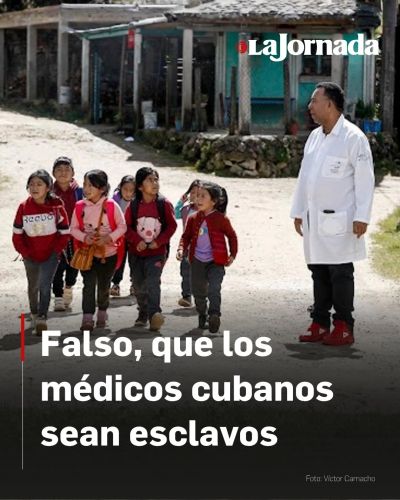
Luis Hernández Navarro, Special Correspondent / La Jornada
The offensive against Cuban medical brigades continues. Pressure from the United States for the countries where they operate to sever ties with them persists. Just a few days ago, 227 members of the project returned from Jamaica after Kingston unilaterally terminated the bilateral health cooperation agreement. This ended a 30-year-old agreement in which Cuban doctors treated more than 8,176,000 patients.
The same fate awaits the Cuban medical personnel in Guatemala, from where 412 healthcare professionals will depart after 27 years of collaboration. The Cuban medical brigade covered more than 70 percent of the 22 departments, providing over 2 million consultations last year, often in areas where local doctors cannot reach.
From Cuba to the world
The healthcare solidarity of the Cuban medical professionals with more than 100 nations has a long history. Dr. Ana Beatriz Pérez Díaz, a medical scientist and longtime researcher at the Pedro Kouri Institute of Tropical Medicine, explained to La Jornada that these collaborations began “as early as the beginning of the 1960s, when the first Cuban medical brigade left for Africa, specifically Algeria, led by Che Guevara, our commander.”
According to her, this healthcare solidarity “is one of the defining characteristics of the Cuban Revolution, a product of Fidel Castro’s internationalist thinking, which he instilled from a very early age, on a massive scale, in our people, and which has fostered a genuine sense of solidarity from the peoples of the world toward this island.”
From then on, he explains, our army of white coats became a symbol of solidarity with the world’s poorest people. Cuban doctors were always willing to go to the most remote places to care for the poorest, those who lacked access to healthcare in their own countries. And this earned them the affection of the families. They forged deep bonds of friendship and gratitude. “Not only to one side, but also to the other; that is, it was mutual gratitude and a true feeling of fraternity.”
It’s impressive, Mexican-American historian Tanalís Padilla tells this newspaper, how since 1960, the island has sent around 600,000 doctors to more than 160 countries, mostly in the Global South. The researcher from the Massachusetts Institute of Technology attended the Nuestra América Convoy in Havana to express her solidarity with the Cuban people and her outrage at the criminal U.S. blockade. She has been working on a book about the medical missions for more than three years.
Dr. Padilla argues that events like those in Jamaica, Guatemala, and Honduras are part of a policy that the United States has promoted for several years. It began with the Cuban Medical Parol Program during the Bush administration (2006), which actively sought Cuban healthcare professionals to defect, promising them citizenship and the opportunity to practice their profession if they went to the United States. “Then the reality was different,” she says. She points out that many who went were very disillusioned upon arrival. Obama ended that policy for a few years, but the Trump administration reinstated it.
“And now,” she concludes, “Marco Rubio is determined to see how many countries he can convince, manipulate, and pressure to withdraw the medical brigades. Several of them, unfortunately, have done so. There are very sad scenes where the community, which will no longer have access to doctors, bids them farewell, sometimes in tears.”
Becoming Better
Two sides of the same coin: the medical brigade members who go to other parts of the world face risks, but also take advantage of the opportunity to improve themselves as professionals.
According to Dr. Pérez Díaz, this assistance from healthcare personnel to other communities involves sacrifices. He explains: “First, being away from family—parents, partners, spouses, children—for several years is a sacrifice. Second, sometimes you have to live in precarious and even risky conditions. And also, you’re exposed to diseases that we don’t have in Cuba, diseases that are serious and can be fatal.”
However, he reflects, “the human benefit for our doctors is enormous. They have the opportunity to advance professionally in the treatment of diverse pathologies and confront them effectively; pathologies that are not present in Cuba, that are not seen here, and that have broadened the vision and training of our doctors.
“Also, being able to experience other realities in different corners of the world. In a country like Cuba, which doesn’t have abundant natural resources, this helps to better appreciate the achievements of the revolution. When you travel to places where things are different, it creates an important point of reference.
“But,” he concludes, “beyond all of that, something we must always be grateful for is the practice of human solidarity. It is an opportunity to be better, to practice altruism and generosity toward other human beings. The medical profession itself inherently includes that. And when you face it with greater sacrifices for yourself, in conditions far from your family and often precarious, that altruism and generosity reach a higher level and make us better.”
Slaves?
According to Professor Padilla, the accusation that Cuban doctors are slaves of the government is part of a right-wing campaign because, while Cuba, a poor, blockaded country, sends hundreds of thousands of doctors to other parts of the world, the United States drops bombs and sends in the DEA. The contrast is striking. What gives an idea of the hypocrisy of this campaign, she asserts, is that Washington has never cared about labor exploitation.
Tanalís has interviewed many Cuban doctors in various countries. They have responded time and again: “We come as volunteers. We have to fill out a complete application to apply. Sometimes, so many want to do these missions that others don’t get the chance. We know what we’re getting into, what our contribution is, and what the healthcare system’s contribution is to continue training doctors free of charge, to continue training doctors from other countries. We know this and we do it consciously. We are not slaves.”
It is – the professor explains – an indignity to call them foreigners, because they go with great pride to offer this solidarity to other countries. They go because their training as doctors is based on the principle of not only providing healthcare to their fellow citizens, but also being internationalist. Doctors are educated this way. By going to other countries, they have the opportunity to offer this human and compassionate service.
In interviews, the doctors have proudly told her: “There we become better doctors, because we have to treat diseases that no longer exist in Cuba. That helps us improve our training and meet more people.”
Internationalism
Why do other nations use Cuban healthcare services? According to Dr. Padilla, “They do so because many countries in the world, not only in the Global South but also the United States, do not have enough doctors to meet the needs of their population. And, even if they have doctors, they are concentrated in certain cities, and there are many areas without coverage. There are many countries where, if it weren’t for the missions that Cuba sends, a substantial percentage of their population would not have access to medical care.”
For her part, Dr. Pérez Díaz recalls: “After the Special Period, Fidel Castro envisioned the development of science and the scientific hub, where the biotechnology industry gained particular prominence as a way to overcome that economic stagnation.
She notes: “Our professors have also trained tens of thousands of healthcare professionals in other countries, both at medical universities in developing countries and at the Latin American School of Medicine, where I have taught. Fidel told us: make this an institution at the service of humanity. He taught us to conceive of medicine as serving not only Cuba, but the most needy and humble people throughout the world.
“I am yet another heir to that vision. We are fortunate to have had it and because this nation has defended those ideals of altruism and solidarity through Cuban internationalism.”
[ SOURCE: www.cubainformacion.tv / La Jornada (Mexico) ]