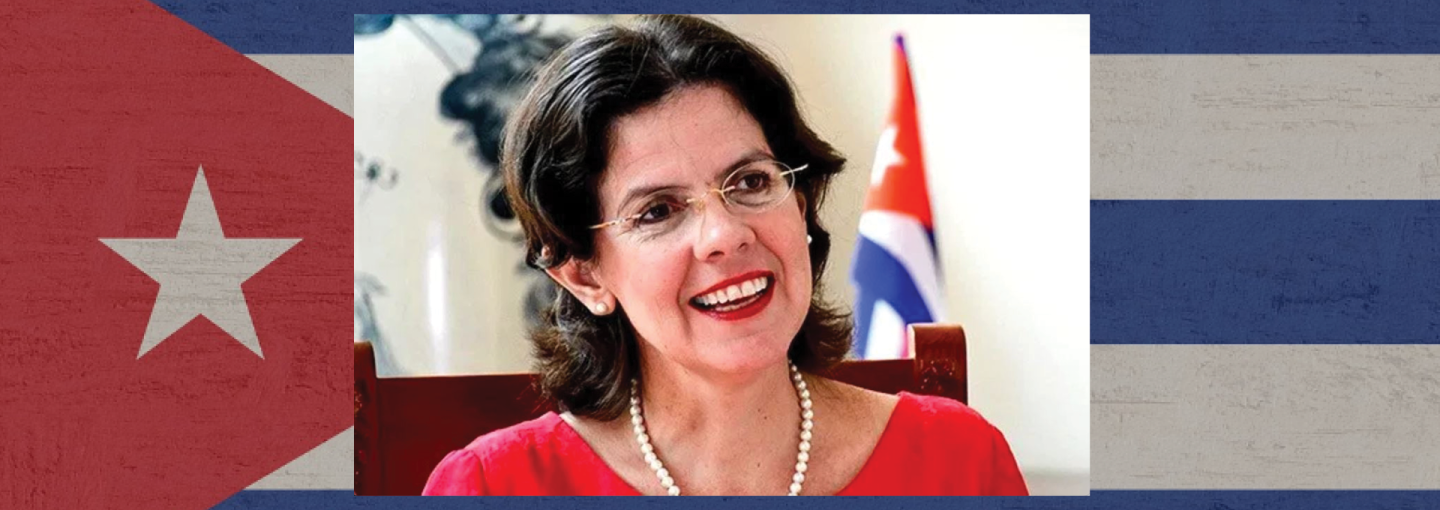
The Los Angeles Times newspaper has published an interview with Cuban Ambassador Lianys Torres Rivera, in which she reiterated her country’s readiness for dialogue with the United States, based on respect for sovereignty and the right to self-determination.
The diplomat — who serves as Chargé d’Affaires at the Cuban Embassy in Washington, DC — stated: “We are ready to engage in dialogue with the United States regarding issues important to the bilateral relationship, and to discuss those areas where we have differences.”
She noted that any such dialogue must respect Cuba’s sovereignty and its right to self-determination. “We are confident that it is possible to find a solution,” she affirmed.
The newspaper highlighted that the interview—which covered a wide range of topics—comes at a particularly volatile moment for Cuba, marked by the tightening of the long-standing economic, commercial, and financial blockade imposed by the United States on the Caribbean nation. Added to this now, as a pressure tactic, is an oil embargo implemented by the Donald Trump administration.
The near-impossibility for Cuba to access essential oil supplies—due to an executive order signed by Trump on January 29—has further deepened the crisis situation within the Caribbean country.
“We are doing everything possible and are being very creative, but it is having a severe impact,” Torres Rivera said regarding the blockade. “It is a form of collective punishment against the Cuban people,” she underscored.
The Head of the Cuban Mission emphasized in her responses that “we are neighbors,” and that “we face common challenges and common threats; we can discuss all of these matters, and we can do so while respecting each other’s sovereignty and right to self-determination. We are ready for that.”
In this regard, she reaffirmed that Cuba is “ready to participate” in such talks, regardless of who is leading them. “We are not talking about individuals; we are talking about the government, and we are ready to engage in dialogue with the United States regarding the important issues facing our bilateral relations,” he concluded.
Since assuming his second term in January 2025, President Trump has intensified his policy of “maximum pressure” against Cuba. One of his first measures was to reinstate the country on a unilateral and arbitrary list of states that allegedly sponsor terrorism—a list from which his Democratic predecessor, Joe Biden, had belatedly removed it before leaving the White House.
Trump’s gamble on Cuba’s collapse is part of a script written more than six decades ago by Lester D. Mallory in a secret memorandum.
On April 6, 1960, Mallory—then Deputy Assistant Secretary of State for Inter-American Affairs—outlined the philosophy behind the economic, commercial, and financial blockade unilaterally imposed against Cuba months later.
“The majority of Cubans support Castro… the only foreseeable way to erode his internal support is through the disillusionment and dissatisfaction stemming from economic hardship and material deprivation… every possible means must be employed swiftly to weaken Cuba’s economic life… a course of action that, if executed with sufficient skill… would yield the greatest success in… provoking hunger, despair, and the overthrow of the Government.”
Since then, the strategy has consisted not only of this but also of fostering the belief that the root cause of such ills lies in the “failed state” theory, rather than in the policy of economic strangulation implemented by successive U.S. administrations.
The current administration persists in its hostility and continues to disregard the nearly unanimous call from the international community to put an end to this illegal and inhumane policy against Cuba — a call reiterated in 33 resolutions adopted by the UN General Assembly.
[ SOURCE: PRENSA LATINA ]