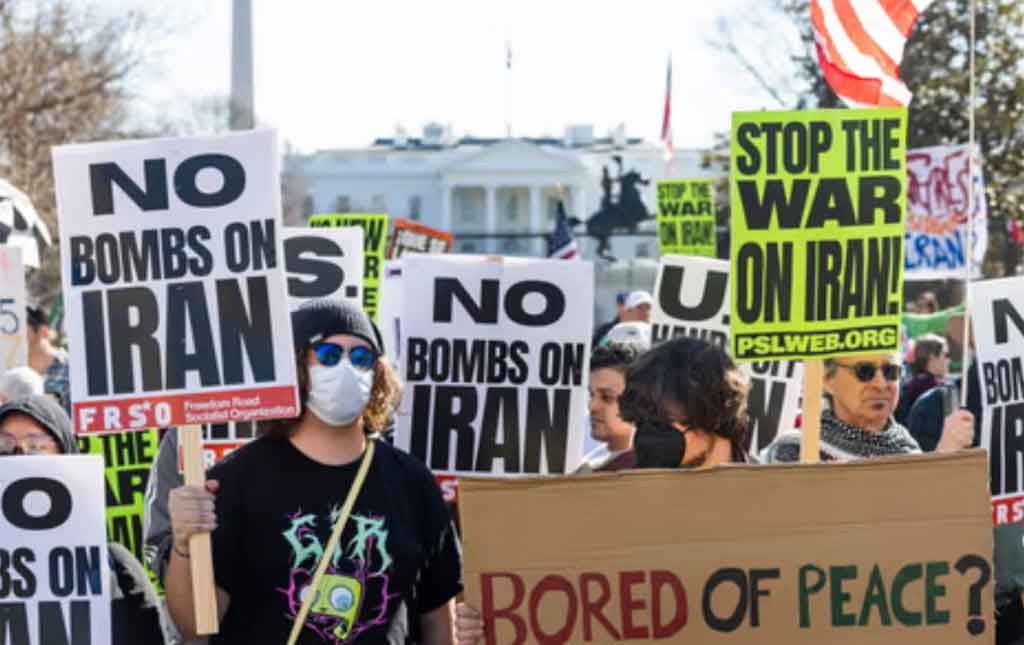
Nearly six out of ten Americans disapprove of the US attack on Iran, and a majority consider it likely that this new military adventure ordered by President Donald Trump will lead to a protracted conflict.
Senator Bernie Sanders wrote in X: “Trump said we had to attack Iran because we can’t allow it to ‘have a nuclear weapon.’ Really? This is the same president who in June said, ‘Iran’s nuclear facilities have been destroyed.’ Vietnam. Iraq. Iran. Another lie. Another war.”
But for Trump, the polls don’t matter, and he asserted that he would be doing the right thing. At a Medal of Honor ceremony at the White House, where three service members were awarded the medal, two of them posthumously, he promised that the United States would “easily defeat” what he called the “terrorist regime” of Iran.
A CNN poll conducted by SSRS revealed that a majority of Americans doubt Trump will make the right decisions regarding the use of force in Iran. Specifically, 60 percent of those surveyed said they do not believe he has a clear plan to handle the situation, and 62 percent said he needs congressional approval.
Central Command (CENTCOM) confirmed yesterday that the number of US military personnel killed in Iran’s response to the US-Israeli attack, Operation Epic Fury, has risen to six.
The death toll increased after the remains of two soldiers were recovered from a facility targeted by Iran’s defensive actions in the region, according to CENTCOM.
In a press conference prior to this announcement, Defense Secretary Pete Hegseth had reported the deaths of four US soldiers in an Iranian attack on a tactical operations center in Kuwait.
The Pentagon chief attempted to downplay the incident, stating that the United States has “incredible air defenses,” but that “once in a while, there might be one—unfortunately, we call it a jet bomb—that gets through.”
“And in that particular case, it hit a fortified tactical operations center, but these are powerful weapons,” he added.
Since the United States and Israel launched Operation Epic Fury against the Islamic Republic early Saturday morning, Iran has responded with attacks on U.S. military and commercial interests in at least five Persian Gulf countries and surrounding waterways, using hundreds of ballistic missiles and drones.
According to Hegseth, the losses “only strengthen our resolve to make sure we do this right.”
Referring to the United States’ objectives in Iran, Hegseth echoed the White House narrative: Iran’s alleged ability to “project power against us and our allies in ways we cannot tolerate.”
It was no longer just the nuclear program, but also the fact that they could not allow Tehran to possess ballistic missiles and drones.
Regarding the four- to five-week duration of this war, he said, “President Trump is free to talk about how long it might or might not last: four weeks, two weeks, six weeks. It could be moved up. It could be delayed… We will execute, under his direction, the objectives we have set for ourselves.”
The Secretary of Defense asserted in his meeting with reporters that this “is not a regime change war,” contradicting Trump’s statements.
Hegseth declined to offer a timeline for the next steps in Operation Epic Fury and said it has nothing to do with the 2003 invasion of Iraq. In that regard, he dismissed the possibility that the new military impasse would turn into another endless war.
The midterm elections will take place on November 3, and the Republican Party, which controls both houses of Congress (the House of Representatives and the Senate), could face difficulties due to growing voter anger.
Operation Epic Fury, launched in the early hours of February 28 by the United States and Israel against Iran, left more than 200 dead on its first day, including Supreme Leader Ayatollah Ali Khamenei and almost the entire military high command.
[ SOURCE: PRENSA LATINA ]