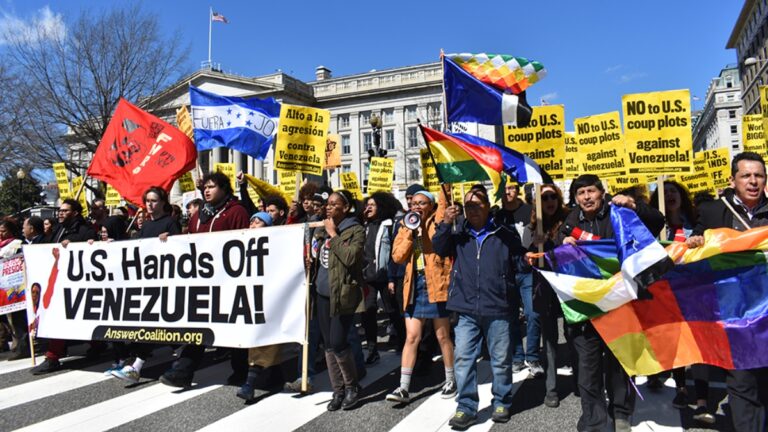
61% of Americans reject the foreign policy and military interventions ordered by President Donald Trump, especially after the recent military aggression in Venezuela, according to the latest data from the AP-NORC Center for Public Affairs Research.
Fifty-six percent of adults in the United States believe that Trump “has gone too far” by using military power to intervene in sovereign nations, a stance complemented by the 57% of those surveyed who disapprove of his handling of the situation in the South American country, where the White House has attempted to exert direct control over energy resources.
This disconnect between the executive branch and the citizenry demonstrates a disconnect between presidential decisions and popular sentiment and underscores a widespread discontent with the country’s diplomatic direction.
Additionally, the rejection has a strong ideological component in key sectors. Nearly nine out of ten Democrats and six out of ten independents agree that military overreach is a worrying reality under the current administration. These numbers suggest that the perception of excessive use of force is not just a partisan stance, but a majority concern among those who do not align with the current government’s policies.
The findings of the survey, conducted between January 8 and 11, 2026, reveal that the American public perceives Trump’s actions as a dangerous excess that compromises international stability.
Despite attempts by the official narrative to justify the military presence abroad under the pretext of security, the American people advocate for a less hostile diplomacy.
Nearly half of those surveyed demand that the United States assume a “less active” role in global conflicts, rejecting the imperialist stance that seeks to control assets in other countries or intervene in the internal affairs of third parties.
Even within Republican ranks, enthusiasm for new military aggression is nonexistent: only one in ten Republicans wants the president to deepen his policy of military intervention, which underscores a domestic political risk posed by the continued belligerent approach.
The survey, which polled 1,203 adults, confirms that the use of force and the rhetoric of control over nations like Venezuela do not enjoy the democratic support that the Trump Administration seeks to project.
On January 3, U.S. military forces attacked Venezuelan territory, bombing the capital, Caracas, and various areas in the states of Miranda, Aragua, and La Guaira.
According to the tally provided by the Minister of the Interior, Justice, and Peace, Diosdado Cabello, this action left at least 100 people dead, including civilians and military personnel, and a similar number wounded.
As part of this operation, which the Bolivarian Government and various world leaders have denounced as a criminal act of aggression, U.S. Delta Force commandos kidnapped Venezuela’s constitutional president, Nicolás Maduro Moros, and his wife, Cilia Flores, a member of parliament.
Following their kidnapping, the presidential couple was taken to New York City, where they are currently being held in a maximum-security prison.
IMAGE CREDIT: 56% of adults in the United States believe Trump “has gone too far” by using military power to intervene in sovereign nations like Venezuela. Photo: Answer Coalition.
[ SOURCE: teleSUR ]