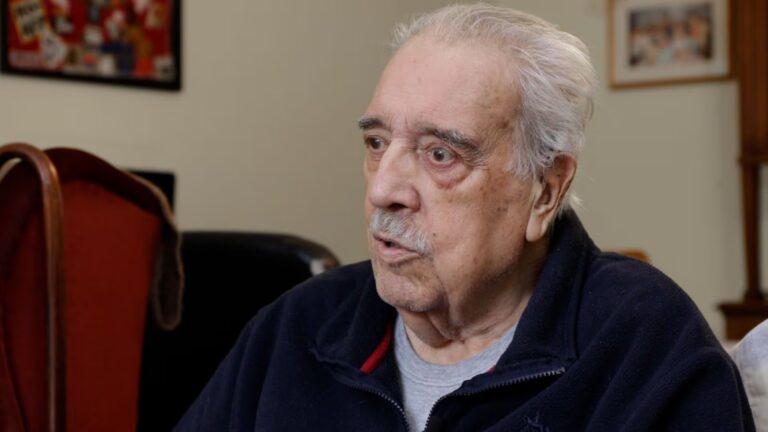
There were journalists who reported. There were others who took sides. Manuel Cabieses Donoso did both for more than half a century, without apologizing for it. His death, at 92, is not just the loss of a man: it is the end of a way of understanding the profession.
Born in 1933, he forged his career in the labor press alongside Clotario Blest, the historic president of the Central Workers’ Union (CUT). From there he learned that journalism could be a tool, not a mirror. In 1965, together with Mario Díaz, he founded Punto Final with an idea as simple as it was radical: to exhaustively cover the topics that the mainstream press barely touched upon, to get to the bottom of things without censorship. A member of the Revolutionary Left Movement (MIR), he never separated his pen from his conviction.
September 11, 1973, found him in the eye of the storm. Pinochet himself ordered, via radio that same day, the arrest of all Punto Final staff and the destruction of its facilities. Two days later, Cabieses was arrested. He spent two years in Chacabuco, Melinka de Puchuncaví, and Tres Álamos, until an international solidarity campaign secured his expulsion from the country. He did not stop in exile; in 1979, he returned clandestinely to Chile as part of the MIR’s Operation Return, to continue fighting the dictatorship from within.
With the restoration of democracy, Punto Final resumed publication—until its closure in 2018—as one of the few publications that refused to be diluted by the consensus of the transition. The same consistency that landed him in jail sustained him in the face of complacency.
Venezuela and Chávez: The Journalist Who Was Interviewed
His commitment always transcended Chilean borders, and Venezuela held a unique place in his career. In July 2005, Cabieses traveled to Caracas to interview President Hugo Chávez. He recounted it thus: “The setting was the upper floor of the Miraflores Palace: a patio that Chávez had transformed into a garden, with a hammock among the plants and a desk under the shade of a Caribbean thatched roof, a corner where the president read, wrote, and received informal visitors. From the street rose the shouts of vendors and the noise of vehicles that disturbed this rural refuge in the very heart of power.”
The interview yielded something memorable. Before getting down to business, it was Chávez who took the initiative. “Is Punto Final turning forty, Manuel?” the president asked. Cabieses confirmed. And Chávez himself opened the conversation about the magazine, its name, its history, and its purpose. The interviewer was, for a moment, the interviewee.
That scene encapsulates something essential about Cabieses: his work had built an authority that transcended the printed page. Punto Final was not just a publication; it was a political touchstone for an entire generation of Latin American leaders, activists, and intellectuals. That Chávez knew about it and celebrated it on the threshold of a conversation about 21st-century socialism was not a mere formality: it was recognition.
That same Latin Americanist vocation made him an active part of the teleSUR project from its founding years. For Cabieses, the signal wasn’t a television channel but a logical consequence of everything he had defended: a press that would tell the continent’s story from within, without asking permission.
A rebel who refused to yield to time
Cuba also marked his life. The Cuban Revolution was, in his own words, “the most important event of the 20th century in Latin America.” The Cuban Council of State awarded him the Friendship Medal; the Union of Journalists of Cuba, the Félix Elmuza Medal. In 2018, the National Institute for Human Rights of Chile recognized him with the Lifetime Achievement Award in Journalism and Human Rights.
At 85, he published his Autobiography of a Rebel. The title wasn’t a pose: it was a description. He continued writing on his blog almost until the end, as if silence were the only defeat he was unwilling to accept.
What it leaves behind is not just a journalistic archive. It is the uncomfortable yet necessary demonstration that it is possible to maintain a position for nine decades without becoming dogma or cliché. That, in any profession, is difficult. In journalism, it is almost a miracle.
IMAGE CREDIT: Half a century of journalism without compromise. Cabieses was always the voice that power could not buy. Photo: teleSUR
[ SOURCE: teleSUR ]