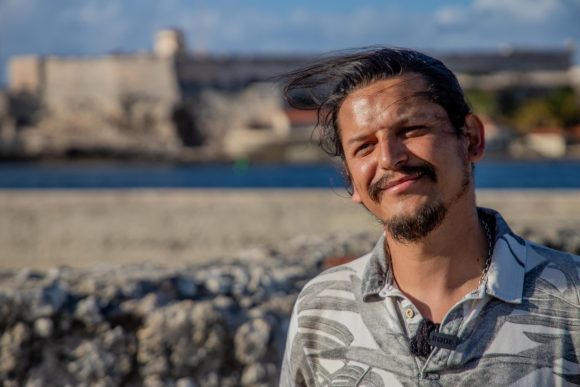
Manuel Varese was born in Oaxaca, Mexico. A journalist, political analyst, poet, and doctoral candidate in Latin American studies at UNAM (National Autonomous University of Mexico), he carries Cuba in his blood, in his memory, and in his activism.
His connection to the island began with a family story. His younger brother, Martín, was born prematurely. In Mexico, doctors couldn’t diagnose why he cried incessantly. Someone suggested taking him to Cuba. There, a doctor examined him, touched his ear, and declared: he has a middle ear infection. They gave him treatment. The next day he stopped crying. “My dad held him and smiled. It was the first time I’d ever seen my son smile,” Manuel recalls.
That experience sealed his love for Cuba. There’s also a family tradition of leftist leanings: friends of his parents came to the island fleeing Latin American dictatorships. Cuba has been, Manuel says, “an inexhaustible source of resistance and dignity for Our America.”
In February of this year, his father, a lifelong leftist revolutionary, died. His last article, written weeks earlier, was about Cuba. In the midst of his grief, news arrived of the Our America Convoy, a solidarity flotilla that would set sail from Yucatán to Havana to symbolically break the blockade.
Manuel was already involved: his fellow graduate students at UNAM had held a fundraiser. A journalist for Canal Red and Diario Red América Latina, he offered to cover the voyage. He was told that the spaces were almost full, but 24 hours later he received confirmation: there was a spot on a small boat, a rusty tuna fishing vessel from the 1950s, the only one they could find.
“In the end, this is about solidarity; it’s from the people, for the people,” he affirms.
The boat set sail with 32 people on board. They loaded 73 solar panels, 10 bicycles, rice, beans, medicine, and diapers. Everything was adorned with messages written by the people: “Cuba, we love you, Cuba, hold on.”
The journey wasn’t easy. The engine failed, and they drifted for two hours. There was fear: they knew that 46 boats had been bombed in the Caribbean and the Pacific. But there was also a certainty: “Only those who are afraid can be brave,” says Manuel.
Amid the uncertainty, the sound of a guitar filled the air. Manuel played La Bamba, Carlos Puebla’s Comandante Che Guevara, and the Internationale. Nicole León and Lisi Proenza—leaders of the flotilla—organized the shifts and reminded everyone that they were all crew members, not passengers.
On the ship, Manuel encountered stories that deeply affected him: a woman who lost her mother, who disappeared in Ciudad Juárez; an Italian dockworker who blocked weapons shipments to Israel; a Mexican man who repairs bicycles and brought several to donate to the Cuban people. “That solidarity that formed in just a few days is proof that people can do more.”
The Arrival
“Seeing Cuba for the first time was beautiful. It was early morning, and you could see the mountains. But it took a long time: you see Cuba, and you still have a long way to go to reach Havana. Almost another day.”
They arrived around five in the morning. They waited, had breakfast. Some showered for the first time in four days. When they approached the Malecón, they climbed onto the roof of the ship with the flags. “There were so many hugs. Yes, there’s something mystical about this.”
He knows that some people referred to the voyage as “Granma 2.0” in a derogatory way. “It’s childish,” he says, “and I like that it hurts them, because in the end they’re talking about a reality that is love, affection, hope, and solidarity as a way to transform the world.”
And he recalls Fidel’s story: “There were between seven and twelve men left. And he said, ‘Well, how many are we? Seven. That’s good, because we’ve already won the war, we’ve won the revolution.’ For us, it’s a bit like that: this is a first step, and many more have to be taken. Because if it was possible, solidarity among peoples will never cease to exist.”
IMAGE CREDIT: Manuel Varese. Photo: Secret Nature.
[ SOURCE: CUBA DEBATE ]