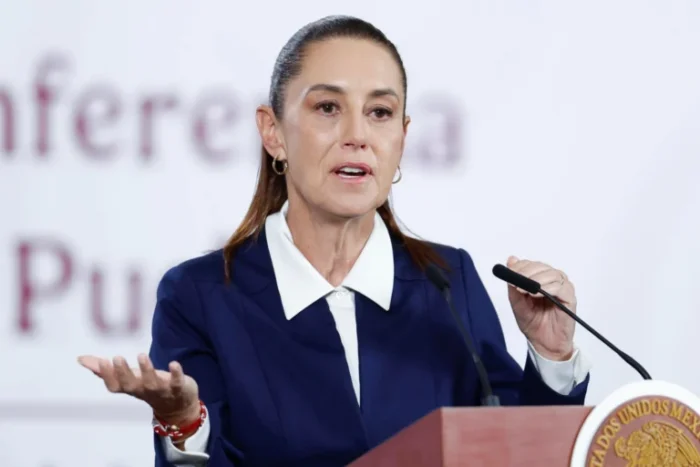
Mexican President Claudia Sheinbaum confirmed that this Monday, March 23, a new ship carrying solidarity aid is departing from Mexican territory bound for Cuba. During her press conference, the President assured that her administration would maintain its support on a consistent basis and highlighted the mediation efforts Mexico is undertaking to foster dialogue between Havana and Washington.
As part of this diplomatic effort, Sheinbaum underscored that Mexico is keeping channels of communication open with both governments to facilitate the rapprochement recently announced by Cuban President Miguel Díaz-Canel. “Mexico is always present to help avert any conflict,” the Head of State emphasized.
Sheinbaum clarified that her stance is grounded in respect for the self-determination of nations and the conviction that any dispute must be resolved through multilateral mechanisms, within the framework of the United Nations—an international body she called upon to become involved in the delivery of solidarity aid to the island.
“These are the proper channels in the event of a dispute… not one country imposing its will upon another, not invasion, and no violent solutions,” Sheinbaum underscored, while simultaneously affirming the Cuban people’s right to self-determination.
Separately, the official reported that the Mexican Navy is providing escort support to international brigades transporting aid collected for the island aboard smaller vessels. This security measure aims to ensure the safety of the crews during the voyage, as the small size of some of the ships poses a navigational risk.
“We have provided support to ensure the vessels do not travel alone—since some of them are very small—so that they do not encounter any problems during the journey,” she detailed. The vessel *Granma 2.0* set sail last Friday afternoon, March 20, from the Port of Progreso in Yucatán, Mexico, bound for Havana, Cuba.
This vessel is transporting over 30 tons of assistance—including medical supplies, food, solar panels to help mitigate the energy crisis caused by the U.S. blockade, and bicycles—all collected through the joint efforts of activists from more than 11 countries.
Subsequently, on Saturday, March 21, the final two sailboats of the Mexican delegation belonging to the *Nuestra América* convoy set sail from Isla Mujeres, in the Mexican Caribbean, also bound for the largest of the Antilles.
In addition to the provisions and assistance materials that Mexico continues to send to Cuba, Sheinbaum’s administration is seeking alternatives to resume fuel shipments to the island. “We are also exploring ways to deliver fuel without negatively impacting Mexico—whether as humanitarian aid or even through commercial agreements,” she explained.
As part of a long-term cooperation strategy, Sheinbaum suggested that Cuba’s recent opening to private investment represents an opportunity for the Mexican business sector, potentially strengthening economic ties beyond emergency assistance.
The official noted that, since the early 1960s, Mexico has maintained a firm stance against the economic, financial, and commercial blockade imposed by the United States against Cuba. Based on this historical principle, “we oppose any obstruction of fuel deliveries—including through retaliatory measures against other nations to prevent such shipments—whether they involve humanitarian aid or commercial agreements that any country may have with another,” he emphasized.
On January 29, U.S. President Donald Trump signed an executive order declaring a national emergency, deeming Cuba an “unusual and extraordinary” threat to the security of U.S. territory. This measure empowers Washington to impose tariffs on goods originating from countries that supply oil to the Caribbean island.
IMAGE CREDIT: “We are also seeking ways for fuel to reach [Cuba] without negatively impacting Mexico—whether as humanitarian aid or even through commercial agreements,” explained Sheinbaum. Photo: EFE
[ SOURCE: teleSUR ]