By Manuel Calviño
When the prominent Spanish psychiatrist and psychologist, Emilio Mira y López, born in Santiago de Cuba, wrote his book “Four Giants of the Soul”[1], he didn’t hesitate to begin with fear, the black giant:
“…the emotion with which, at the higher levels of the animal kingdom, the phenomena of paralysis or arrest of the vital course are felt, observed even in the simplest unicellular living beings, when they are subjected to abrupt or disproportionate changes in their environmental conditions of existence” (Mira y López, 1988, p. 13).
When the conditions in which we live are subjected to abrupt and disproportionate changes, we face the possibility of producing an adaptive reaction that we identify, from subjective perceptions, from what we feel, as fear.
Why do we speak of an adaptive reaction? Because it is a reaction to what is perceived as (fear, properly speaking), or what we assume could be (dread), an attack on stability, coherence, and our ways of coping with life. It is a protective reaction that aims to dismantle the created situation and favor the defense of what we have, what we have achieved. Fear is the first defensive reaction of the organism that feels threatened.
Fear not only appears in response to something that has already happened, but also in response to something we assume might happen.
“Man suffers not only fear in the face of the absolute, concrete, present, and harmful situation, but also in the face of all the signs associated with it that now evoke it; he also suffers from the ineffectiveness of ensuring his escape; or from the (ethical) conflict that arises when he considers that his escape will have worse effects than those he tries to avoid” (ibid., p. 26).
So we are talking about fear. Man feels fear about what he has learned to fear, though this is not the only reason.
Paralysis, cessation, inhibition. That is the behavioral essence of fear. A reaction that permeates the entire body, from the physiological to the mental levels, under the influence of an “emotional” stimulus (which evokes the emotion, in this case, a “phobic” one, which produces fear). Fear, then, calls for flight, inhibition, surrender. Fear paralyzes us, closes off the possibilities—temporarily, I should add—of engaging in adaptive behavior, but of the opposite, non-reactive kind.
In such a case, when we manage—and it is certainly possible—to overcome that initial reaction and decide to act upon the situation, then we enter the realm of adaptive behaviors, the “set of conceptual, social, and practical skills that the individual has learned and that allow them to respond to the circumstances of daily life.” Respond, not react. Then we confront the situation. Mira and López suggested that
“the best remedy against fear consists of going to meet it and overwhelming it through constant, well-planned action: ‘Fleeing forward’” (ibid., pp. 37–38).
Are fearful reactions normal? Is it common to feel fear in certain situations? Is it appropriate to feel fear in the face of what we believe might happen to us? My answer is a resounding yes. However, when these reactions are very intense, persist over time, and overwhelm our ability to live with well-being and happiness, they cross into the realm of mental illness. But we shouldn’t reach that point.
We Cubans are living through difficult times. Days in which the force of shortages of basic services falls upon us with overwhelming frequency. Our daily lives are being shaken. And no matter how much we talk about “having experience,” the impression remains that, at times, doubts, uncertainties, and questions about the foreseeable future (which is not unipolar, but multipolar) arise, along with emotional and behavioral reactions bordering on fear.
We shouldn’t be afraid of fear itself; we must confront it. Leaving behind the psychophysical sensation and giving way to our most human skills, those that build a proactive, decisive attitude. To our reactive system, we can oppose our reflective system, subordinating reactive emotion to reflective, focused thought, without denying the former because, in a way, it is a warning signal, and being alert is always necessary.
While fear “inspires flight, escape,” as a specific reaction to a situation that feels threatening, and fear can be experienced toward something that may only be a possibility, thinking rationally can counteract both reactions. Above all, because human beings are not the sum of unconditioned or even conditioned reflexes that subjugate them. On the contrary, we are what we are capable of doing with our reactions, our learning, our decisions, and our convictions.
Some key points can help us avoid the unhealthy influence of fear.
Share what you feel, your fears, your anxieties. Don’t isolate yourself. Open up. Engage in dialogue about your feelings with others. Listen to others. Share your experiences. Communication and socialization have healing effects.
Be mindful of your social media use. While social media is an excellent tool for personal development, today, undoubtedly in our country, it is the primary source of fear and anxiety. Fake news is specifically designed to generate fear, biased opinions exaggerate the elements of the crises the country is experiencing, and pessimism is induced. It’s better to get your information from reliable sources. Develop your own opinions.
Build viable, simple, and realistic alternatives for dealing with situations that may trigger phobic stimuli. Distance yourself from them. Don’t let them enter your receptive system. Don’t give credence to alarmists and catastrophists. Don’t let them sow doubt. Opt for objectivity, which is never “ist.” However harsh it may be, reality always offers a better alternative than phobic fear.
Bring joy to life, bring health to body and mind. Revisit what brings well-being and embrace it. It doesn’t matter if it seems small. A little can, under certain conditions, be a lot. Build hope, faith, optimism. Build happiness.
Nurture interpersonal relationships. Especially nurture family. Both are havens where we can feel good. They nurture our needs for affection, protection, and security. Key elements in the fight against the “dark giant.”
And if fear overwhelms you, there are many professionals in Psychology and other human sciences ready to lend a hand.
I close as I began, returning to Mira and López.
“Today we know that fear—the Black Giant—is the harbinger of death, and we do not like its presence, not even in its least repulsive disguises. It is necessary, therefore, to fight it tooth and nail. Fortunately, we have the help of the other giants… none of whom are on good terms with it, and especially the two youngest: love and duty, which are frankly opposed to it.”
Here is a seventh suggestion: make an alliance with love and duty. There is no room for misunderstanding. Fear is usable, but it is also disposable and destructive. Love and duty are creative, healing, drivers of human growth, and call us to “paint our faces the color of hope.”
[1] Emilio Mira y López. Four Giants of the Soul. Lidiun Editions, Argentina. 14th edition. 1988.
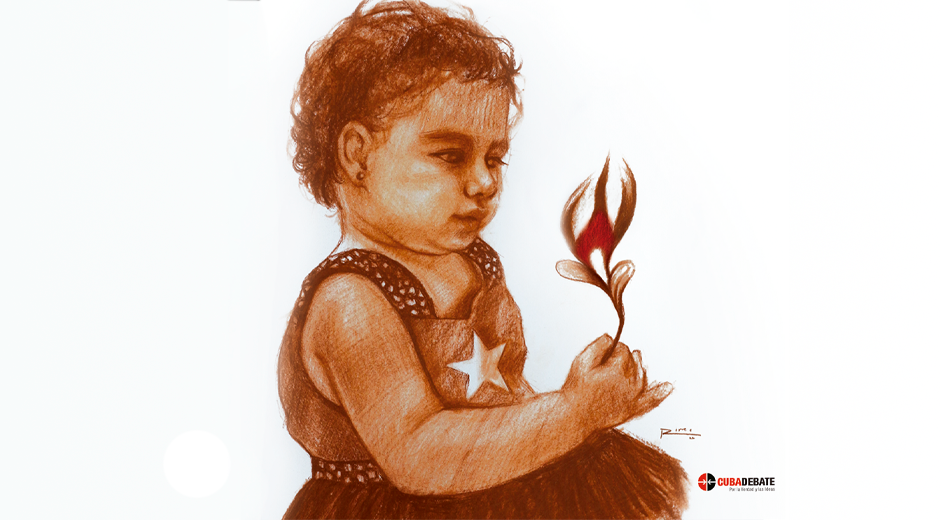
IMAGE CREDIT: Let hope come. Illustration: Stephanie Rivero / CUBA DEBATE
[ SOURCE: CUBA DEBATE ]